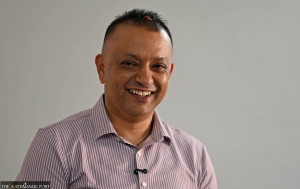
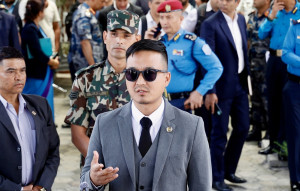
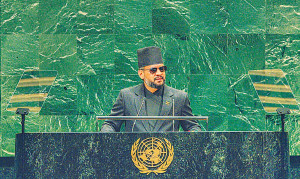
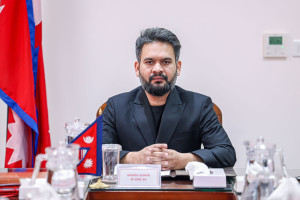
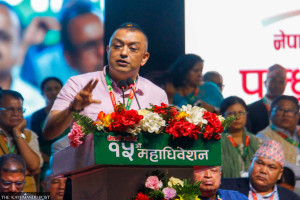
In one of his visible actions after being elected Kathmandu mayor from the 2022 local polls, Balendra (Balen) Shah tried to remove illegal structures and settlements on the Bagmati riverbank at Thapathali.
Mayor Shah’s attempt, however, led to tense confrontations between the city police and residents of the informal settlements. At the time, Mayor Shah openly accused the Home administration under then-home minister Balkrishna Khand of non-cooperation.
A few months later, in November 2022, there were federal and provincial elections. Sidelining established political parties, the Rastriya Swatantra Party (RSP), which had positioned itself as a force for alternative politics, emerged as the fourth-largest party in the federal parliament.
Not only that, on December 25, 2022, the party joined the government led by CPN (Maoist Centre) chair Pushpa Kamal Dahal, backed by the CPN-UML, securing the powerful deputy prime minister and home minister position. Party chair Rabi Lamichhane assumed that office.
Within days of Lamichhane taking charge, Mayor Shah visited the home ministry on January 10, 2023 to seek support for the resolution of the long-standing squatter settlement issue. However, the home ministry under Lamichhane made it clear that it could not provide immediate security assistance to deploy bulldozers and clear the Thapathali riverbank settlements. The ministry responded, albeit indirectly, that it could not help the Kathmandu Metropolitan City (KMC) by bypassing legal procedure.
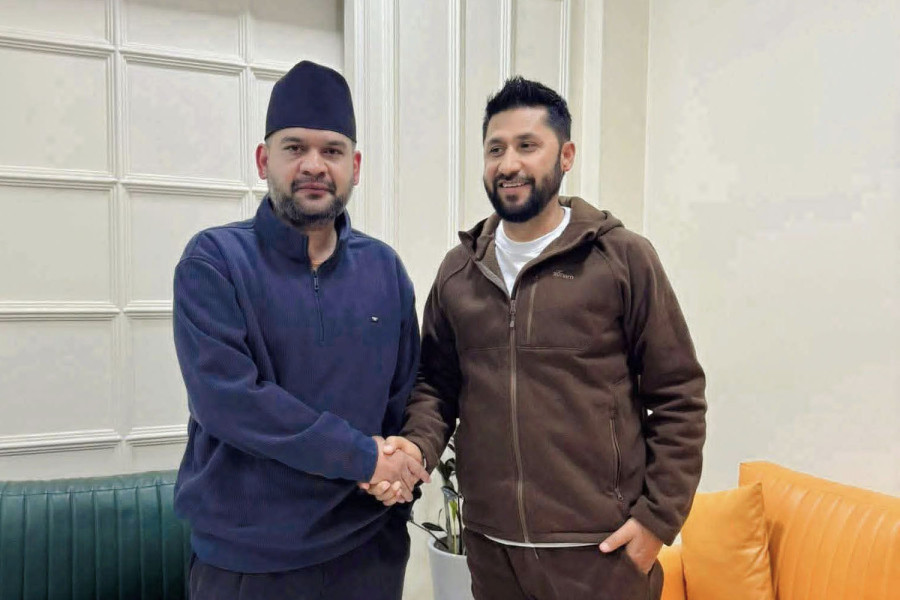
Although the initial attempt at cooperation between Mayor Shah and Lamichhane failed, the political equation appears to have changed. On Sunday morning, Lamichhane and Mayor Shah reached a seven-point agreement to work together in the House of Representatives election scheduled for March 5, with Mayor Shah and his group set to formally join the RSP.
RSP chair Lamichhane, who was in judicial custody for almost nine months in connection with a cooperative fraud case, was released on bail on December 19.
Just three days after his release, Lamichhane met Shah on December 22 for more than six hours. This marked the first direct meeting between the two leaders in the wake of the September Gen Z movement that built pressure on alternative political forces to unite and contest the forthcoming elections together.
Less than a week after that initial meeting, Lamichhane and Mayor Shah have inked the deal to jointly contest the upcoming elections, signalling a significant realignment of Nepal’s political space.
Under the agreement, RSP chair Lamichhane will continue as the party’s central chair, while Mayor Shah will be the party’s parliamentary leader if he wins the election. The RSP will go to the polls with Shah as its prime ministerial candidate.
The agreement further reiterates that the RSP’s core principles, leadership structure, the party flag, and election symbol (bell), will remain unchanged. It also invites other reform-oriented and committed political forces, groups and individuals to rally around the party under this framework.
The document makes specific reference to youth-led movements, including the Gen Z protests of September 8 and 9, which it says reflected wider frustration with prevailing political practices. The parties have pledged to translate such demands into concrete political action.
Shishir Khanal, who led the RSP dialogue team tasked with forging unity between the two sides, said talks with Mayor Shah’s camp began after the Gen Z movement reshaped the political landscape.
According to Khanal, Mayor Shah had made it clear that he would support an alternative political party but only one that genuinely embraced the Gen Z movement and its achievements. It was on this basis, Khanal claims, that the RSP approached Shah’s side for discussions.
“Over time, as it became clear that Mayor Shah himself was preparing to enter national politics, our dialogue gained momentum,” Khanal told the Post.
Dialogue with Mayor Shah’s group began while the party chair was still in Nakkhu prison. “At the time, our main challenge was how to make the talks effective while the chair was in custody,” Khanal said. “That challenge eased considerably once he was released.”
In this period, he adds, the RSP also held talks with other alternative forces, including the Ujyalo Nepal Party (UNP), which is backed by former Nepal Electricity Authority managing director Kulman Ghising who currently is the minister for energy in the interim government, among others.
Multiple efforts to tie a knot with the UNP bore no fruit. Both RSP and Shah teams blame UNP patron Ghising’s ‘rigid’ demands.
“The contentions with Ghising were over party name, leadership and party symbol,” Khanal claimed. “When he was not ready to compromise, multiple efforts to bring him on the same page failed.”
Ultimately, Khanal said, a seven-point agreement was reached with Mayor Shah on Sunday morning, paving the way for the two sides to move forward together.
As the personal relationship between party chair Lamichhane and Mayor Shah grew warmer, the two sides agreed to be part of a single political party, Khanal claims. He also added that the agreement was reached without any substantive discussion on ‘quid pro quo’ arrangements.
When two parties sit for negotiations, there is definitely a bone of contention, Khanal said, sharing the internal issues during the time of negotiation. “One of the key struggles for us was what kind of position we can offer Mayor Shah should we induct him into our party, and how we arrange the power-sharing modality.”
Mayor Shah said that he is not keen on any party position; he would simply be a central committee member, Khanal told the Post.
“Once he showed that generosity, as a party we also felt the need to honor that by offering him the candidacy for future prime minister. Despite being a central committee member, he will be second-in-command of party meetings.”
Bhoop Dev Shah, a member of Mayor Shah’s personal secretariat who took part in the negotiations with the RSP, also supports Khanal’s claims. Shah adds that, from their side, the agreement largely centred on placing certain individuals in the party secretariat and central committee on an immediate basis, and that there was no other understanding.
The core of the agreement is laid out in the seven-point deal itself. Beyond that, Bhoop Dev Shah said both sides first reached an understanding on how to move forward on ideological ground—by embracing the Gen Z movement and upholding the spirit and substance of the constitution.
During the negotiations, Shah explains, considerable time was spent discussing how to restructure the party. The agreement was to retain the RSP’s existing organisational framework while also allowing room for expansion for capable individuals joining the party. However, any such expansion would be carried out in phases rather than all at once.
For the time being, Shah said, the party’s ideological foundation rests on respecting the mandate of the Gen Z movement.
“What we need right now is not abstract ideological debates over systems of governance or constitutional theory,” he said. “The clear mandate at present is a democratic way forward—holding elections, ensuring good governance, and accelerating development. On these priorities, the two sides are fully aligned.”
The period of intensified dialogue between the RSP and Mayor Shah coincided with a politically charged moment, when a majority of lawmakers from the two largest parties in the dissolved House of Representatives—the Nepali Congress and the CPN-UML—filed petitions at the Supreme Court seeking the House’s reinstatement. Asked whether a sense of political anxiety or “fear psychology” pushed the two sides towards unity, Shah firmly rejects the idea.
While Shah dismisses that interpretation outright, RSP leaders acknowledge that the broader political developments may have played some role in encouraging unity—though they insist the agreement was not solely a product of fear-driven calculations.
As the unity took shape, two major questions emerged.
The first concerns the RSP’s long-standing defence of party chair Lamichhane’s past controversies. Since its formation, the party has spent nearly three years treating Lamichhane’s personal legal troubles as an attack on the party itself. The question now is whether Mayor Shah, upon joining the RSP, will also defend Lamichhane’s case, which remains under judicial consideration.
Shah’s personal secretary makes their position clear: they consider the court’s verdict to be final and have no intention of defending or politicising a sub judice matter. “In cases that are before the court, we accept the court’s decision as final,” he said.
Meanwhile, the atmosphere at the RSP’s central party office in Banasthali on Sunday afternoon was visibly energetic. The buzz among party leaders and cadres rivalled the enthusiasm seen in 2017 when the CPN-UML and the then Maoist Centre decided to contest elections together.
Samiksha Baskota, who recently led the merger of the Bibeksheel Sajha Party into the RSP, argued that with Mayor Shah joining, the RSP had now become the sole pole of alternative politics in the country.
Yet comparisons with past political mergers inevitably arise. Much like KP Sharma Oli and Pushpa Kamal Dahal—co-chairs of the Nepal Communist Party (NCP) formed through the UML–Maoist unification—Lamichhane and Mayor Shah are two distinct personalities with sharply different political styles. This raises the natural question of whether such contrasting figures can jointly lead a party.
RSP leader Khanal said the concern is understandable but insists that their party is different. To prevent such a scenario, he said, Lamichhane has agreed that if the party leads the government, he will not exert undue pressure over its day-to-day functioning—an un-written commitment made part of Sunday’s agreement.
From Mayor Shah’s side, Bhoop Dev Shah strikes an even starker note. He said neither side has the luxury of splitting after unification. “If this unity were to collapse at some point,” he argues, “it would mean both Mayor Shah and Lamichhane would be forced into a position whereby leaving the country is the only option.”




 14.2°C Kathmandu