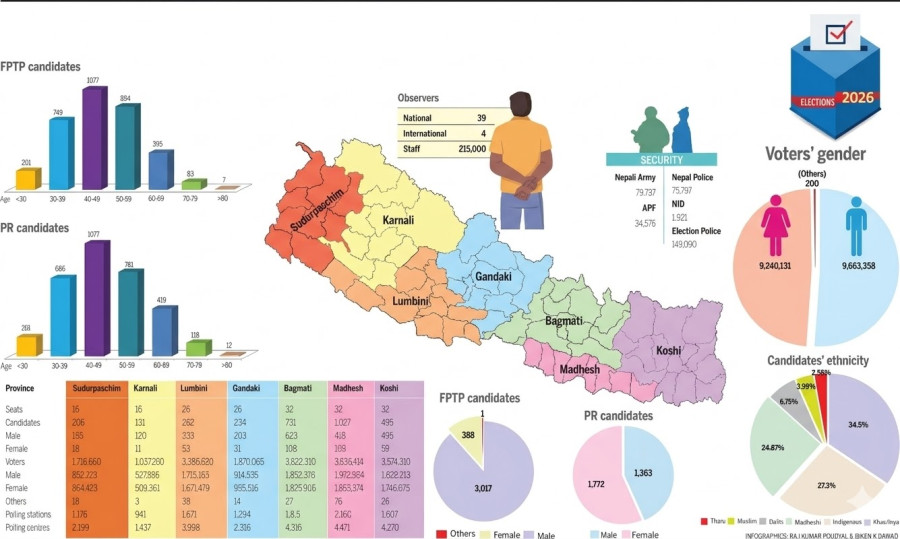
A total of 18,903,689 voters will determine the fate of 6,541 candidates vying for 275 seats in the House of Representatives. Infographics: Raj Kumar Poudyal & Biken K Dawadi
The stage is set for Thursday’s elections, which are being held following the unprecedented September Gen Z movement that ousted the KP Sharma Oli-led coalition government and led to the dissolution of the House of Representatives.
Clearing all doubts, the Election Commission, with strong backing from the Sushila Karki administration, has completed all preparations to hold the snap polls that will give the country an elected government after six months.
In her first decision as the executive head, Karki recommended to President Ramchandra Paudel, on September 12, the dissolution of the lower house. Paudel also gave her the mandate of holding the snap polls on March 5.
“All the arrangements for free, fair, transparent and peaceful elections are in place,” said acting chief election commissioner Ram Prasad Bhandari. He urged everyone to exercise their franchise without fear.
The commission has allotted 10 hours, starting at 7 in the morning until 5 pm, for voting.
A total of 18,903,689 voters will determine the fate of thousands of party and independent candidates vying for seats at the 275-strong House of Representatives.
The total number has increased by 915,119 voters from the 2022 elections tally. Among them, 52 percent are aged 18-40 years, which falls under the youth category.
The final tally of candidates for the lower house stands at 6,541. Among them 3,406 are for the first-past-the-post and the remaining for the proportional representation system.
Under the FPTP, 65 parties have fielded 2,263 candidates for 165 seats, and 1,143 are running as independents. Of the total candidates contesting direct elections, 3,017 are male and 388 female. Only one is from the sexual and gender minority community.
The candidates are predominantly above 41 years of age. While 1,925 are aged between 41 and 60 years, 425 are senior citizens, and 201 are 30 years or younger.
Likewise, the number of candidates for 110 proportional seats stands at 3,135. Of them, 1,772 are male, and 1,772 female. Sixty-three parties have submitted their closed list of candidates to the commission. Only the party that qualifies as the national political force by bagging at least three percent of the proportional votes and winning at least one FPTP seat will qualify as a national party and be eligible to claim proportional seats.
The commission has fixed 10,963 polling stations and 23,112 polling centres across the country. Similarly, 341,113 security personnel have been mobilised for the conduction of peaceful elections. The government has recruited 149,000 election police for 40 days, as the existing permanent security force was inadequate for the poll security.
A Security Council meeting led by Prime Minister Sushila Karki on Wednesday evening concluded that all necessary security arrangements for the polls are in place. Its assessment shows this election will be more peaceful, fair and transparent than the previous ones.
“No force can disrupt the election,” said Bhandari, referring to tight security arrangements. He also said that the commission believes that the participation of new and young voters will increase overall turnout, while the number of invalid votes will go down.
The average voter turnout since the 2006 people’s movement stands at 69.4 percent, with the highest (78.3 percent) seen in the 2013 second Constituent Assembly elections, and the lowest (61.4 percent) in the 2022 elections.
“Our effort will be to collect the ballot boxes from the hill regions as quickly as possible. If feasible, they will be transported by helicopter,” Bhandari said. “We will be able to publish the results of the first-past-the-post vote within 24 hours after vote counting begins.”
Binod Ghimire covers parliamentary affairs and human rights for The Kathmandu Post. Since joining the Post in 2010, he has reported primarily on social issues, focusing on education and transitional justice.




 14.82°C Kathmandu