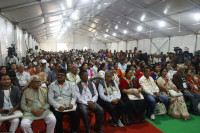
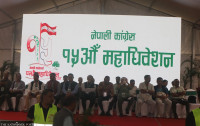
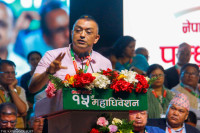
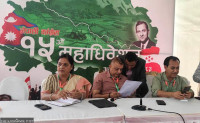
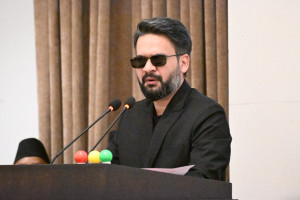
Barely four years after its formation and a dramatic rise to national prominence, the Rastriya Swatantra Party (RSP) is preparing to hold its first general convention in Chitwan from June 21 to 23. At the centre of it all, party leaders say, stands Rabi Lamichhane, whose position as chairman appears all but unassailable.
The RSP, which secured an entry into the House of Representatives within six months of its formation in the 2022 elections, currently leads the government with 182 lawmakers in the 275-member lower house.
“There is no indication of any change in the core leadership of the party. Rabi Lamichhane will remain the chairman. The government is currently being led by our senior leader and parliamentary party leader, Prime Minister Balendra Shah. The party will move forward by maintaining this vital balance,” said Kabindra Burlakoti, the RSP’s general secretary. The party has officially branded this upcoming gathering as its ‘First historic general convention’.
Ganesh Parajuli, the deputy leader of the RSP parliamentary party, echoed these sentiments, stating that the party is moving forward in a unified manner under Lamichhane’s guidance.
“The RSP is not looking for a new leader, and the Nepali public is not seeking an alternative to our chairman either. The historic national convention will conclude all statutory responsibilities through a democratic process,” said Parajuli.
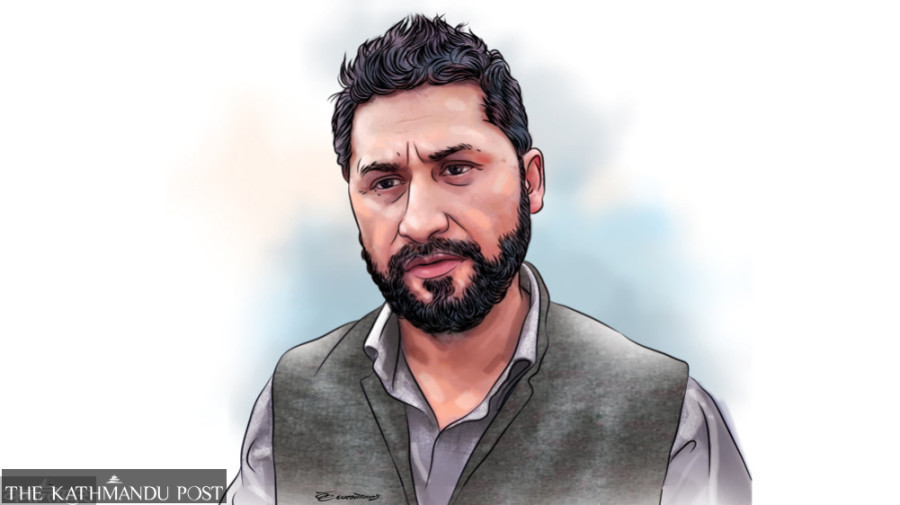
According to party insiders, Prime Minister Shah has similarly confided to his close aides that Lamichhane must continue to lead the party. A leader close to Shah confirmed that the prime minister will travel to Chitwan to attend the convention and participate directly in the official leadership declaration ceremony.
According to RSP leaders, discussions on the election of other office bearers through consensus will begin immediately after the provincial conventions conclude.
Currently, the party is conducting its ward and municipal-level conventions across the country, with central leaders deployed to various districts to oversee the local proceedings. Ram Gurung, the deputy chief of the RSP Central Election Commission, reported that convention schedules are moving forward efficiently.
On May 21, the central election body gave a comprehensive timeline to district and provincial presidents. The directive required district and provincial election committees to be formed by May 29.
Local committees must submit their final lists of convention delegates by June 8, followed by the submission of district convention and election reports by June 13. Provincial committees are expected to submit details of their newly elected officials by June 19. The party’s central election commission has instructed provincial chiefs to coordinate closely with local chapters to monitor progress.
While internal debates continue on the potential use of online voting for leadership selection, the election commission is actively exploring the deployment of electronic voting machines. The commission announced it will conclude technical consultations on this matter by June 19.
“As of Monday, conventions have been successfully concluded in 2,800 out of 6,743 wards. For the municipal conventions, which were scheduled for May 30 and 31, proceedings have already wrapped up in around 50 municipalities,” said Gurung. “Leadership is being chosen through both consensus and democratic voting. As a democratic party, we don’t discourage open contests. Competition brings out the best leaders, while consensus unifies the rank and file. While elections are a fundamental democratic tenet, a large majority of wards and municipalities have opted for consensus, with only a few requiring active voting.”
To streamline the national event, a main organising committee has been formed under the leadership of Chairman Lamichhane himself, according to party leader Prakash Chandra Pariyar. The committee comprises outgoing central committee members.
Additionally, separate sub-committees have been set up to manage specific tasks, including delegate management, report and proposal drafting, financial management, publicity, security, information technology, food and accommodation, health and first aid, cultural events, guest hospitality, statutory revision, and venue decoration.
“We estimate that at least 2,500 delegates from all 77 districts will participate,” said Pariyar. He added that the party’s current local government representation is limited to Pheta Rural Municipality in Bara district. The rural municipality’s chairman Rustam Ansari and vice-chairperson Nilam Shah will serve as ex-officio delegates. All sitting RSP members of parliament and members of the convention organising committee will also receive automatic delegate status. Central committee members have been assigned specific district responsibilities to ensure the smooth completion of local conventions.
Although the final number of convention delegates has not been fixed, Gurung noted that at least 2,500 representatives will arrive from the districts, complemented by delegates from various departments including foreign chapters. These departments include the discipline commission, accounts commission, election commission, advisory council, and the Rapid Action Team (RAT). The party has strictly mandated that at least one-third of the total delegates must be women.
Concurrently, the RSP is undertaking significant revisions to its party statute. The original statute, drafted during the party’s formation, accommodated a small number of office bearers and central committee members. Over time, newly integrated leaders were assigned positions on an ad hoc basis through mutual understanding.
First amended in 2024, the 2022 statute is now undergoing a second major overhaul by a dedicated committee led by Bipin Acharya, the party’s joint general secretary. The revision committee includes Ganesh Parajuli, Chanda Karki, Prakash Chandra Pariyar, and Sushant Vaidik.
“Our statute amendment work has entered its final phase. We will soon present our comprehensive proposal of structural changes to the party secretariat meeting,” said Acharya.
A member of the amendment committee revealed that substantial restructuring of leadership positions and central committee seats is underway. Current discussions propose an executive lineup featuring one party chairman, three vice-chairs (at least one woman), two general secretaries, three joint general secretaries (at least one woman), a treasurer, a joint treasurer, and a party spokesperson.
The committee is also discussing a dedicated provision to permanently secure the title of ‘senior leader’ for Prime Minister Shah within the statute as an honorific acknowledgement. Further, plans are afoot to expand the central committee from its current 121 members to a minimum of 131 and a maximum of 151 members, while ensuring inclusive representation of Nepal’s diverse demographics.
Similarly, a separate task force led by RSP General Secretary Bhoop Dev Shah is managing the systemic integration of political groups and independent figures who have recently joined the party.
“We have a diverse influx of partners joining us from the Tharuhat movement, Bibeksheel Sajha Party, various independent campaigns, and civil society groups. We formed a task force under General Secretary Bhoop Dev Shah to manage the formal integration of these political forces,” said Burlakoti.
Ahead of the convention, this task force is working to accommodate political groups aligned with Prime Minister Balendra Shah, alongside managing leaders who joined the party during the high-profile entry of Kulman Ghising (who later launched his own Ujyalo Nepal Party) and chose to remain with the RSP.
Convention organising committee member Pradip Gyawali stated that the event is designed to yield a highly capable and unified leadership. “The central committee has formalised all arrangements. Following the political upheaval of September 8 and 9 last year and our subsequent electoral success that yielded 182 seats, we are poised to hold our first general convention while successfully running the government,” said Gyawali. “The party stands completely unified. Chairman Rabi Lamichhane and Prime Minister Balendra Shah are working in lockstep. This convention will solidify leadership and guarantee historic youth participation.”
Why was Chitwan picked for the convention?
The RSP has chosen to align its first general convention with its upcoming anniversary, selecting Chitwan as the host venue. Party leaders explained the district’s significance for the organisation.
Speaking outside the parliament building recently, Burlakoti explained the geographical and political logic for the choice of the venue. “Chitwan serves as a central hub accessible from all parts of the country. More importantly, it is the political epicentre of our party—a district that granted us an overwhelming mandate and drove our early momentum. Its proximity to the capital and the fact that our chairman contested and won his seat there made it the ideal choice,” said Burlakoti.
RSP chief Lamichhane has secured three consecutive electoral victories in Chitwan constituency 2. After winning his seat in 2022 general elections, he won a subsequent by-election in 2023, and defended the seat for a third time in the March 5 snap elections.
Similarly, the party swept all three constituencies in Chitwan, with Hari Dhakal elected from Chitwan-1 and Sobita Gautam elected from Chitwan-3. Dhakal had previously won the constituency during the 2022 elections as well.




 20.85°C Kathmandu