Three prime ministers, 10 premierships. Why is Sudurpaschim still Nepal’s poorest province?
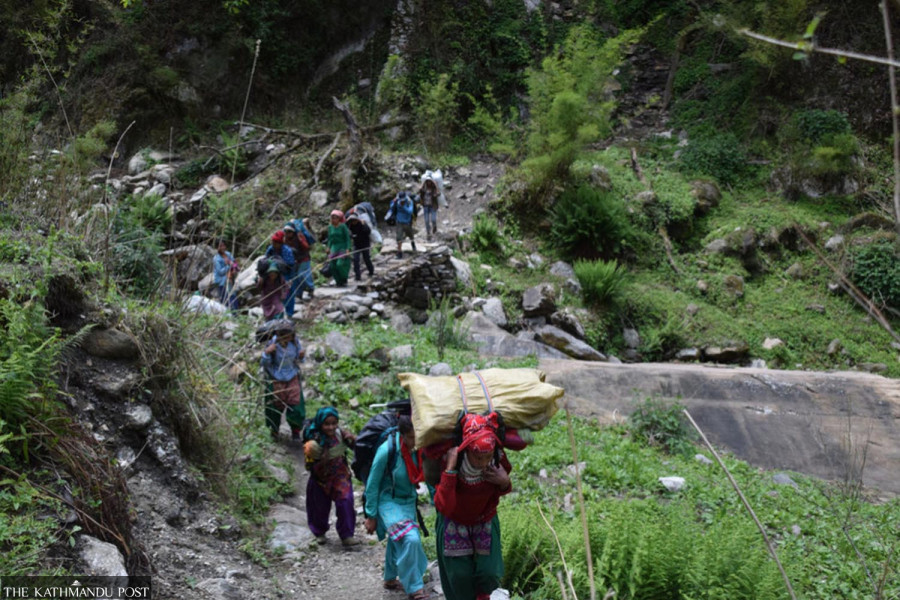
Sudurpaschim’s abundant resources and prominent national leaders have done little to improve livelihoods, as chronic political instability and poor execution continue to undermine development. Residents of Bajhang head for the highland meadows with supplies to collect yarsagumba. Post file photo
Sudurpaschim has produced some of Nepal’s most influential political leaders. The roster includes prime ministers who shaped national politics for decades. Ironically, however, the province now ranks as the country’s poorest. The province’s human development indicators remain weak, incomes are low and persistent political disputes keep preventing meaningful progress.
The latest figures have reinforced a long-standing complaint among residents—that political representation has rarely translated into development. According to the Fourth Nepal Living Standards Survey (2022-23) by the National Statistics Office, Sudurpaschim has Nepal’s highest absolute poverty rate at 34.16 percent. The government’s 2025 Small Area Estimation of Poverty report also places six local units of Sudurpaschim among the country’s 10 poorest.
The Human Development Report 2024 shows the province’s Human Development Index at 0.601, well below the national average of 0.622. An economic activity study published by Nepal Rastra Bank’s Dhangadhi office says Nepal’s annual per capita income stands at $1,513, while Sudurpaschim’s is only $1,179.
The statistics point to a province lagging behind on nearly every major development indicator. Local leaders and analysts say the problem lies not only in limited federal investment but also in chronic political instability within the provincial government.
Two years ago, Sudurpaschim entered the 2024-25 fiscal year without an approved budget, forcing the province into nearly three months of budget paralysis after political parties failed to reach an agreement.
The proposed budget for the upcoming fiscal year of 2026-27 has run into similar trouble. Although the budget was tabled in the Provincial Assembly shortly before midnight on June 15, deliberations have remained stalled for nearly three weeks. The CPN-UML, coalition partner, has refused to endorse the budget in its current form and is demanding amendments despite being part of the governing coalition.
Political bargaining over budget allocations has become an annual feature of provincial politics. Opposition parties regularly accuse ministers and lawmakers of distributing small development projects to reward party supporters, while allegations of middlemen influencing budget decisions surface every year without leading to formal investigations.
“The budget has been prepared after development schemes were sold through middlemen,” said Khagraj Bhatta, parliamentary party leader of the main opposition Nepali Communist Party. “Even the UML, which is in government, says the budget must be revised. With so many irregularities, we will not allow it to pass in its present form.”
Sudurpaschim possesses some of Nepal’s richest natural assets. The province is home to the fertile Tarai plains, the vast grasslands of Shuklaphanta National Park, and renowned destinations such as Badimalika, Ramaroshan, Khaptad and Budhinanda, along with the Api and Saipal Himalayan ranges.
Tourism entrepreneur Bhim Bahadur Khadka, a former executive director of the Khaptad Tourism Development and Management Committee, believes those resources remain vastly underused.
“These natural and cultural sites represent the province’s economic, social and cultural wealth,” he said. “If they are properly utilised, Sudurpaschim could become one of Nepal’s leading provinces.”
During election campaigning in Dhangadhi, Prime Minister Balendra Shah had argued that Sudurpaschim possessed landscapes comparable to Switzerland.
“Badimalika and Ramaroshan are our own Switzerland,” he said. “We have the treasures but have failed to use them.”
The province has hardly lacked national representation. KI Singh briefly served as prime minister during Nepal’s early democratic period, while Lokendra Bahadur Chand became prime minister four times and Sher Bahadur Deuba five times. Altogether, leaders from Sudurpaschim have occupied the country’s highest executive office 10 times, alongside dozens of influential cabinet positions and senior state appointments.
Yet many residents believe those achievements have brought little tangible benefit.
“Why has Sudurpaschim remained trapped in poverty and underdevelopment despite its natural resources and strong political influence?” asked Kishor Khadka of Bajhang. “Will leaders continue to share power among themselves while ordinary people continue to suffer?”
Civic leader Khadak Raj Joshi of Dhangadhi echoed that frustration. “Sudurpaschim has produced 10 prime ministers and more than 50 influential federal ministers over the years,” he said. “Even so, the province has failed to join the national mainstream of infrastructure development and improved living standards. The backwardness remains.”
In the grip of poverty
Sudurpaschim continues to bear the heaviest burden of poverty in the country, prompting renewed calls for political accountability and long-term development planning.
After the House of Representatives election was announced, Dhangadhi Mayor Gopal Hamal urged voters through a social media post to demand concrete poverty reduction plans from candidates rather than campaign slogans. Referring to official statistics, he questioned how Sudurpaschim’s poverty rate had risen from 25.30 percent in 2019 to 34.16 percent in 2023, making it the poorest province in the country.
According to the National Statistics Office, Sudurpaschim has the highest absolute poverty rate at 34.16 percent, compared with 26.69 percent in Karnali, 24.34 percent in Lumbini, 22.53 percent in Madhesh, 17.19 percent in Koshi, 12.59 percent in Bagmati and 11.88 percent in Gandaki.
Sudurpaschim’s five districts rank among Nepal’s 10 poorest. Achham tops the national list with a poverty rate of 49.58 percent, followed by Baitadi, Bajura, Doti and Bajhang.
Hamal argued that sustained investment in tourism infrastructure and major development projects could have transformed the province’s economy. He pointed to destinations such as Shuklaphanta, Khaptad, Ramaroshan, Badimalika, Ranisain, Api and Saipal, while lamenting that the long-discussed West Seti Hydropower Project has remained stalled for decades.
Rajendra Bir Chand, an economics professor at Kailali Multiple Campus, attributed the province’s poor performance to inadequate education, limited technical training, weak healthcare services, the absence of industries and late expansion of road networks into the hill districts. As a result, many residents depend on low-paid work in India and Gulf countries, with remittances barely covering household expenses.
Provincial Minister for Economic Affairs Bikram Singh Dhami, however, rejected the description of Sudurpaschim as a poor province, arguing that it is rich in natural resources but has failed to harness them effectively. He said the government is prioritising tourism development to unlock the province’s economic potential.
Weak health infrastructures
Sudurpaschim’s struggle with poverty and underdevelopment is reflected not only in economic indicators but also in its fragile healthcare system, where shortages of medical facilities and specialists continue to limit access to quality care.
Despite a government policy to establish at least one medical college or health sciences academy in every province, Sudurpaschim remains the only province without either. According to the Department of Health Services’ Nepal Health Fact Sheet 2025, the country has 28 teaching hospitals, yet none is located in Sudurpaschim.
Development campaigner Pramod Pathak of Dhangadhi believes successive political leaders from the province failed to prioritise the issue.
“Those who reached the highest levels of government neither pushed for a medical college nor demanded other major development projects for Sudurpaschim,” he said. “During Girija Prasad Koirala’s tenure, Morang and Sunsari alone received larger budgets than the whole of Sudurpaschim.”
The shortage of health professionals remains acute. Chetkanta Bhusal, a public health administrator at the Provincial Health Directorate, said only 20 of the 109 sanctioned specialist doctor positions across the province’s 13 hospitals have been filled. Likewise, only 37 of the 79 approved medical officer posts are occupied.
The Department of Health Services also shows that Sudurpaschim has the fewest general hospitals with more than 100 beds. While Bagmati has 25 such hospitals, Madhesh 15, Lumbini 12, Gandaki nine, Koshi seven and Karnali three, Sudurpaschim has only one.
The province also continues to face high rates of child marriage. The Nepal Multiple Indicator Cluster Survey2024-25 found that 37.9 percent of women in Sudurpaschim marry before the age of 18, the third-highest rate among Nepal’s provinces behind Madhesh and Karnali.
Meanwhile, the long-awaited Geta Hospital remains largely unused despite modern infrastructure worth nearly Rs7 billion being completed four years ago. The complex includes 53 buildings designed for a 600-bed hospital, medical education and residential facilities, yet many remain empty.
Lok Raj Pandey, coordinator of the struggle committee for the Shahid Dasharath Chand University of Health Sciences, said there is renewed optimism after the government allocated funds to begin MBBS and three other academic programmes in the coming fiscal year, although delays in establishing the university remain a concern.
Malnutrition remains a severe public health crisis
Sudurpaschim continues to grapple with a serious malnutrition crisis, with health experts warning that poor nutrition is undermining children’s growth and long-term development.
According to the National Nutrition Assessment Campaign 2026, screenings of 93,892 children in the province found 9,487 suffering from acute malnutrition, including 1,776 cases of severe acute malnutrition. The province’s overall malnutrition rate stands at 10.10 percent, a level that public health expert Gyanendra Dawadi says the World Health Organisation classifies as serious.
The Nepal Demographic and Health Survey 2022 shows that 28 percent of children in Sudurpaschim are stunted, compared with the national average of 25 percent. Bajura records the province’s worst figures, with stunting affecting 48.8 percent of children, according to last year’s SMART survey.
Muktikot in Swamikartik Khapar Rural Municipality, Bajura, is among the hardest-hit areas. Brij BK, head of the local Outpatient Therapeutic Care Centre, said eight children are receiving treatment for severe acute malnutrition and 16 for moderate malnutrition.
Poverty, food insecurity, poor dietary awareness, closely spaced pregnancies and inadequate breastfeeding all contribute to the problem, he said.
Dawadi warned that malnutrition has increased stunting, wasting, anaemia and underweight conditions among children, affecting both physical and cognitive development. He stressed that proper maternal nutrition, hygiene and regular health check-ups from pregnancy through a child’s first 1,000 days are essential to preventing lifelong health consequences.
Sudurpaschim records weakest educational outcomes
Sudurpaschim continues to lag behind the rest of the country in education, with literacy and examination results remaining below the national average. According to the National Census 2021, the province’s literacy rate stands at 76.2 percent. In the 2025 Secondary Education Examination (SEE), only 52.05 percent of students from Sudurpaschim passed, compared with the national average of 65.98 percent.
Ministry of Social Development Under-Secretary Jayadev Mahara said only 1,385 students achieved a GPA between 3.60 and 4.00. He attributed the poor performance to shortages of subject teachers, inadequate educational infrastructure, limited teaching time, weak monitoring and insufficient teacher training.
Vast water resource remains unused
Sudurpaschim possesses vast water resources, yet only a fraction of its hydropower potential has been developed. According to the Independent Power Producers’ Association, Nepal (IPPAN), the province has an estimated hydropower potential of 18,149MW. However, the Sudurpaschim Provincial Economic Survey shows that only 167MW—about 0.92 percent—has been generated so far.
Major proposed projects include the 10,000MW Karnali, 6,780MW Pancheshwar, 750MW West Seti and 20MW Budhiganga hydropower schemes. Residents say decades of delays have eroded public confidence. “We no longer believe the Budhiganga project will be completed in our lifetime,” said Dipak Kunwar of Sanfebagar, Achham. Meanwhile, the Ranijamara-Kulariya Irrigation Project in Kailali, a national pride project, has completed only 74 percent of construction after around 15 years.
Province’s medicinal herb potential fading away
Sudurpaschim is one of Nepal’s richest reservoirs of medicinal herbs, thanks to its diverse landscape stretching from the subtropical Tarai plains to the snow-covered Api and Saipal mountains.
According to Bhakta Raj Giri, a forest officer at the Ministry of Industry, Tourism, Forests and Environment, the province produces high-value herbs ranging from yarsagumba to timur, alongside kutki, jatamansi, chiraito, satuwa and other commercially important species.
However, excessive harvesting and premature collection have sharply reduced production in recent years. Herbal traders say the decline has severely affected business. Darchula-based trader Birendra Bhatta said many merchants have abandoned the trade altogether, while Bajhang entrepreneur Dan Bahadur Surmeli estimated district-wide trade has fallen by around 70 percent over the past decade. “I once traded herbs worth Rs250 million annually,” he said. “Now my business barely reaches Rs10-15 million.”
Provincial records show herb exports rose from 1,975 tonnes in 2023-24 to 2,112.7 tonnes in 2024-25, reaching 2,132.3 tonnes by mid-March 2025-26.
Poor road network another hurdle
Sudurpaschim’s weak transport infrastructure remains a major obstacle to economic growth, with several strategically important road projects stalled for decades. Long-proposed projects including the Khutiya-Dipayal Expressway, Seti Highway, Mahakali Corridor linking Brahmadev in Kanchanpur to Tinker on the Darchula border, Chainpur-Taklakot road, Daiji-Chela road have yet to receive sustained government priority.
Pushkar Raj Ojha, president of the Kailali Chamber of Commerce and Industry, said upgrading at least one border crossing to facilitate international trade is essential for the province’s development.
The provincial government’s latest Economic Survey claims that 774 kilometres of blacktopped roads and 1,351 kilometres of gravel roads have been built since 2020-21. However, progress on flagship projects remains slow. Seven years ago, the province identified nine strategic road projects covering 882 kilometres across all nine districts. Construction contracts began in 2020-21, but most remain incomplete.
According to Ram Chandra Khatri, chief of the Rural Roads Division at the Ministry of Physical Infrastructure Development, only 128 kilometres have been blacktopped so far. Although the government has pledged to complete these projects during the coming fiscal year, many remain sceptical, citing chronic budget shortages and slow implementation.
India remains main destination of employment
Every day, long queues of migrant workers cross the Gauriphanta border in Kailali in search of jobs in India. Biru Ekheda of Budhiganga-7 in Bajura said he has worked as a labourer in India since childhood because earning a livelihood at home is impossible.
According to migration researcher Prakash Chandra Madai, more than 700,000 people from Sudurpaschim work in India, with at least one family member migrating from around 70 percent of households. Most are employed in the informal sector, where low wages, unsafe working conditions and a lack of social security are common. Madai said limited access to overseas labour markets leaves many with no alternative.
Although the government introduced a Labour Migration Policy in 2025, its implementation has stalled because the necessary legislation has yet to be enacted, while the provincial government has shown little interest.
Tourism potential remains largely unrealised
Tourism is widely regarded as the cornerstone of Sudurpaschim’s economic future, yet the province has failed to capitalise on its rich natural and cultural heritage.
Home to renowned destinations such as Khaptad, Badimalika, Ramaroshan, Shuklaphanta National Park, Budhinanda, Api and Saipal, the province boasts immense tourism potential, but commercial activity remains limited.
Padam Bikram Singh, Sudurpaschim president of the Nepal Association of Tour and Travel Agents (NATTA), said the province could attract hundreds of thousands of visitors annually from nearby Indian cities, including New Delhi, Lucknow, Rudrapur, Bareilly, Gurugram and Kanpur, all within a day's journey from Dhangadhi. However, tourist arrivals remain disappointingly low.
Singh criticised both the federal and provincial governments for neglecting the sector. “While the province allocated more than Rs50 million for 178 temples in a single district, repeated requests for Rs20 million to upgrade roads inside Shuklaphanta National Park for year-round safari operations were ignored,” he said. During the monsoon, poor road conditions force the park to suspend tourism activities.
Tourism entrepreneurs have also called for tourist assistance centres at the Gauriphanta and Gaddachauki border crossings, improved trekking trails in Api Himal, landslide control measures, tourism infrastructure at major destinations and skills training for hospitality workers.
Kishor Khadka, provincial president of the Nepal Mountaineering Association, said the government has ignored these recommendations for years. Tourism entrepreneur Dinesh Raj Bhandari added that inadequate infrastructure, a shortage of licensed guides, the absence of tourist transport services and the lack of a provincial tourism law continue to prevent Sudurpaschim from realising its tourism potential.
Political wrangling, instability mar Sudurpaschim’s progress
Sudurpaschim was the only province to retain the boundaries of the former Far-Western Development Region after Nepal adopted federalism. Despite its diverse geography, abundant natural resources and strong development potential, it continues to record the country’s highest poverty rate, raising questions about the performance of its provincial government.
Many residents had expected the provincial government to identify local priorities and drive development independently. Instead, civic leader Khadak Raj Joshi of Dhangadhi said frequent political bargaining has left people deeply disappointed.
The 53-member Provincial Assembly has witnessed four changes of government in just three and a half years. Excluding the Speaker, Deputy Speaker and one member, 36 of the remaining 49 lawmakers have already served as ministers or state ministers, earning the administration a reputation for functioning as a ‘minister-producing factory’.
Public criticism has focused particularly on budget allocation. Since its formation, the provincial government has introduced nine budgets worth a combined Rs249.09 billion. According to the Ministry of Economic Affairs, around Rs139.41 billion had been spent by the end of fiscal year 2024-25, while spending is expected to rise further after the current fiscal year concludes.
Although the province generates only around Rs1.5 billion in its own revenue and depends largely on federal grants, critics say budget distribution has prioritised politically connected, small-scale projects over transformative investments. Allegations that ministers, lawmakers and influential officials manipulate project selection and even sell budget allocations for commissions have persisted for years without formal investigation.
This year, directly elected lawmakers were reportedly allocated projects worth Rs50 million each, while proportional representation members received projects worth Rs30 million through confidential recommendations.
Former National Planning Commission member Bijaya Kunwar said the centralised state historically neglected Sudurpaschim, but argued that the provincial government has also failed to make effective use of the powers and resources devolved under federalism. He warned that continued misuse of public funds and political infighting have prevented the province from achieving meaningful development.
With disagreements over the 2026-27 budget still unresolved, uncertainty over its passage has again exposed the province’s fragile political governance.




 21.66°C Kathmandu