Nepal overruled its own security agencies to cancel Tibetan studies conference under Chinese pressure, officials say
Days after the Home Minister said the seminar would proceed with security vetting, the government’s Chief Secretary personally ordered Kathmandu University to shut it down. The last iteration of the conference was held in 2022. Photo: Courtesy of International Association for Tibetan Studies
The Nepal government cancelled a week-long international Tibetan studies conference that had been four years in the planning — overriding its own security agencies’ assessment that the event posed no threat, and reversing a public assurance from Home Minister Sudan Gurung that it would go ahead.
Chief Secretary Govinda Bahadur Karkee, after consultations with Foreign Secretary Amrit Bahadur Rai, personally called senior Kathmandu University officials and instructed them to stop the event, according to multiple government officials who spoke to Kathmandu Post. The decision was never brought before Cabinet, despite what one minister described as significant foreign policy implications. Officials who spoke to the Post asked to speak on condition of anonymity so they could discuss sensitive decisions without fear of retribution.
“We advised the organisers that it would be better not to hold the event. It could be sensitive, several concerns might arise, and it could pose security risks. So we advised the organisers, in good faith, to cancel the event,” Karkee told the Post, confirming the matter had been discussed.
However, the head of one security agency told the Post that officials had examined the event “from various angles” and, even with “around 18 or 19 days remaining,” had explicitly stopped short of recommending cancellation — choosing instead to continue monitoring. Just days before Karkee’s order, Home Minister Gurung had told journalists from Kantipur that the seminar would not be cancelled, only that participants would face security vetting.
The reversal followed a sustained pressure campaign by Chinese diplomats that intensified once registration closed in June. On July 21, Ambassador Zhang Maoming met Foreign Secretary Rai to discuss the conference; officials familiar with the meeting said Zhang stopped short of directly demanding cancellation but urged Rai to stay “vigilant” about participants who might make pro-Tibet statements.
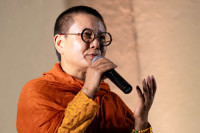
As the lobbying continued, Venerable Master Yinshun — a member of the National Committee of the Chinese People’s Political Consultative Conference (CPPCC), former vice president of the Buddhist Association of China, and abbot of the Chinese Temple of Nepal — arrived in Kathmandu on July 29. A senior security official said Yinshun discussed the seminar during his visit, which also took him to Lumbini. Following his visit and a separate meeting between Rai and the ambassador, half a dozen Tibetan experts from the Tibetan Policy Institute in India withdrew from the conference.
“Beijing has already become suspicious that the present government is tilted toward the West. The seminar became a test of the government’s neutrality. To assuage China’s concerns, the decision was taken to cancel the event,” another senior government official said.
Organisers of the conference reject the framing that the seminar was sensitive.
“Nepal was selected to host the conference in 2022,” one organiser said. “It is therefore incorrect to suggest that the event was planned only recently. The decision was made four years ago, and a large delegation from several Chinese universities, including Peking University, was expected to participate.”
Around 100 Chinese scholars and experts — including from the China Tibetology Research Centre — had registered to attend the seminar, which was to bring together scholars of Tibetan history, language, culture, art, philosophy and religion. Organisers say they had already agreed to Beijing’s core conditions.
“We had assured the authorities that there would be no pro-Tibet or anti-China activities or statements and that no individuals associated with such activism would be invited. We do not understand why the government is now considering stopping the event,” another organiser said.
A Kathmandu University spokesperson said the institution had repeatedly told the government the conference was “purely an academic exercise” with no pro-Tibet or anti-China agenda.
“There has been immense pressure on us to cancel the event,” the spokesperson said. Kathmandu University has since withdrawn as convener, leaving it to the International Association for Tibetan Studies (IATS) to decide whether — and where — the seminar can still be held.
One organiser linked Beijing’s alarm to a separate flashpoint: protests by Tibetans against China’s new Ethnic Unity Law, which took effect July 1. According to Amnesty International, the law frames “ethnic unity” as a precondition for advancing the Chinese Communist Party’s political agenda, including Xi Jinping Thought. “There have been major protests against China’s new Ethnic Unity Law. That is why Beijing intensified its lobbying and used its influence to prevent any untoward incidents in Kathmandu,” the organiser said.
One high-ranking government official who was aware of the decision told the Post the government should have focused on managing risk rather than cancelling the seminar outright.
Despite the cancellation, a Chinese delegation linked to the seminar is still expected to arrive in Nepal. Jiang Jianguo — a member of the Standing Committee of the CPPCC’s National Committee, vice director of its Ethnic and Religious Committee, and executive vice president of the China Society for Human Rights Studies — is scheduled is set to be accompanied by a five-person delegation, arriving on August 18 for a three-day trip.
The Chinese Embassy in Kathmandu did not respond to the Post’s repeated requests for comment.
“Since we have withdrawn as conveners, it is now up to the IATS to decide where and how the programme will be organised,” said Professor Sagar Sharma, one of the event's chief conveners.
Anil Giri is a Chief Sub Editor covering diplomacy, international relations and national politics for The Kathmandu Post. Giri has been working as a journalist for more than two decades, contributing to numerous national and international media outlets.




 25.95°C Kathmandu