Bhattarai urges Prime Minister Shah to put five issues on agenda for India visit
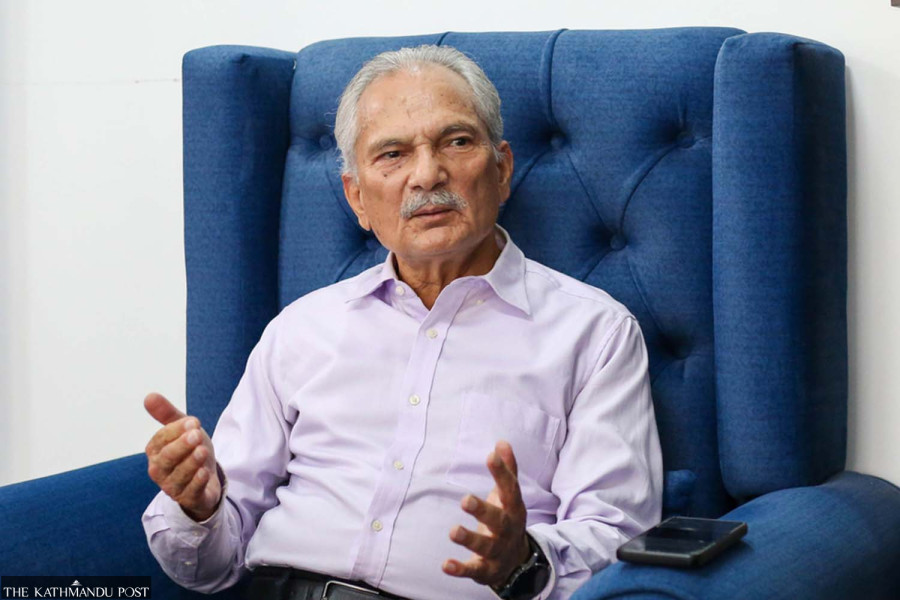
In an interview with Kantipur, the former prime minister says Nepal should press India on the border dispute, trade deficit, air routes and hydropower, while seeking trilateral cooperation on the Himalayan climate crisis. Post Photo
Former prime minister Baburam Bhattarai has urged Prime Minister Balendra Shah to firmly raise issues ranging from the border dispute and trade deficit to air routes, water resources and the Himalayan crisis during his official visit to India in mid-November.
In an interview with the Kantipur daily, Bhattarai suggested that Shah propose a new mechanism to address all outstanding bilateral issues through a comprehensive approach.
According to Bhattarai, Nepal’s relationship with India is fundamentally different from its ties with other countries because the two share an open border stretching around 1,850 kilometres. Nepal cannot resolve the effects of its relationship with India on its domestic politics and economy without addressing bilateral issues properly, he said.
The Sugauli Treaty places the territory east of the Kali river within Nepal. Under international norms, the stream originating from Limpiyadhura is considered the main source of the Kali river. India, however, has been unwilling to discuss the issue and has stopped referring to the disputed area as Kalapani, Bhattarai said.
The economic relationship is equally sensitive. According to the latest figures, India accounts for 63 percent of Nepal’s total trade, while Nepal’s exports to its southern neighbour remain relatively small. Industrial development will remain difficult unless Nepal addresses its trade deficit and economic dependence on India, he said. He added that smaller countries should receive special protection in sectors where they have a comparative advantage.
Bhattarai recalled that the idea of forming the Eminent Persons Group (EPG) on Nepal-India relations was conceived during his premiership precisely to address such issues comprehensively. Although the group prepared a report, India has yet to formally receive it. He suggested that Shah ask why the report remains unaddressed. If its recommendations are unacceptable, the EPG could be disbanded and a new mechanism established, he said. But unresolved issues cannot be settled by simply sweeping them under the carpet.
Bhattarai also criticised Foreign Minister Shisir Khanal’s statement that there was “no old baggage” and Finance Minister Swarnim Wagle’s remark that the “era of anti-India nationalism is over”.
The state is a continuing institution and cannot walk away from responsibilities inherited from the past, Bhattarai said. Nepal has not opposed India; it has stood up for its own national interests, he argued. While he did not question the ministers’ intentions, he said their remarks reflected a lack of diplomatic finesse. Whatever the prime minister’s personal style, it should not be allowed to influence the country’s foreign policy, he added.
Bhattarai identified five key issues that Shah should raise during his visit to India:
1. A comprehensive bilateral mechanism: Re-establish a mechanism to address outstanding issues, including the border dispute, trade, transit, water resources and the 1950 Treaty of Peace and Friendship, through a single process.
2. Economic nationalism: Seek trade concessions as a matter of right to reduce the trade deficit and make it easier to export agricultural products. Nepal’s exports face obstacles arising from quarantine requirements and rules of origin, he said.
3. Air routes: Seek additional air entry routes for the Bhairahawa and Pokhara international airports. Nepal should also seek to open one additional border crossing each to the east and west of Birgunj, he said. Such arrangements could help reduce losses amounting to billions of rupees.
4. Water resources: Push Indian companies to expedite hydropower projects they have secured in Nepal and create conditions for the smooth export of Nepali electricity to India and Bangladesh.
5. The Himalayan crisis: In the wake of the floods in the Bhotekoshi and Budhigandaki rivers, seek a trilateral understanding among Nepal, India and China on climate change. Resolving the location of the western tri-junction between the three countries is also linked to this issue, he said.
Bhattarai said that even if the two larger neighbours were unwilling to participate in trilateral talks, Nepal could work towards a trilateral understanding through separate agreements between Nepal and India, Nepal and China, and China and India.
As for the South Asian Association for Regional Cooperation (SAARC), Nepal could only extend goodwill and offer suggestions, he said.




 21.12°C Kathmandu