As Nepali women’s choices expand, marriage becomes an option
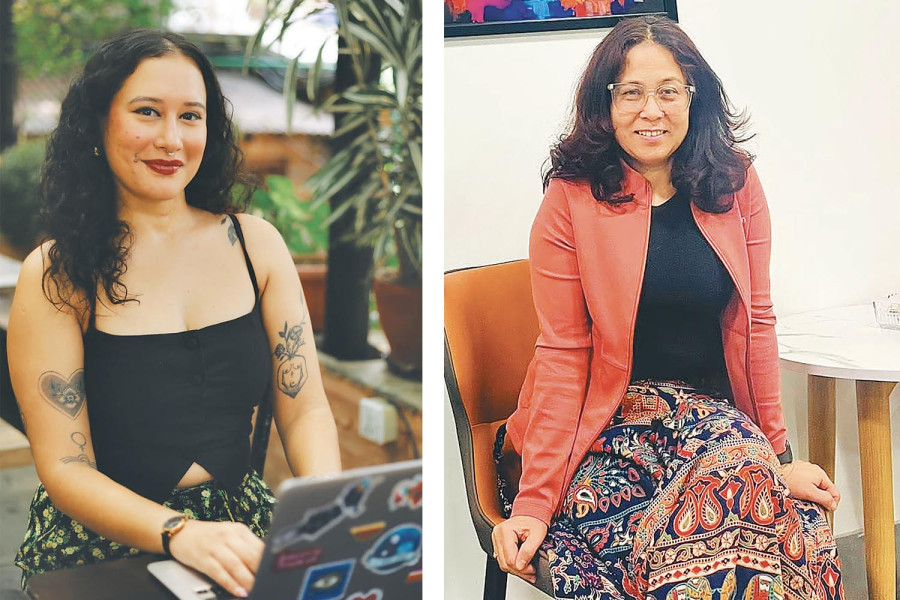
As marriage loses its place as the only marker of adulthood and respectability, more women are deciding whether marriage fits the lives they want.Nirvana Bhandary (left) and Nirupa Prasun Photos Provided to the Post
At 29, Reema Bhusal (name changed) finds herself answering a question she never imagined would become hers: What if she never married?
Marriage is considered a key milestone for women, something that makes or breaks a woman’s life. In Nepal, strong social value is attached to ramro keta sanga bihe (marriage to a good man). Without it, society often questions a woman’s status, her worth. Marriage is treated as the ultimate marker of stability, respectability and adulthood.
Yet beneath this tradition, a quiet rethinking is taking place. More women are questioning whether marriage is a necessity or simply a social expectation. While the number of women choosing to remain unmarried is still small, rising education, employment and financial independence are allowing some women to imagine lives outside traditional marital roles.
According to the 2021 National Population and Housing Census, the share of Nepali women who have never married beyond age 35 by choice has risen from virtually none in 1961 to 0.7 percent in 2021. The number is small, but the trend signals a shift: For many women, marriage is no longer a compulsion but a choice.
A similar shift is taking place in South Korea, where a growing number of women describe themselves as bihon—a term that means “willfully unmarried” or “no marriage”. The movement rejects the expectation that women should marry, have children and assume the load of unpaid domestic work.
For Bhusal, marriage was never presented as a choice growing up. Instead, she accepted it as something that happened to everyone. “It felt as unquestionable as the sun rising in the east,” she says.
“It wasn't a question of whether I wanted it, but rather how I would go about it.” She believed that if marriage was inevitable, she should at least find someone she could get along with.
A turning point came when a relationship she expected could end up in marriage failed. The breakup led her to question why she was pursuing an institution she had never fully believed in.
It also made her question the expectations placed on wives and daughters-in-law and come to see marriage as an unequal institution where women were often expected to sacrifice more than men. Reports of violence against women and the inequalities embedded in everyday customs only deepened those doubts.
“For me, financial independence and emotional independence eventually made it possible to imagine a different future,” she says.
Bhusal also rejects the common argument that marriage and parenthood are necessary to avoid loneliness in old age.
“The idea that you should marry and have children so that they can take care of you later feels deeply self-serving to me,” she says. “If that is the primary motivation for bringing life into the world, then I don't think it's a fair or honest one.”
Today, Bhusal says she is “genuinely comfortable with the possibility” that she may never marry. Although she describes herself as “a pendulum” — pulled by family expectations and social pressure, she no longer sees remaining single as a failure, but as a legitimate and peaceful way of living.
Unlike Bhusal, whose views evolved over time, 34-year-old feminist writer Nirvana Bhandary says her decision not to marry is a “conscious rejection” of the institution of marriage itself.
Bhandary credits financial independence and education with making that choice possible. “It’s only when you have the space to ask if marriage is actually necessary, then only you can reject it," she says, arguing that opting out of marriage remains a privilege unavailable to many women who are financially dependent or have never been exposed to alternative ways of thinking.
Over the years, after watching both arranged and love marriages around her, Bhandary came to see marriage as a patriarchal institution whose historical roots cannot be separated from unequal gender roles. “I don't see it making me happier or improving my life in any meaningful way,” she says.
While she acknowledges that many women reject the unequal expectations placed on wives and daughters-in-law, her disagreement goes further. “For many of us, it's about fundamentally disagreeing with the institution of marriage itself.”
Yet rejecting marriage does not mean rejecting companionship.
Bhandary says emotional and sexual intimacy need not be confined to marriage.
“Marriage is just an institution,”she says. “Love and intimacy are available in abundance without it as well.”
Rather than remaining single for life, Bhandary envisions a long-term partner with whom she can build a relationship on her own terms. "I definitely would like to have a life partner," she says. "But we can design a model of our relationship that suits our needs. It doesn't have to follow socially constructed definitions or boundaries of what is considered an acceptable relationship."
For Bhandary, the decision is not about rejecting love, but rejecting the belief that marriage is the only legitimate way to experience it.
Unlike Bhusal and Bhandary, 39 year old writer, Nirupa Prasun, says she never imagined marriage as part of her life. From childhood, she says, she viewed it as a restriction rather than a milestone.
“I always felt that marriage is a kind of restriction. I never wanted to be bound by it. I always wanted to live freely, like a bird,”she says.
After witnessing relationships break down around her, her conviction of not wanting to become someone's wife strengthened.
Yet, for Prasun, rejecting marriage has not meant rejecting motherhood.
As she entered her thirties, Prasun found herself longing for a child. Financially independent, she believes she has the means to raise one on her own.
“I’m financially independent. I have the means to raise a child,” she says.
But what holds her back is not the practical challenge of single parenthood; it is the fear of hurting her family. She fears that becoming a mother outside marriage would bring stigma not only upon herself but also upon her parents and brother’s family.
She says she has repeatedly gathered the courage to discuss the idea but has never been able to do so. “I cannot bear the thought of causing my parents pain by becoming a mother outside marriage,” she says, describing her desire for motherhood and loyalty to her family as a moral dilemma she has yet to resolve.
Although her parents have never pressured her to marry and have respected her decision, her mother still worries about her daughter's future and hopes she will one day change her mind.
"After I die, Yama [the god of death] will ask if I married off all my children,” her mother often tells her. “If I haven't done it for one daughter, he will send me to hell.”
Assistant Professor Dr Neeti Aryal Khanal of Tribhuvan University, says the growing number of women consciously choosing not to marry should be understood as part of broader social transformation rather than simply as resistance to marriage.
“We cannot simply say that it is resistance to marriage,” she says. “Human beings have an essential need for emotional connection. We all want someone to care for us and someone we can care for.”
According to Khanal, women choosing to remain unmarried is not a new phenomenon. What has changed, she says, is its visibility and the growing number of women able to make that choice.
Historically, marriage provided women with financial security and social acceptance at a time when gender roles confined them largely to homemaking and caregiving. Education, employment and financial independence have since expanded women’s choices, allowing many to decide not only whom to marry, but whether to marry at all.
At the same time, Khanal says, expectations within marriage have not changed as quickly as women’s lives outside it. “While the ratio of women participating in higher education and paid work has plummeted, they are still often expected to shoulder most domestic and caregiving responsibilities after marriage.”
For some, she says, that imbalance makes marriage appear as a loss of autonomy rather than a partnership.
Khanal cautions, however, against generalising all unmarried women.
Some consciously reject marriage as an institution, while others remain single because they do not fit society’s expectations of the “ideal wife” or “ideal daughter-in-law.”
She also notes that marriage remains the most socially accepted form of intimate relationship in Nepal. “Single women may still experience exclusion in a family centred society where conversations and social life often revolve around spouses and children.”
At the same time, she rejects the assumption that unmarried women are necessarily lonely, stating that many build meaningful lives through friendships, work and other forms of social support.
According to Shreya Sanjel, a legal professional at the Supreme Court, Nepal’s laws do not explicitly discriminate against women based on whether they are married or unmarried. Constitutional guarantees of equality prohibit discrimination on the basis of marital status and unmarried women enjoy the same rights to own property, vote, travel and inherit property as married women.
However, Sanjel argues that the gap lies less in the law itself than in the assumptions embedded within legal and administrative systems.
“Legally, there is no clear distinction between married and unmarried individuals. But in practice, you can see differences,”she says.
One example is identity documentation. From citizenship records to banking and voter registration, women are often recognised through their father's or husband's identity, while men are rarely identified through their wives. Although these practices do not deny rights to unmarried women, they reflect an assumption that a woman's identity eventually becomes linked to marriage.
Sanjel also points to legal language that reinforces social attitudes. The Constitution, for instance, refers to "single helpless women", a phrase she believes wrongly equates singlehood with vulnerability. Likewise, some court judgments in rape cases continue to discuss how sexual violence affects a woman's "marriage prospects", framing the harm in relation to marriageability rather than bodily autonomy.
Overall, Sanjel says the barriers faced by women who consciously remain unmarried are less about formal legal restrictions than about social norms that continue to shape the interpretation and implementation of the law.
"The law itself does not restrict women from living independently," she says. "The challenge is that society does not always accept those rights in practice."




 25.58°C Kathmandu