Why a viral TikTok about ‘baddies’ has struck such a nerve in Nepal
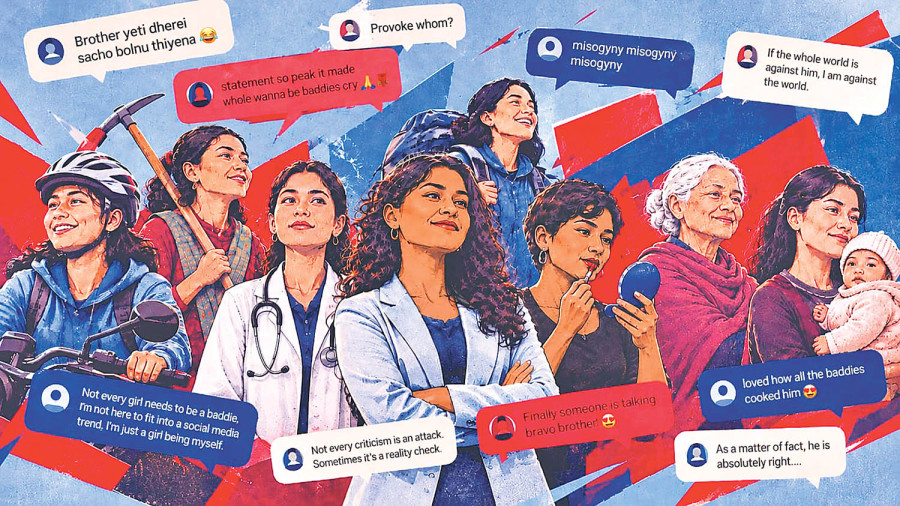
When a TikToker declared Nepal’s young women an ‘epidemic’, they answered with stethoscopes, spreadsheets and sarcasm. Post illustration with AI assistance
Nepal has no shortage of national crises. But on TikTok, none appears as urgent as the growing population of baddies.
On November 10, a TikTok user, @immature_wisdom, dropped a bombshell, posting a front-facing monologue that opened with the gravity of a parliamentary announcement. “Ladies and gentlemen,” he started, “we’re officially in the middle of a baddie epidemic.”
The announcement was not received as a casual observation about makeup or style. It was treated with urgency usually reserved for national security briefings. The video has since travelled well beyond TikTok, where it has garnered over 1.8 million views, over 69.7k likes and over 27k shares.
In the three-minute monologue, the creator diagnosed what he believed was a growing social problem—that young women have been mistaking appearance for substance. “Just as you find a tea stall around every alleyway,” he said, “there is a baddie every two houses down.” On TikTok, he added, you meet one every few scrolls.
According to his diagnosis, the warning signs of the baddie epidemic include “coherent facial features, a carefully curated Instagram profile, expensive clothing, perfectly applied makeup, provocative photographs, and most dangerously, a certain attitude.” He asked what they “bring to the table” besides an “aesthetically-pleasing face.”
To seal his point, he invoked a roll call of Nepal’s national icons: mountaineer Pasang Lhamu Sherpa, social reformer Yogmaya Neupane, and humanitarian Anuradha Koirala. These luminaries, he declared, were the “real baddies.”
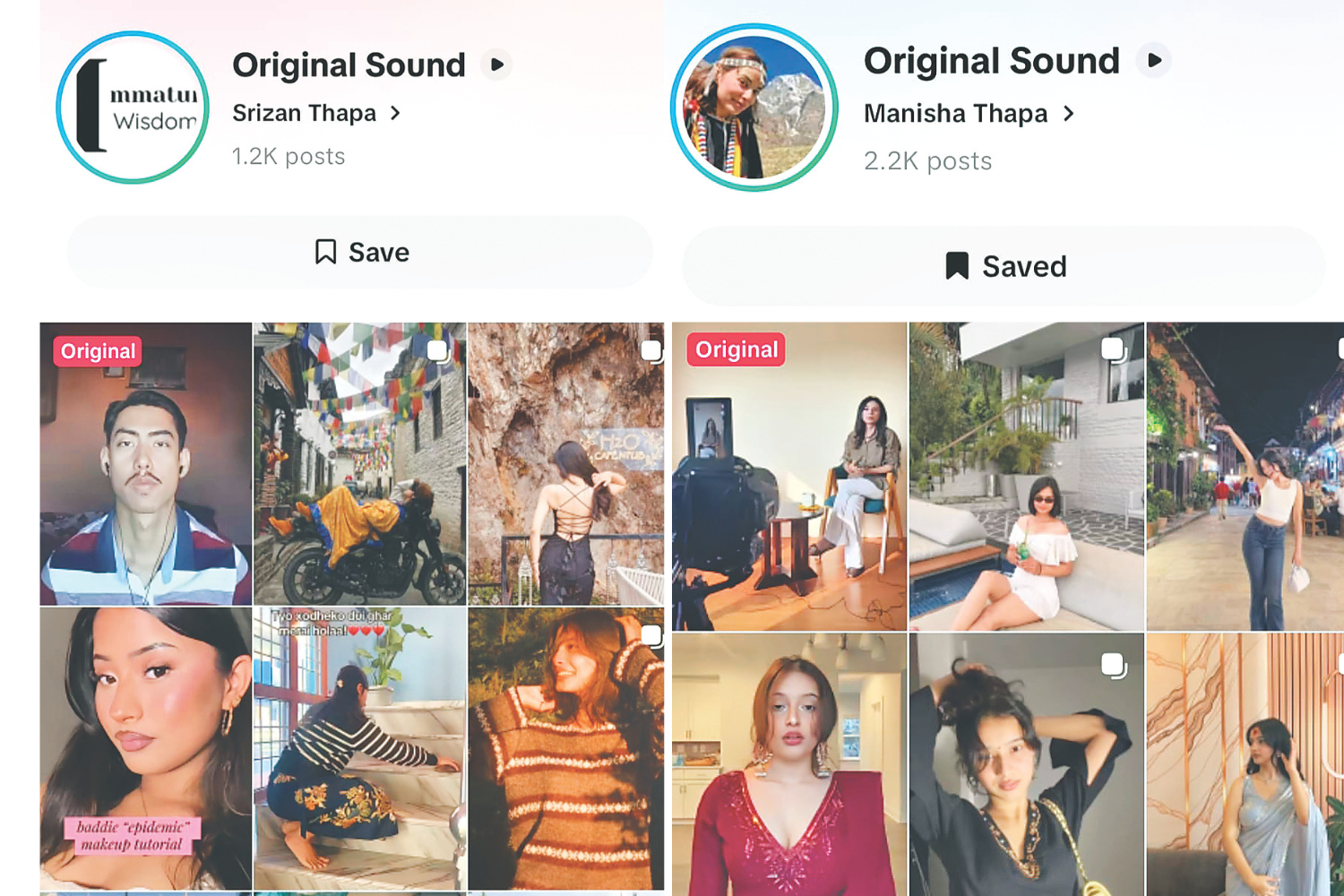
But not everyone is impressed with @immature_wisdom’s monologue. Many argue that his take fits his username a little too well. In the days since the post, his audio has been repurposed into a self-organised TikTok trend, with more than 2,200 women using it to present themselves on their own terms.
Beyond the pixelated world of TikTok, however, the question underneath is an old one: Who gets to decide what a woman is, and what she owes anyone for being seen?
The video taps into a genre that has flourished globally across YouTube, podcasts and TikTok: the calm, articulate male commentator who frames his verdicts on women’s behaviour as psychological insight and common-sense advice. As media scholar Debbie Ging has theorised in her work on online masculinities and the ‘manosphere’, contemporary digital anti-feminism rarely needs to announce itself through overt hostility. Instead, it often operates through the language of rationality, self-improvement and seemingly benevolent concern.
This monologue follows that script. The user’s assurance, “Wear whatever you want… enjoy your femininity however you please”, serves as a pre-emptive disclaimer, lending the argument an appearance of tolerance before he turns to diagnosing their supposed insecurities, childhood wounds and need for male validation.
The problem is not simply that he disapproves of a particular aesthetic. It is that he assumes the authority to interpret the psychology behind women’s choices.
This paternalism creates an impossible bind. As essayist Jia Tolentino notes in ‘Trick Mirror’, digital platforms encourage women to curate their visual identities, only for commentators to condemn them for doing so. Apparently, the rules are to look good online, but not enjoy looking good.
In South Asia, where women’s mobility has historically been policed in the name of family honour—izzat—the format feels like an algorithm-ready update of an old impulse. Sociologist Stanley Cohen’s concept of “moral panic” in Folk Devils and Moral Panic (1972), describes societal overreactions to perceived threats to traditional values. The creator’s framing turns women’s self-expression into precisely such a threat.
The word ‘baddie’ itself makes the controversy more interesting. Once associated with villains and antagonists, the term was reclaimed through Black American and hip-hop culture, where “bad” acquired the celebratory meaning: formidable and fiercely self-possessed. By the late 2010s, “baddie” had evolved into a globally recognised aesthetic. Today, even mainstream dictionaries list it in slang indexes.
More than 2,200 women have repurposed the viral “Baddie epidemic” audio on TikTok, turning a creator’s criticism into a trendto present themselves on their own terms. Screen shots
On South Asian social media, the term became shorthand for a polished urban aesthetic: sharp eyeliner, fitted streetwear, salon hair, and unbothered posture. Its adoption as an insult by male commentators is therefore ironic. The TikTok monologue appears to strip the word of its celebratory roots and reduce a woman who embraces glamour to a superficial antagonist in society’s moral order.
Meanwhile, on the other side of the aisle, the commentary found an enthusiastic audience. In reshared clips and comment sections, men praised the creator for delivering what they termed an overdue correction.
One user, Manoj Chalise, declared that a single young man had “straight up cooked the entire baddie community.” Another, @Sahil_Bikram_Khatiwada, insisted the speaker was “absolutely right.” Others celebrated him for finally saying aloud what polite society withheld for so long.
As pushback mounted, defenders accused female viewers of missing the point. In a widely circulated video, a user named @Zenith argued that critics were dodging an honest question. “The fact that you’re triggered in comments is proving his point,” he said.
The counter-offensive did not arrive as an earnest rebuttal. It arrived as satire.
Rather than litigating the lecture, women across Nepal took the opening line and turned it into an open canvas for self-definition. Creators who joined the trend used the audio to show their routines, interests and professional lives. Abisha Limbu (@dr_abisha) posted herself in clinical scrubs adjusting a stethoscope—a credential that proved difficult to out-lecture. Another creator, Pooja (@baby_dragon), danced to the audio with a cheerful caption: “Self-proclaimed baddie with a Masters Degree (Engineering), loves make-up, dancing, and dressing up!”
The videos captured the full spectrum of everyday life. A nurse shared footage of teaching menstrual hygiene classes in rural villages. Others uploaded clips packing orders for their small businesses; hiking mountain trails; or working agricultural fields in their hometowns. Some simply posted them applying make-up from hospital beds or booking international travel.
The collective response refused the premise that visual style indicates a hollow intellect, insisting that looking good, working hard, and having fun are not mutually exclusive. As user @jefflovr pointed out in the replies, “You’re the one who’s reducing her to her appearance in the first place.”
In internet culture, this subversion functions as an effective act of micro-feminism—decentralised, humorous pushback that neutralises condescension without validating the original insult.
Some male creators also joined the mockery. Creator Brindan Adhikari said that when a woman applies make-up, commentators treat it like “a national crisis.” He added that the desire to dress up was not a pathogen, but “if anything… a vaccine against insecure men.”
The debate has little to do with appearances and everything to do with social control. The UNDP’s Gender Social Norms Index found that nearly nine out of ten people worldwide hold biases against women, a figure that has barely moved despite large gains in women’s education and economic participation. UN Women has warned that online spaces have become a main arena for technology-facilitated gender-based violence, where unsolicited surveillance and public moralising are routinely used to check women’s visibility and autonomy.
Rita Shah, a writer and researcher working on gender issues, says that patriarchal norms have always sought to control three fundamental dimensions of a woman: “Her body, her sexuality, and her mobility.”
“Society has historically dictated what clothes a woman should wear, where she can go, and how she presents herself, labelling quiet, modest women as ‘civilised’,” she says. “What we are seeing on TikTok is simply a modern manifestation of that impulse.”
Shah argues that while women in Nepal have achieved higher education and economic independence, societal mindsets have failed to keep up. “Men no longer wear traditional dhotis or spend their days behind a wooden plough; they have evolved their attire and lifestyles,” Shah says. “To judge modern women against century-old standards while men embrace modernity is hypocrisy.”
Obtaining an academic degree does not automatically eliminate underlying bias, Shah says. “True consciousness requires abandoning the urge to police others.”
This double standard makes the weaponisation of national icons particularly grating. Yogmaya Neupane sacrificed her life in the Arun River in 1941, fighting religious orthodoxy and child marriage. Pasang Lhamu Sherpa defied extreme political and physical hurdles to reach Everest’s summit. To summon their sacrifices to lecture young women about their appearance is to turn their legacies into a cudgel.
Women do not owe society martyrdom just to be left alone, as one creator, Sushmita, put it in a widely shared response: “You don’t need to live an extraordinary life to deserve ordinary human respect.”
Aarya Chand is a reporter at The Kathmandu Post covering social issues. Before moving to the social beat, Chand was an intern covering culture and lifestyle for the Post.




 14.12°C Kathmandu