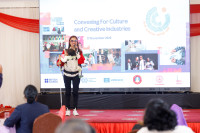
At 26, Bhojpur-born singer Pratik Himal Rai represented Nepal at Eurovision Song Contest Asia in Bangkok, and won over audiences even as he finished ninth. Pratik Himal Rai performs at the inaugural Eurovision Asia competition in Bangkok on November 14. Photo: Courtesy of Pratik Himal Rai
On November 14, twenty-six-year-old Nepali singer Pratik Himal Rai stood before a large audience in Bangkok, introducing the world to Nepali rock music. His voice rang out across a stage he had never imagined performing on, let alone one of such scale.
It was his first appearance on the grand stage of the Eurovision Song Contest Asia, where 11 performers from 11 countries competed, each representing their country through music. As he sang, flags from across the region waved in the audience. Among them were a few Nepali flags. Seeing them, he was overcome by a sense of belonging and national pride.
“For the first time, I felt such a deep connection with my country. My eyes remained wet for a long time backstage,” Rai says.
His emotions were also shaped by the Bhotekoshi catastrophe of August 26, which claimed hundreds of lives, and swept away homes and livelihoods. Thinking of those affected, Rai became emotional. After his performance, he used the stage to appeal to the international audience: “Nepal is going through a difficult time. Please help us.”
The competition was eventually won by 19-year-old Filipino singer Carmelle with her song ‘Sobra-Sobra’. Rai finished ninth, but he did not consider the result a defeat. For him, the real achievement was introducing Nepali music to an international audience and leaving its distinct mark.
“Making it to this platform and introducing the world to something distinctly Nepali was my goal. Achieving that is my victory,” he says.
Although he did not bring home the title, Rai won over many international fans. After his performance, several people approached him to praise his singing. Some told him that Nepal had produced a remarkable rock star. Even while exploring Bangkok, he was recognised by fans who stopped to take photographs with him.
“What greater achievement could there be for me and my country?” he says.
Rai’s journey to Eurovision was unexpected from the outset. A few months earlier, when he received the first phone call from the organisers, he could hardly believe it.
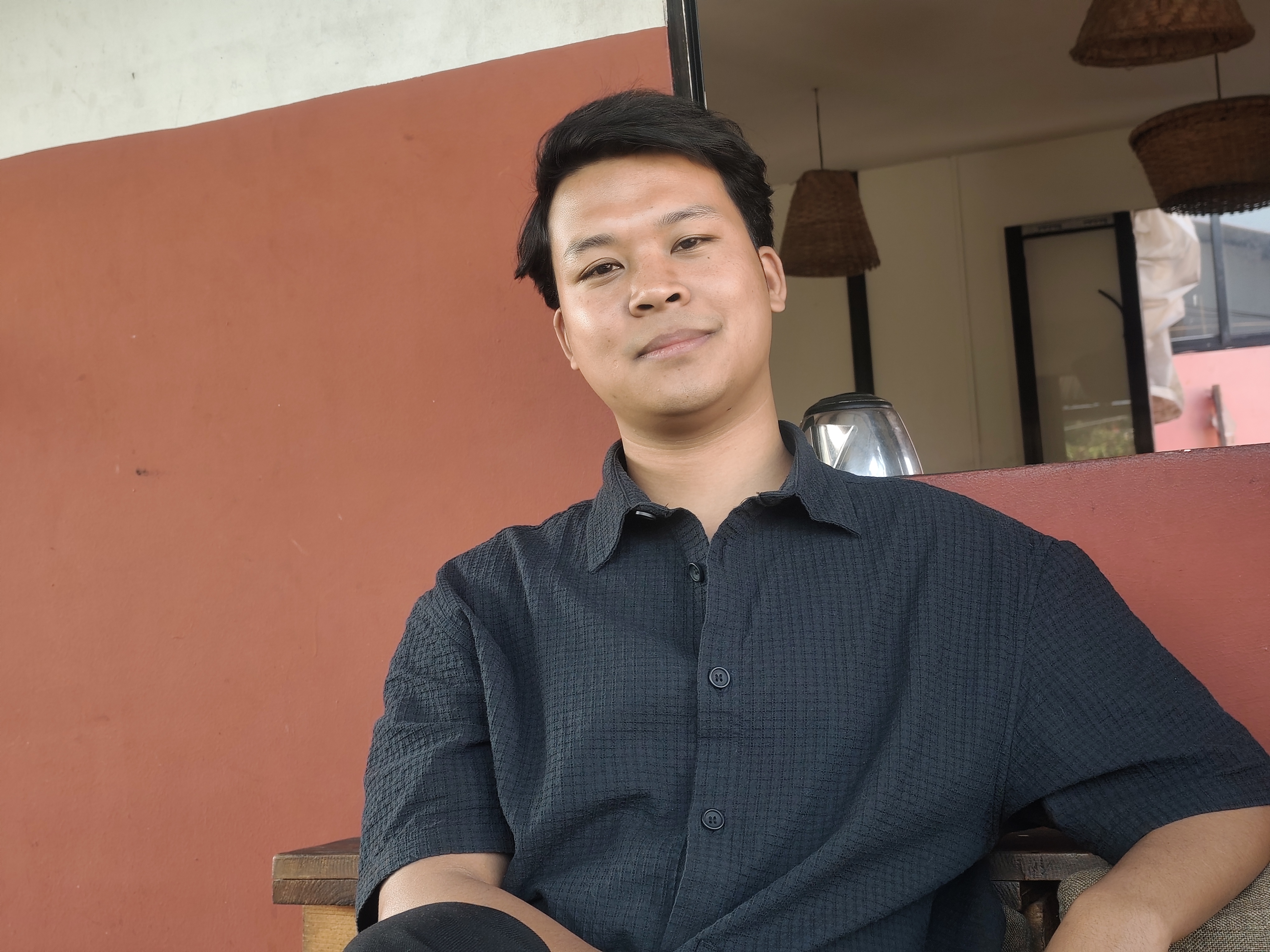
Artist Pratik Himal Rai
“They had already watched clips of my performances on Voice of Nepal and listened to my songs. Apparently, they had noticed me even before making contact,” he says.
At the time, Rai knew little about the competition. When the Eurovision team in Nepal contacted him, he began researching its history and was astonished by its stature.
The Eurovision Song Contest was first held on May 24, 1956, in Lugano, Switzerland. Established by the European Broadcasting Union in the aftermath of World War II, it was intended to foster cultural unity and goodwill among European countries. It has since grown into one of the world’s longest-running international music competitions, and provided a platform for artists who have gone on to make their mark in music history.
When Rai learnt that he might get to perform on the same stage, he initially wondered whether it was all a dream.
His disbelief, however, soon gave way to a frantic rush to prepare. The call came shortly before the selection process for the grand finale in Bangkok, leaving him with very little time to submit an original song.
“I wasn’t prepared at all. I had to submit a song the very next day. In a hurry, I wrote and composed a new song, Ananta Maya [boundless love],” he recalls.
Writing, composing, and performing his own music came naturally to Rai. The organisers, it turned out, were looking for precisely that kind of independent musical talent. He submitted a three-minute song, and on October 7, the Eurovision Nepal team announced him as its winner. He had beaten 11 other contestants to earn the opportunity to represent Nepal in Bangkok.
The moment was especially emotional for someone who had never won a competition before. Rai recalled his earlier attempts to make it as a singer, including two auditions for Nepal Idol and one for Voice of Nepal. Both are televised singing competitions. He failed to make it to the finals on all three occasions.
“I had never even won a toffee in my life. So, when I got such a huge opportunity, it took me a while to believe it,” he says.
After winning the national selection, Rai returned to the stage in his home district of Bhojpur for the first time since his Eurovision breakthrough. He had grown up among the district’s hills and ridges, singing and dreaming of becoming a musician.
As a child, he listened to and sang along to songs by Narayan Gopal, Satyaraj Acharya, Swaroopraj Acharya and Rajesh Payal Rai. He eventually told his parents that he wanted to pursue a career in singing. But his father had other plans, hoping his son would establish himself in a technical profession.
After completing his Secondary Education Examination (SEE) in 2015, Rai told his family that he wanted to move to Kathmandu to pursue music. When his parents refused to support the plan, he left for the capital anyway.
“I sang at bars across Kathmandu, from Thamel and Jhamsikhel to Chabahil. I earned money through singing and paid for my education,” he says.
Performing at bars also taught him an important lesson: “For an artist, no stage is too small or too big.”
Pratik Himal Rai performs at the inaugural Eurovision Asia competition in Bangkok on November 14. Photo: Courtesy of Pratik Himal Rai
Rai went on to earn a bachelor’s degree in music from RR Campus at Exhibition Road, Kathmandu, and subsequently took private music lessons for another three years. Through years of practice, study and struggle, he gradually built a career as a singer.
The Eurovision achievement eventually brought him back to Bhojpur, this time with a sense of fulfilment. But the reception he received there gave him a new perspective.
“Only after reaching Bhojpur did I realise that this success wasn’t mine alone. It belonged to the entire district. And when I reached Bangkok, I realised it belonged to the whole country,” he says.
Rai first made a name for himself through rock music. But he does not want to be confined to the genre or known only as a rock star. He sees music as a much wider territory to explore.
“I want to sing every kind of song. I find something of myself in music from all over the world. I want to sing modern music, classical music, and folk songs too,” he says.
His songs ‘Jhari’ [rain] and ‘Brahmanda’ [universe] are available on YouTube. Rai also writes his own lyrics, a practice he attributes to his love of reading.
“I read fiction and poetry because words teach me so much,” he says.
His Eurovision experience has left him with another aspiration: to see Nepal win the competition in a future edition. He hopes that whoever represents the country next time will go one step further and claim the title.
Under the competition’s hosting tradition, the winning country gets to host the following edition. Rai would love to see Nepal get that opportunity.
“I hope Nepal gets the chance to host it one day,” he says.




 13.12°C Kathmandu