For Mamta Kafle’s family, a guilty verdict is not enough
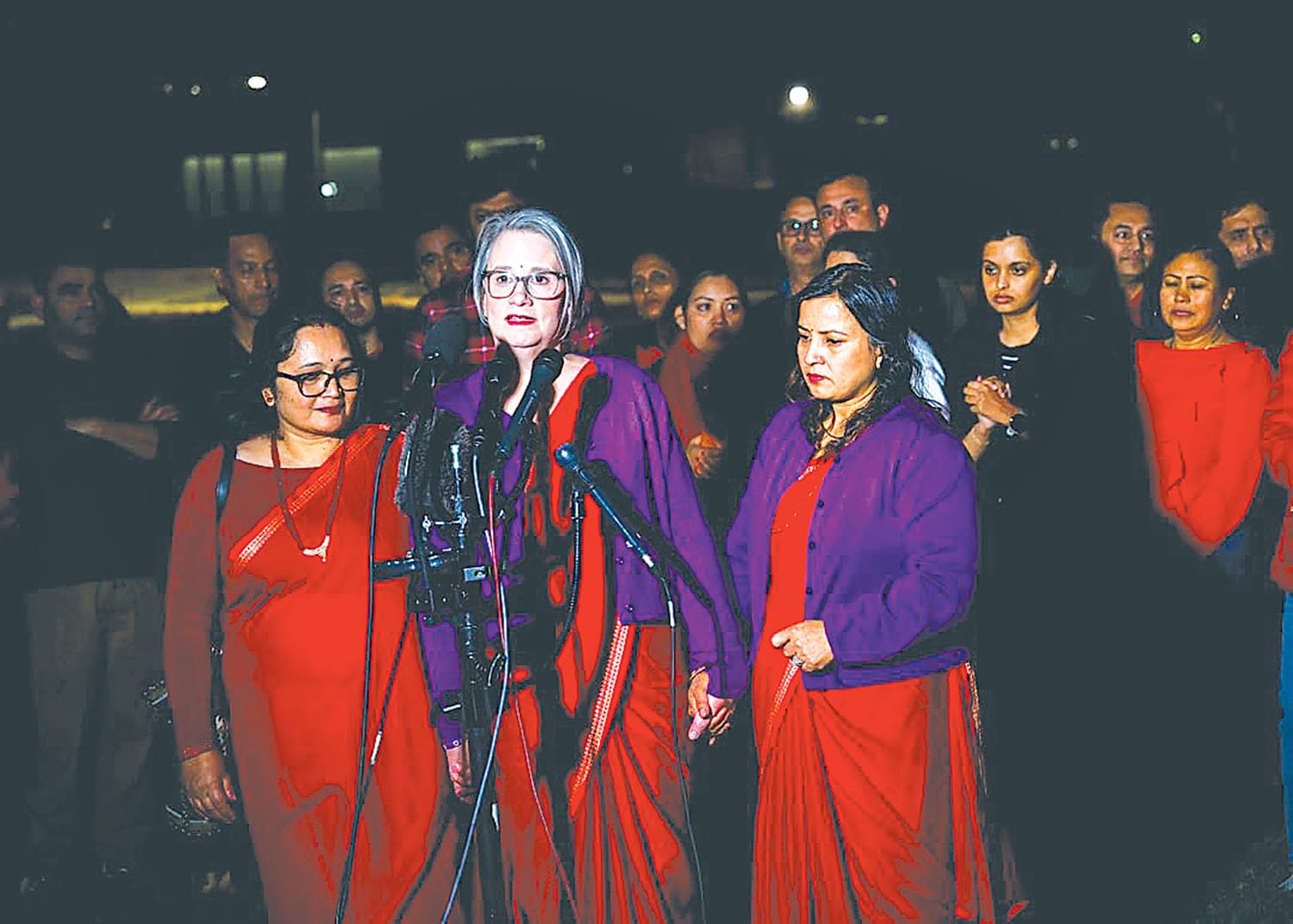
A US jury convicted Naresh Bhatt of murdering his wife, whose body remains missing. Her family and advocates say the case highlights the difficulties Nepali women face in leaving abusive relationships abroad. Mahesh Kafle, Mamta Kafle Bhatt’s brother, and Sunita Basnet Thapa embrace after Naresh Bhatt was convicted of all charges, includingfirst-degree murder, on November 10. Photo: InsideNoVa
Naresh Bhatt showed little emotion as the guilty verdict was read in court. He briefly spoke with his lawyer. Outside, relatives and friends of his wife, Mamta Kafle, embraced each other, some in tears. One thanked the prosecutor.
After two years of waiting, they had finally had a measure of closure. But for Mamta’s family, justice remains incomplete. Her body has never been found, her daughter is growing up without her mother, and the questions surrounding her death remain unanswered.
On Tuesday, a jury in Prince William County Circuit Court in Virginia, US, found Bhatt, 39, guilty of first-degree murder, the CNN reported. It rejected his claim that Kafle had died by suicide. He was also convicted of concealing and defiling her body. The judge revoked his bond.
Prosecutors built their case on circumstantial evidence, despite having no body, autopsy, or established cause of death. They presented a power saw containing DNA consistent with Kafle’s blood, which was found on the bedroom carpet. Store surveillance footage showed Bhatt buying trash bags and cleaning supplies.
Phone and Tesla records also traced his movements to rubbish compactors across Northern Virginia.
Bhatt admitted in court that he had lied to Kafle’s relatives, friends, neighbours, and police. He also acknowledged dismembering her body and disposing of it. But he disputed the prosecution’s account of how she died.
While the verdict held Bhatt accountable, the case has raised a larger question: how can Nepali women living abroad get help and protection before domestic violence turns fatal?
Kafle had reportedly sought help months before she disappeared. Her brother, Mahesh Kafle, told the court that she had sent him a photograph in February 2024 showing what appeared to be an injury to her face and told him she did not feel safe.
She had also confided in friends and contacted police over a domestic dispute. On February 14, 2024, she reported that Bhatt had taken her identification documents. That same day, she opened a bank account in her own name.
Bhatt told the court that he was angry because she had called the police.
Kafle moved to the United States in 2021. Police later learned that she had no biological family in the country.
“Mamta did what they tell women to do,” Jesselina Rana, a human rights lawyer and Harvard Law School graduate based in the US, told the Post over the phone. “She confided in a friend, her family feared for her safety, and police had been called to her home months before she disappeared. She was taking steps, and it still was not enough.”
Rana said families should support women in leaving abusive relationships at the first sign of violence, rather than waiting for the situation to worsen.
But leaving can be particularly difficult for Nepali women who move abroad to join their partners.
“Control can run through immigration status and money, so leaving can mean losing their home, their immigration status, and sometimes their child,” she said.
Research on domestic violence among Nepali women living in the United States remains limited. However, a preliminary study of intimate partner violence among Nepali women in the country found that 75.6 percent had been verbally insulted by their current partners. Another 62.2 percent said they needed permission to visit friends or relatives.
Rana said social isolation, financial dependence, immigration insecurity, language barriers, and pressure to protect family reputation can make it harder for women to seek help.
Holly Wirth (centre, speaking) and Sunita Basnet Thapa (left), both friends and former coworkers of Mamta Kafle Bhatt, address the media outside the Prince William County courthouse following the verdict of ‘guilty on all charges’ against Naresh Bhatt on November 10 as Bina Khadka Lama, a Nepalese community advocate and influencer, looks on. Photo: InsideNoVa
She called for stronger legal protection for women on dependent visas; interpreters in courts and shelters; and Nepali-speaking lawyers who can help survivors with protection orders, divorce, and child custody cases.
Community organisations should also hold regular awareness programmes in Nepali and work with local authorities to establish helplines, she said.
Outside the courthouse, Kafle’s friends and former colleagues expressed both relief and grief.
“We stand here today with tear-stained eyes because we got the verdict that we've been fighting for—guilty, guilty, guilty,” Holly Wirth, a former colleague, told local media outlet InsideNoVa.
“He killed her, he defiled her, he threw her away like trash. But let me tell you what I know: She’s not trash. She wasn’t trash then, she’s not trash today,” she said.
Sunita Basnet Thapa, who testified for the prosecution and described Kafle as her “emotional daughter”, also spoke to reporters alongside Wirth and Nepali community advocate Bina Khadka Lama.
For some supporters, Kafle’s case was painfully familiar.
“We’d seen this pattern before,” said Julia Kosatka, a supporter from Gainesville, Florida, in the US. “All of us had seen it, either in the news or from friends or from relatives.”
For Mahesh Kafle, the verdict has brought little happiness after two years of uncertainty.
“I don’t know whether to feel happy or sad,” he said. “Even after two years, there’s still no finality, as the sentencing is yet to be decided.”
“I only had one sister. This has been an incredibly painful experience for me,” he said. Still, he found some comfort in knowing that the justice system had held Bhatt accountable.
Bhatt faces 20 years to life in prison for murder and up to five years for each of the other two convictions. His sentencing is scheduled for March 12, 2027. Kafle’s family is seeking life imprisonment without parole.
“That is the justice we are hoping for,” Mahesh said.
Kafle’s daughter, Neema, was about to turn one when her mother disappeared. She is now three and is being raised by relatives, including her grandmother and uncle.
“Although we have gotten justice, the fight is not over,” Melissa Barton, a leader of a Facebook group supporting Kafle, told InsideNoVa.
The verdict has brought an end to one part of the case, but it cannot answer every question. For Nepali women living abroad, the challenge remains finding support and a safe way out of abusive relationships.
Whether Kafle’s case brings change will depend on whether families take women's fears seriously, communities speak openly about domestic violence, and institutions provide protection before another woman loses her life.
Aarya Chand is a reporter at The Kathmandu Post covering social issues. Before moving to the social beat, Chand was an intern covering culture and lifestyle for the Post.




 12.12°C Kathmandu