



 17.13°C Kathmandu

Fri, Nov 6, 2026
The Long View
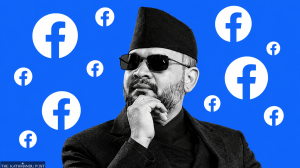
Balendra Shah’s Facebook page used to hold power to account. Now it holds power.
As mayor, he posted constantly on Facebook, often attacking the government. As prime minister, his Facebook page has become the government.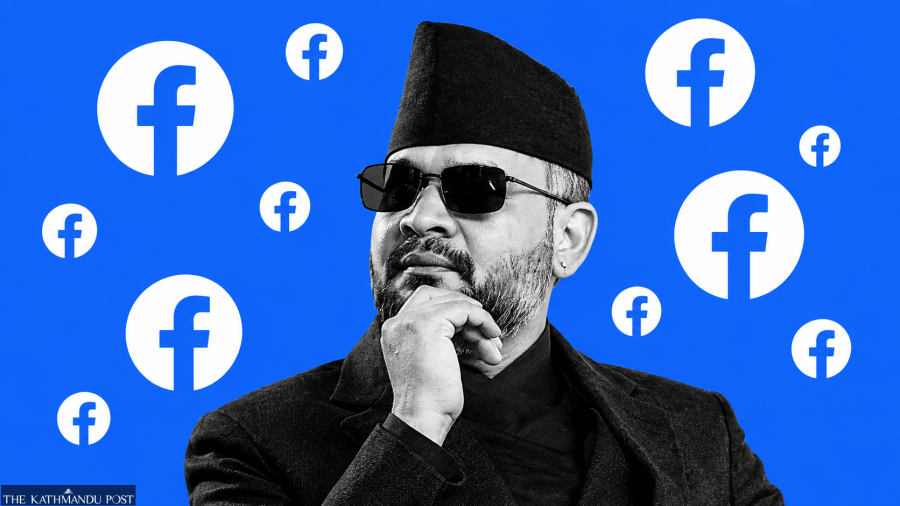
bookmark![]()
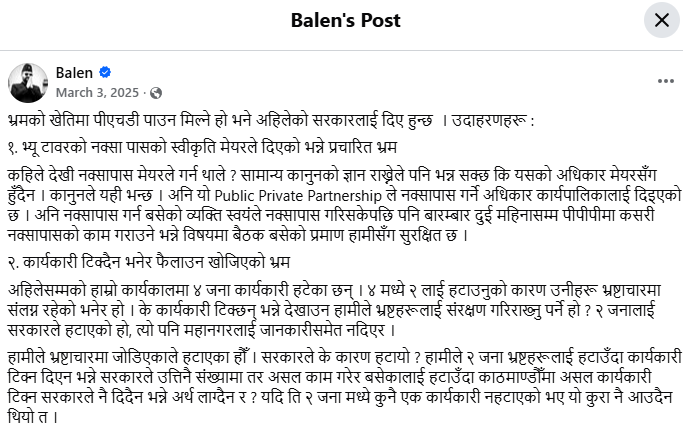
Screengrab of a status Shah posted when he was the mayor of Kathmandu Metropolitan City. ![]()
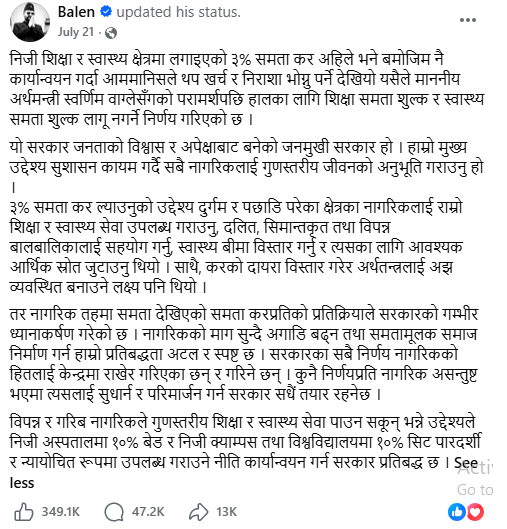
Shah's July status announcing the government would drop the 3 percent fee imposed on private schools and hospitals. Screengrab
Anup Kaphle
Published at : November 6, 2026
Updated at : November 6, 2026 19:19
Kathmandu
This essay was originally published as part of our weekly newsletter, Letter from Kathmandu. Sign up to receive this free newsletter in your inbox every Friday from The Kathmandu Post.
On the morning of October 31, a day after plainclothes police entered several newsrooms and took journalists into custody, Prime Minister Balendra Shah posted on Facebook about mobile games. Ludo and Callbreak, two of the world’s most downloaded games, were made in Nepal, he wrote, and his government would ease the rules for the gaming industry.
It is one of 58 posts Shah has published on his official account since he was sworn in on March 27. This past week, I read all of them, along with more than 200 messages he posted as mayor of Kathmandu, and coded each one with the help of Claude AI’s Opus 5.5 model. What I found is that Shah posts about twice a week, the same rate as in his last two years as mayor. Eight of his posts as prime minister went up after 9 pm.
But one of the most significant changes is what Shah uses his Facebook page for as prime minister. During his tenure as mayor, he posted on Facebook to hold power to account. He called out the people he was furious with, he put numbers on projects his office took on, and he often set targets people could judge him against. Since becoming the prime minister in March, he has been using the same page — it is still categorized as Musician/Band, versus “politician” or “government official” — to announce decisions and to reassure his followers. Shah’s Facebook page is arguably the most powerful political account in Nepal, but it no longer carries the same aura of accountability as it once did.
Let’s look at the pattern of attacks on his social posts. Shah used 39 of the 207 posts during his time as mayor to mock or attack someone by name, most often someone in the federal government. “If anyone could earn a PhD in farming confusion,” he wrote in March 2025, “give it to the current government.” On the day police killed protesters last September during the Gen Z protests, he wrote about then Prime Minister KP Sharma Oli, calling him “the father only of your cronies,” appending the post with the hashtag #kpoliisterriorist. But many of these attacks stopped when he began campaigning in January for the election the following month. Since taking office in March, he has done it only once, against the Nepali Congress that held a rally at the Khula Manch ground. He spent three years mocking the government, and now that he is the government, the accusation and mockery have stopped.
Pay attention to how he uses numbers in his post, and you’ll see the same pattern. As mayor, Shah liberally threw around numbers to highlight results or promises: 3,469 street dogs sterilized in 60 days, goal to train 15,000 young people each year, and find work for at least 5,000 of them. But as prime minister, he has rarely attached numbers or measurable targets to what his government promises to deliver. His promises have turned to reassurances. On budget night, for example, he wrote two words: “Rest assured.” In August, he wrote that “it takes some time for the right time to come.” The following month, on the anniversary of the Gen Z protests, he said that “good governance will surely be established.”
The personal attacks on his Facebook post have given way to the voice of an official addressing his subjects. Since the night of the Bhotekoshi floods in August, he has used a phrase in 10 posts that he never appears to have used on any of his social platforms before: “Respected mothers and fathers, sisters and brothers.” For nearly two weeks, he used his page to share bulletins between 7:30 pm and 8:30 pm, highlighting the number of security personnel deployed and people rescued. He’s also used his page to drop official decisions first. In July, he announced that the government would drop a 3 percent fee his cabinet had decided to impose on private schools and hospitals. His finance minister, Swarnim Wagle, told the Kathmandu Post that whatever the prime minister says is final.
More recently, if you put his posts against the news cycle, you’ll see a pattern appear. Shah wastes no time when he needs to convey that the state is coming to help. He posted on the same day in the case of both the August and September floods, and two days later in the case of the clashes in Sunsari. But when the state’s own power is in question, he tends to go quiet. For example, in April, his cabinet cut short the parliamentary sessions to push through ordinances. He didn’t post anything. His party has been weighing in on the impeachment of judges caught in leaked chats with middlemen. He’s not posted anything.
The morning after a group of journalists was detained, he posted about the gaming industry, shifting attention to a seemingly unrelated subject. On Sunday, he warned that “no one should dream that one or two people will escape,” but he didn’t say who he was referring to. Hours earlier, his chief adviser, Kumar Ben, had tagged 28 journalists — including a number of them from Kantipur Media Group — and asked whether anyone left off the list could be called a journalist. Ben and Shah regularly engage on each other’s Facebook posts. Earlier during the summer, after weeks of criticism, including about his posts, he wrote that he liked “fooling around on weekends.”
Since coming to power, Shah has posted 58 times but appeared in the parliament only twice. His party won a majority on his promise to clean up Nepal’s politics, and it was on Facebook he made that promise. That platform remains almost the only place he tries to explain himself, and even though his posts receive thousands of comments from his followers and critics, he has not had to answer a single question.
On Wednesday, I sent the prime minister’s office seven questions about Shah’s Facebook posts and asked for a response within 24 hours. For transparency, here are the questions I put to his team.
Who writes and publishes the posts on the Prime Minister’s Facebook page? Does he write them himself, or does a team in his office prepare them?
Is the page the government’s official channel for announcements? If so, why does it still list its category as “Musician/Band”
On July 21, the Prime Minister announced on Facebook that the 3 percent equity fee would not be applied, before the cabinet had formally decided. Why was it announced there first, and on what date did the cabinet formalize the decision?
On November 1, the Prime Minister wrote that “no one should dream that one or two people will escape.” Whom was he referring to?
On that same day, Kumar Ben tagged several journalists in a post and asked whether those left off his list could be called a journalist. Does that reflect the prime minister’s view?
Since taking office, the prime minister hasn’t given any interviews or held press conferences. Does he plan to? Will he take questions directly from journalists at any forum?
As mayor, he regularly criticized the government on Facebook. Has his view of what the role of his page is changed now that he leads the government?
The prime minister’s office did not respond.
Political leaders around the world have learned that they don’t need to shut down communication to avoid scrutiny; they just need to control its terms. Shah is not the first leader to figure this out. He discovered Facebook’s power as mayor, challenging those in power. Now in power himself, he is using the same platform to set the narrative and offer reassurances — without having to answer questions.
(A note on methodology: The 265 posts were collected from Shah’s public Facebook page using a custom scraping tool and cover the period between November 2023 and November 2, 2026. Posts that were no longer public when the page was collected were not included. I used Anthropic’s Claude Opus 5.5 to help classify the posts across several measures, for example, whether a post attacked a named person or set a numerical target, using written definitions. The dataset does not include comments. Shah also uses another account with a significantly smaller following, which was not examined for this article.)
Anup Kaphle
Anup Kaphle is the Group Editorial Director of Kantipur Media Group. He previously served as the editor-in-chief of Rest of World in New York, where he led award-winning coverage of technology's impact in the emerging markets. He has spent nearly two decades in U.S. newsrooms covering international affairs and national security, including roles at The Washington Post, BuzzFeed News and The Atlantic.

Most Read from The Long View

Editor's Picks
The police chief who objects, delays—and ultimately complies

How Inam Sapkota tested the state

Beyond sushi and sukiyaki, a taste of Japanese culture in Kathmandu
How Deepak Bhatta became Nepal’s most influential power broker
Everest Base Camp trek: From self-doubt to finding my feet in the Himalayas
E-PAPER | November 06, 2026

×