Kathmandu’s evicted squatters say they have no proper food, medical care at temporary centres
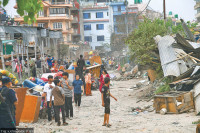
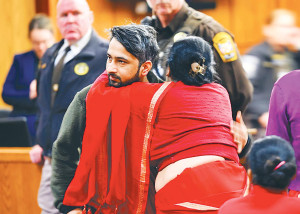
Displaced families are being asked to leave holding centres without secure housing, adequate food or access to essential healthcare. Chaos at the Gairigaun squatter settlement in Kathmandu in April this year as the government deployed bulldozers to tear down their houses. Post File Photo
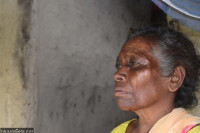
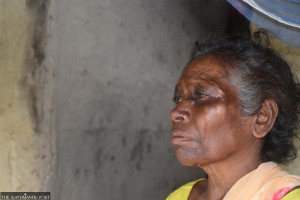
Kamala Yonjan needs urgent surgery to remove a metal implant from her hand. But she cannot even afford the transport fare to reach a hospital.
The 47-year-old currently lives on the cold floor of a holding centre in Ichangu Narayan, after her home in Kathmandu’s Manohara squatter settlement was demolished during the government’s April eviction drive.
Yonjan spent years working in Lebanon, cleaning toilets and washing dishes to save enough money to build a house. She had left behind a toddler while migrating for work. Her life’s savings were wasted when a bulldozer tore down her riverside house.
“At 47, I am disabled. Where am I supposed to go now?” she wondered.
Yonjan’s experience reflects the plight of families displaced from squatter settlements in Thapathali, Manohara and Sinamangal of Kathmandu. On April 25, bulldozers moved into the settlements. The displaced residents say the government promised to make alternative arrangements within 15 days. Seven months later, they have received neither land ownership certificates nor permanent homes.
According to the High Powered Committee for Integrated Development of Bagmati Civilisation (HPCIDBC), 2,608 households, comprising 11,105 people, were initially registered as squatters. A subsequent digital survey collected details from only 2,082 families. The committee is now in contact with 388 households, or 1,488 people. Of these, 96 families remain in holding centres: 45 in Ichangu Narayan in Kathmandu, 32 in Kharipati in Bhaktapur and 19 in Bode, also in Bhaktapur.
Many of those staying in the centres are older people, people with disabilities and patients with chronic illnesses. Residents say they are struggling to get adequate food and medical care, with little consideration for the needs of people suffering from serious health conditions.
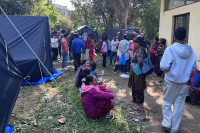
At the Ichangu Narayan centre, where 45 families are staying, residents say they are given black tea at 7:30am, followed by meals at 9am and 6pm. The food usually consists of stale lentils and poor-quality vegetables, they say. There is no provision for nutritious meals, dhindo (traditional porridge) or fruit needed for people with kidney disease, cancer and diabetes, for whom diet is an essential part of treatment.
“Sick people need nutritious food. Without proper meals, how will we get better?” said Urmila Tamang, who lives at the holding centre.
Maiya Shrestha, 60, said residents had been served meat at only four meals during Dashain, with a 200 gram portion each time, and at just two meals during Tihar.
“During Dashain, they gave us only a small serving of beaten rice and 200 grams of meat per meal. I did not eat it. I have kept it all to show the government officials when they come. I will ask them, ‘Is this what you call humanity?’” she said.
For residents who need regular medical attention, the lack of support can be life-threatening.
Pratap Bahadur Lama, 61, has kidney disease and needs dialysis twice a week. But he has been unable to attend every session since August. Because he cannot walk without a wheelchair, transporting him to the hospital for each dialysis session costs more than Rs3,500.
His wife, Sharmila Lama, 51, who cares for him, is herself hard of hearing and has severe diabetes. She has already spent Rs700,000 on treatment for a heart condition. The wheelchair available at the centre is broken, she said.
“A screw has come loose, and the wheels get stuck. When we have to take him up and down the stairs, someone else has to hold the chair,” she said.
The greatest danger comes at night, when a sudden medical emergency can leave residents without any way to reach a hospital.
“If a patient’s condition becomes critical at midnight or 1 am, we cannot even find a vehicle, let alone an ambulance. It feels as though the state has taken away our homes and left us to die,” Sharmila said, breaking down.
Shrestha also needs to take medication regularly, but says she has struggled to get both food and medicines on time since moving to the centre.
“They made us leave our homes, saying they would make arrangements within 15 days. Perhaps they have now just left us to die,” she said.
The uncertainty has also taken a toll on residents’ mental health. Santosh Sunar, 56, and Som Kumari Bishwokarma are among older residents who describe growing anxiety and despair. They say they lie awake at night worrying about their children’s future and the possibility of ending up on the streets again.
“We had worked hard to build a small hut, but at least it was our own. We left believing that the government would make proper arrangements for us. Now we have neither a secure place to live nor any assurance of getting enough to eat,” Sunar said.
At the Nepal Electricity Authority’s training centre in Kharipati, 32 families, comprising 81 people, are staying together. The group includes older people, children, women and men. Residents say the food provided is often stale or unfit to eat. A 14-year-old boy staying at a holding centre said that some meals emit a foul smell.
Sita Nagarkoti, 73, said her four-room house had been demolished and five members of her family now share a single room.
“We will not leave this place. We are Nepali citizens with citizenship certificates, yet the government has left us to live like refugees,” she said, through tears.
Menuka Gurung, 66, is also staying at the Kharipaticentre with her family of seven, relying on meals provided by an organisation. She said government officials had assured them that they would receive land ownership certificates within 15 days.
“I had decided that I would die here. Seven months have passed, and nothing has happened. We are being kept like prisoners. In jail, you are allowed at least to run a business,” she said.
At the Bode centre, 19 families displaced from Thapathali are staying with 59 people, including 17 children. Jhawar Lal Uraw said government officials had visited a few days earlier and told them that they would have to leave the centre within a week, promising that they would receive land ownership certificates within the same period.
“The government has failed to do anything in seven months. How will it manage to do this in just a week? I cannot sleep at night,” he said.
Niranjani Paswan, 21, described similar uncertainty. Her family has nine members and was told to find a rented room and move out. They were also advised to return to their village, where they would be given land. But when they went to the district, they were told to return to the place where they had been living.
The families were not moved directly to their current holding centres after their homes were demolished. Those evicted were first taken to a centre in Kirtipur. They were subsequently relocated to Kharipati and to small hotels in Balaju and Gongabu before being moved again to Ichangu Narayan.
The repeated relocations have disrupted medical treatment, children’s schooling and efforts to secure official documents, residents say. Housing more than 100 people in a single compound has also created problems with privacy, sanitation and the care of sick residents. The situation is especially difficult for older people, people with disabilities and young children living alongside large numbers of others.
Now, even their temporary shelter is under threat. A notice posted at the Bode holding centre has asked residents to vacate the premises by 2pm on November 27, adding another deadline to the uncertainty facing the displaced families.
The displaced families say no government representatives have come to assess their living conditions in the past seven months. Many feel they are being treated as a burden rather than as citizens entitled to state support.
“Those in power have forgotten the people who elected them. When we are struggling to survive, the government is nowhere to be seen,” Shrestha said angrily.
A Cabinet meeting on May 19 decided to provide financial assistance to families displaced by the demolitions who wanted to arrange alternative accommodation themselves. Under the decision, families of up to five members were to receive a one-off payment of Rs25,000 for relocation and Rs15,000 in monthly assistance. Families with more than five members were to receive an additional Rs2,000 a month for each extra member. Some residents say they have yet to receive even this assistance.
The government also decided to accommodate older people, people with disabilities and others unable to arrange housing on their own in designated holding centres. It pledged to ensure that children continued their education and that residents received healthcare in coordination with the local government. But residents say these provisions have not translated into adequate support.
Government agencies, meanwhile, are pointing to one another over responsibility for the families’ welfare and resettlement.
Machakaji Maharjan, project director at the HPCIDBC, said the committee had overseen the holding centres and compiled records of displaced families because the riverbank areas fell under its jurisdiction. It continues to coordinate with other agencies, he said.
“The remaining work, under the government’s decision, is the responsibility of the Ministry of Women, Children, Gender and Sexual Minorities and Social Security and the Ministry of Land Management, Cooperatives, Federal Affairs and General Administration,” Maharjan said.
But neither ministry has taken full responsibility for the families’ resettlement.
The women’s ministry says its role is limited to providing essential supplies for older people, women and children, while the resettlement of landless families falls under the jurisdiction of the land management ministry. The secretariat of Women and Social Security Minister Sita Badi said the ministry had distributed supplies and was coordinating on other matters.
Ganesh Prasad Bhatta, spokesperson for the land management ministry, said they only have a coordinating role. Identifying genuine landless families, finding land for them and distributing it are the responsibility of the Land Issue Resolving Committee, he said.
Sanjeev Kumar Shah, information officer at the committee, said the process was underway.
“The HPCIDBC’s data has been forwarded through district offices to local governments, which will verify whether the families are genuinely landless and issue land ownership certificates in accordance with the law,” he said.
As government agencies pass responsibility between them and the land verification process drags on, vulnerable residents remain in the holding centres without clear arrangements for healthcare, adequate food or children’s education.
Nepal’s constitution guarantees every citizen the rights to health, housing and education. It provides free basic healthcare for economically disadvantaged people, housing for those without shelter and education for children. Residents of the holding centres say these constitutional guarantees remain largely out of reach.
Mihir Thakur, a member of the National Human Rights Commission, said the rights of genuine landless families must be protected.
“The government must make appropriate arrangements for their housing and other rights,” he said.
Rights activists say the government’s authority to clear unauthorised settlements does not remove its responsibility to provide safe alternative housing for those displaced. While identifying landless families and distributing land may take time, they argue, people must not be left without necessities while legal procedures are underway.




 8.12°C Kathmandu