Fear and uncertainty grip displaced families as exit deadline nears
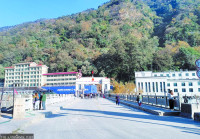
Residents worry about losing temporary shelter before a permanent resettlement plan is in place. Residents at the Radha Soami Satsang holding centre in Kirtipur. Samarpan Shree/TKP
Across holding centres in the Kathmandu Valley and Kavrepalanchok district, displaced families are facing renewed uncertainty after authorities issued a deadline requiring them to vacate temporary shelters by Friday.
The notice, which applies to holding centres in Kathmandu, Bhaktapur and Kavrepalanchok districts, has triggered anxiety among squatters who have been living in these facilities after being displaced by the government’s drive to clear encroachments from public land and riverbanks across the Kathmandu Valley on April 25.
At the Radha Soami Satsang Beas holding centre in Kirtipur, residents describe a growing sense of fear and confusion as they try to determine where they will go next.
Inside the holding centre, residents say their daily lives are marked by illness, financial hardship and an ongoing search for rental housing, which many say has proven nearly impossible.
“Now what is there left to say? We speak, but no one seems to hear our pain,” 50-year-old Pramila Rai told Kantipur.
She said a notice asking residents to vacate by Friday has deepened anxiety among families already struggling with health problems and unstable living conditions.
The displaced families say the government’s recent directive is forcing them to leave the holding centres after three months of displacement instead of fulfilling its promise to provide them with land. They argue that finding alternative housing at such short notice will be difficult.
Authorities, however, maintain that the support package is sufficient. The government has decided to provide an initial relief payment of Rs25,000 and a monthly housing allowance of Rs15,000 for up to three months until permanent accommodation arrangements are made.
According to Pramila, officials visited the holding centre on Tuesday and informed residents that Rs25,000 would be transferred to each family to support relocation. For many, however, the amount raises more questions than answers.
“We have nothing left at home. How can anyone manage with Rs25,000?” she said.
Across the centre, similar concerns are echoed. Families say they are willing to move, but only if there is a clear and stable alternative. Many also claim they are being turned away by landlords once their background as squatters becomes known.
Some residents express frustration and fear over what they see as a cycle of temporary relief and repeated displacement.
“We will not leave until proper arrangements are made,” Pramila said. “We are even ready to face police or army bullets, but we will not go anywhere.”
Others are more focused on immediate survival.
Forty-five-year-old Krishna Maya Pariyar, who lives with seven family members, said her search for rental rooms has been unsuccessful, particularly since her daughter-in-law recently gave birth.
“We searched many places, but no one agreed to rent to us,” she said. “Where do we go with a newborn and a postnatal mother?”
She said the money provided by the government is insufficient to cover housing, food and the needs of children.
For younger residents, the uncertainty is closely tied to earlier eviction experiences.
Twenty-four-year-old Anjali Kumari Paswan said she only learned about the government notice to vacate the holding centre on Tuesday. The latest directive, she said, revived memories of the demolition drive and sudden displacement in Thapathali on April 25.
“The fear I felt that night came back again yesterday,” she said. “When the notice arrived suddenly, we were left wondering where we would go next.”
Like many others at the holding centre, Paswan said her family has repeatedly struggled to secure rental housing because of the stigma attached to being identified as squatters.
“There are seven of us in the family. Who is going to rent a room to a family of seven?” she asked. “My in-laws used to earn a living selling berries and peanuts, but that income is gone now. The stress is only getting worse.”
She fears the government may be seeking to move families out of the holding centres by offering temporary rent support, only to abandon them later.
“What if they move us from here and stop the payments after three months?” she said. “We do not know whether the money will come or not.”
“That same fear came back,” she added. “We suddenly don’t know where to go again.”
She said larger families face even greater difficulty securing housing, especially without steady sources of income.
Seventy-five-year-old Bishnu, however, said he still hopes the authorities will find a long-term solution rather than another temporary arrangement.
“Please ensure a permanent solution,” he said. “In the past, governments have often changed their promises. This time, I hope it will not change.”
Officials say the current arrangement is part of a broader plan to identify genuine landless families and resettle them within three months. Residents of the holding centres have been asked to leave by Asar 12, though authorities say the deadline could be adjusted if necessary.
For now, however, the families remain in limbo, waiting for clarity on what comes after the temporary shelters are closed.
The government has given residents of holding centres until June 26 to vacate. Authorities say it is not feasible to keep displaced families in holding centres indefinitely and that, until a proper land solution is found, they are being asked to shift to suitable accommodation using the relief funds provided.
Anand Singh Bhat, executive chairperson of the High Powered Committee for Integrated Development of Bagmati Civilisation, said residents had been informed about the move well in advance and that the deadline could be extended if necessary.
“We have been informing them about this for some time, so it is not short notice,” he said. “If necessary, the deadline could be extended by a few days.”
Bhat said the government plans to identify genuine landless families and arrange their long-term resettlement within three months.
“If that cannot be completed within three months, the government will consider additional options,” he said.
According to Bhat, the identification of genuine squatters will be completed within the next three months, after which further procedures will be initiated.
Following the government’s eviction drive, holding centres were established at seven locations in Kathmandu, Bhaktapur and Kavrepalanchok to accommodate displaced families.
According to committee data, 1,488 people from 388 households are currently staying in these holding centres.
Of the total, 294 people from 87 households are staying at Machhapokhari holding centre, Balaju; 277 people from 65 households at Radhaswami Ashram, Kirtipur; 355 people from 99 households at the Nepal Electricity Authority training centre building in Kharipati; 115 people from 24 households at the Agricultural Development Bank training institute in Bode; 80 people from 21 households at the National Water Supply and Sanitation Training Centre in Nagarkot; 195 people from 45 households at the Nepal Red Cross Society facility in Banepa; and 172 people from 47 households at apartments in Ichangunarayan.
Meanwhile, digital verification of squatters staying outside holding centres has been ongoing since last Wednesday. Officials clarified that this is not a new registration process but a re-verification of those already listed who are currently living outside the centres.
The committee has already completed digital verification of 1,488 people staying in holding centres, out of 2,608 displaced individuals previously recorded.
The government has decided to provide an initial relief payment of Rs25,000 to those verified and found eligible as displaced informal settlers.
In addition, beneficiaries will receive a monthly housing allowance of Rs15,000 for up to three months until permanent accommodation arrangements are made.




 21.46°C Kathmandu