In Karnali, basic healthcare can mean hours of waiting
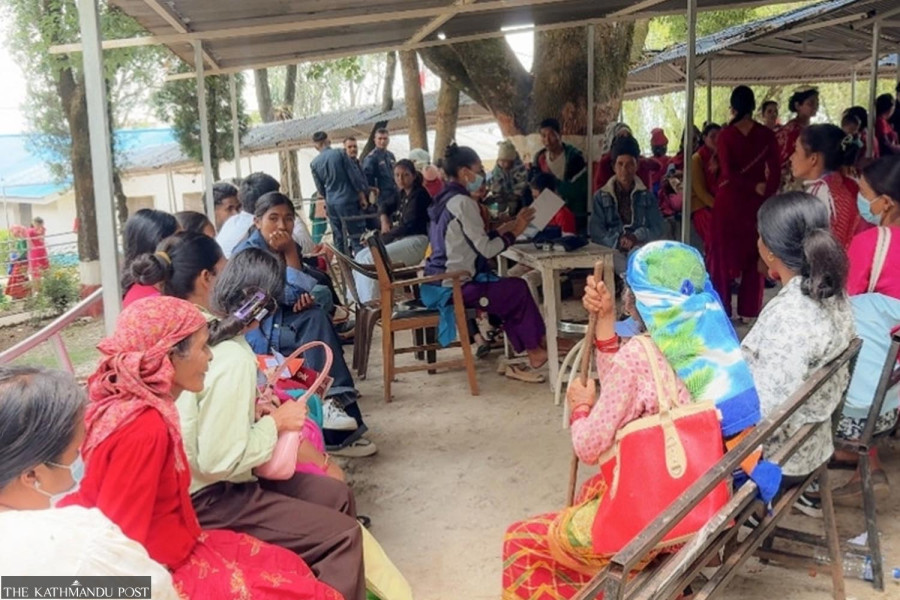
Vacant specialist posts, overstretched doctors and inadequate equipment are leaving district hospitals unable to meet growing demand, forcing patients to travel elsewhere for treatment. Patients wait for treatment at Rukum West District Hospital. Photo: Mahesh KC/Kantipur MAHESH KC/TKP
Khim Bahadur Oli of Musikot reached Rukum West District Hospital around 9am on Wednesday to have his sick child treated. He saw a doctor nearly four hours later.
After the consultation, he was sent to the laboratory for blood and urine tests and told to return around 4pm for the results. He spent another three hours at the hospital before collecting the reports and joining the queue to see a doctor again. His turn came at 5pm.
Oli’s experience is common at district hospitals across Karnali Province, where chronic vacancies, particularly among specialists, have left a small number of doctors handling heavy patient loads. Some hospitals rely almost entirely on medical officers, while others have gone years without filling specialist posts. Patients seeking even routine treatment are often forced to travel outside their districts.
Rukum West District Hospital has sanctioned posts for three ninth-level specialists and four eighth-level medical officers. Only three doctors are currently working there: a gynaecologist, a medical officer and an orthopaedic and neurology specialist hired through the hospital’s own arrangements.
The situation is similar in neighbouring Salyan. The district hospital has sanctioned posts for eight specialists and five eighth-level medical officers, but currently has only one specialist and five medical officers working under scholarship contracts. Critical maternity services have been suspended for a month because the hospital has no gynaecologist.
The hospital has no medical officers in permanent posts. Its chief consultant general physician, Dr Arjun Budha, also went on a month-long leave a week ago, leaving the hospital dependent on doctors hired under scholarship contracts, according to Hospital Development Committee chair Pramod Shrestha.
“We have repeatedly asked the provincial government to fill the posts, but there has been no response,” Shrestha said. “We are the ones who have to face the complaints and criticism. The government does not solve the problem. It is unfortunate, and frankly shameful, that the district’s largest hospital is in this condition.”
The shortage is pushing patients from Rukum West and Salyan to seek treatment elsewhere. In emergencies, the delays can be dangerous, said Rashmi Budhathoki of Salyan.
“When a pregnant woman reaches the hospital, we are told that she needs surgery but that it cannot be done here,” she said. “Having to travel to another district in an emergency puts both the mother and child at risk. People face similar difficulties because other treatments are also unavailable here.”
More than 200 patients visit the hospitals in Salyan and Rukum West each day, according to hospital data. The load is so high that doctors themselves are struggling to cope, said Dr Oshan Pun, a medical officer at Rukum West District Hospital.
Both hospitals officially have 15 beds, but rising demand has forced them to operate up to 40.
Hospital officials say the sanctioned staffing levels do not reflect the actual workload, making it difficult to provide timely and quality care.
Specialists missing, medical officers carry the load
At Jajarkot District Hospital, five medical officers are working against sanctioned posts, but all seven specialist positions are vacant.
Hospital information officer Krishna Khatri said hospital chief Dr Sunil Pun is officially employed as a medical officer but trained as an orthopaedic and neurology specialist and provides specialist-level care.
“He is providing specialist care, which is better than having no specialist at all,” Khatri said. “But we lack the technical staff and equipment required for such services. Still, his presence allows us to provide at least some treatment and refer patients when necessary.”
Bhupendra BK took his daughter to the Jajarkot hospital for treatment but was told to take her to Nepalgunj because there was no paediatrician.
“I came here because my child was sick, but they told me there was no child specialist and that I should take her to Nepalgunj,” he said. “How am I supposed to get her there?”
Humla faces a similar problem. Its 15-bed district hospital receives more than 100 patients a day and has been forced to operate up to 30 beds.
Acting office chief Dr Bhim Budha said the hospital has nine sanctioned doctor posts, of which six are currently filled: four permanent doctors and two working under scholarship contracts.
Humla civil society leader Karna Rawal said patients still have to spend hours waiting for basic treatment and often leave without receiving the care they need.
“The government must pay attention to this and ensure citizens’ right to healthcare is actually implemented,” he said.
At Kalikot District Hospital, all three specialist posts have been vacant for the past year. Three of its four medical officer posts are filled, leaving medical officers to provide services in the absence of a paediatrician, gynaecologist and general physician.
Acting hospital chief Dr Ratna Bir Sunar said seriously ill patients arrive almost every day, but the hospital is often unable to treat them.
“Seriously ill patients with different health problems come almost every day,” he said. “But without specialist services, we are forced to send them away disappointed. We have repeatedly informed the provincial government in writing and verbally, but for some reason the posts have still not been filled.”
Residents of Kalikot say they have to take risks and spend heavily to travel to Surkhet or Nepalgunj when treatment is unavailable locally.
Dolpa has doctors, but lacks the tools to treat patients
In Dolpa, the problem goes beyond a shortage of doctors. Inadequate equipment and technical staff, along with management problems, are also limiting the hospital’s ability to provide care.
Both specialist posts at Dolpa District Hospital are vacant, although a consultant general physician is working under a scholarship contract. Two of the four sanctioned eighth-level medical officer posts are filled.
The hospital has eight doctors in total, including a dental surgeon and four medical officers hired under scholarship contracts, said medical officer Dr Ajaya Prasad.
But staffing alone is not enough, he said.
“Although this is a 15-bed hospital, the patient load has forced us to operate up to 25 beds,” Prasad said. “We also lack essential medical equipment and technical staff. We have to arrange helicopter evacuations for critically ill patients, and that can take several hours. If we had even two ICU beds here, we could save many lives.”
The hospital also urgently needs orthopaedic and neurology specialists and the technical staff to support them, he said, particularly because of the district’s mountainous terrain.
Hospitals in other Karnali districts, including Dailekh, Mugu and Jumla, face similar shortages of skilled health workers and infrastructure.
Doctors on duty are struggling to cope
The shortage has also placed a heavy burden on the doctors who remain.
At Humla District Hospital, roughly half of the doctors provide round-the-clock services seven days a week, said acting chief Dr Bhim Budha.
“With so few doctors, we are doing whatever we can to keep the service running,” he said. “But it is difficult to make the service as effective as we would like.”
At Rukum West District Hospital, Dr Oshan Pun is the only medical officer handling routine outpatient cases. He said the workload is exhausting.
“Forget having time for food or rest, sometimes we do not even have time to drink water,” he said. “From 9am to 5pm, I examine regular patients. As this is a district-level hospital, I also have to handle emergency cases outside those hours. Doing that alone is extremely difficult.”
Two consultant doctors also work at the hospital but generally handle patients within their specialties. Hospital chief Dr Jeevan Pariyar has administrative responsibilities, leaving Pun to handle much of the routine patient load.
“We are doing everything we can, but the hospital cannot keep operating like this, and it should not,” Pun said.
Tek Bahadur Kusari, chair of the management committee under the Rukum West Health Service Office, said filling sanctioned posts should be the provincial government’s most urgent responsibility.
“If the government cannot fill the permanent posts immediately, it should at least send doctors under scholarship contracts,” he said.
Province says posts will be filled through Public Service Commission
Chhanka Bista, a public health expert from Karnali, said the provincial government bears much of the responsibility for the shortage.
Doctors, particularly specialists, have long been reluctant to work in remote areas, he said. But the provincial government has also failed to enact the necessary laws, advertise vacancies and establish mechanisms to ensure doctors serve where they are needed.
“Having doctors alone does not make a health service effective,” Bista said. “You also need skilled technical staff, proper medical equipment, adequate medicines, efficient management, a strong information system and good governance. Stakeholders need to take this seriously and work towards measurable results.”
Asked why sanctioned posts remain vacant and whether the province lacks enough medical personnel, Shankar Rijal, head of the medical section at the Karnali provincial Ministry of Social Development, said recruitment would be carried out through the Public Service Commission.
He said the ministry had identified the required positions and submitted a proposal to the Office of the Chief Minister and Council of Ministers.
“We expect the positions to be included in the Public Service Commission’s schedule and filled within this fiscal year,” Rijal said. “Only then will the current shortage of doctors be resolved.”
For people living in Karnali, however, the problem is immediate.
Dr Bhim Budha of Humla put it bluntly: “We may fall sick here, but where do we go for treatment? That is one of the biggest questions facing the people of Karnali. The government must provide an answer that people can actually feel, because access to healthcare is a fundamental right guaranteed by the Constitution.”




 24.58°C Kathmandu