Deuba faction’s Hindu line opens new fault line in Nepali Congress
A last-minute five-point declaration promotes Sanatan religion as a national identity, departing from an earlier 20-point conclusion and exposing divisions within the faction. Post Photo
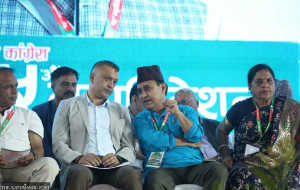
Former prime minister Sher Bahadur Deuba, who returned to Nepal last Thursday after spending nearly five months abroad, made the emphatic statement at the closing ceremony of a three-day national gathering organised by a faction of the Nepali Congress in Sukedhara on Sunday.
He further said that his personal faith did not mean he opposed other religions or rejected Nepal’s religious freedom.
“And I have love and reverence for Buddha and Buddhism. The world today recognises Buddhism. Today, Buddhism is also referred to as a scientific religion and is regarded as such. Likewise, ours is a country that respects nature-based religions. The Rai and Limbu communities follow nature-based religions, and we must respect all of them. I respect them.”
The Deuba faction’s decision to promote Sanatan religion as a national identity has opened a new ideological fault line in the Nepali Congress, while its rejection of Gagan Thapa’s leadership threatens to deepen the party’s organisational dispute.
The three-day gathering concluded on Sunday with a five-point declaration that commits the party to promoting Sanatan religion as a national identity while pledging to protect Hindu, Buddhist, Kirat and nature-based faiths and the religious freedom of all communities.
But the religious provision was added at the last minute and was absent from the 20-point conclusion prepared for the gathering, according to Congress leaders.
The earlier document described Nepal as a multi-ethnic, multilingual, multi-religious and multicultural country and guaranteed communities the freedom to practise and preserve their faiths and cultures.
Bimalendra Nidhi’s political proposal also made no mention of promoting Sanatan religion as a national identity or supporting a Hindu state. The gathering was initially expected to endorse the 20-point conclusion.
After Deuba reviewed the proposal, however, a separate five-point declaration was prepared under his direction, a Congress leader said. It recognised Nepal’s traditional religious and cultural heritage as part of its national identity and committed the party to promoting Sanatan religion while protecting Hindu, Buddhist, Kirat and nature-based faiths and religious freedom.
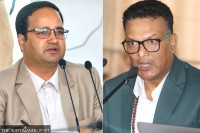
The move faced resistance within the Deuba camp. Nidhi objected to the new declaration, which was absent from his proposal, and exchanged words with Prakash Sharan Mahat on the stage, according to Congress leaders. The five-point declaration was nevertheless read out and endorsed by the gathering.
Political analysts say the move marks a departure from the party’s position since the 2015 Constitution, which defines Nepal as a secular state. They see it as an attempt to establish a distinct political identity after losing control to Thapa.
“The decision to adopt the Hindu line may have been driven by Deuba’s search for political and personal security,” said Krishna Khanal, a political analyst. “Otherwise, religion—whether Hinduism or secularism—does not appear to have been an issue that mattered much to him as a leader.”
Khanal said Deuba’s decision should not necessarily be read as the result of a long-developed political philosophy. “There may have been an influence of Hindu extremists in India,” he said. “The thinking could be that taking this line would make politics and security easier. I do not see it coming from a long-term ideological view of Nepal. Personally, I do not think Deuba makes much distinction between secularism and Hinduism.”
The issue has been present in Congress for years. At the party’s Mahasamiti meeting in February 2024, more than 1,000 members signed a petition calling for Nepal to be restored as a Hindu state. The campaign was led by lawmaker Shankar Bhandari, but Deuba, who was party president at the time, did not formally endorse the demand.
This time, the Deuba camp has gone further by formally adopting Sanatan religion as a national identity. The declaration says Nepal’s longstanding religious and cultural traditions are part of its national identity and commits the party to preserving Hindu, Buddhist, Kirat and nature-based religions while ensuring religious freedom, tolerance and social harmony.
Congress leader Prakash Sharan Mahat described the decision as an important departure in the party’s internal politics after the constitution was promulgated. He said support for a Hindu state had existed in Congress forums before, but the party leadership had not formally taken ownership of it.
“Until now, Congress had repeatedly said that secularism was a provision of the constitution,” said Mahat. “This time, we have said that Sanatan religion is a national identity and have adopted this as a policy through the gathering.”
He said the gathering also rejected the social democratic policy advanced by Thapa after the special general convention and returned to BP Koirala’s concept of democratic socialism. “There are two important departures,” said Mahat. “One is the return to democratic socialism, and the other, more important one, is the position on Hindu religion.”
The decision was not without opposition inside the Deuba camp. According to Congress leaders, Nidhi tried to stop the religious provision from being inserted into the declaration because it was absent from the political proposal presented to the gathering. Another senior leader, Krishna Prasad Sitaula, also expressed dissatisfaction.
Nidhi has consistently defended republicanism, federalism and secularism as achievements of the constitution. Sitaula was coordinator of the constitution drafting committee during the constitution-making process. One Congress leader said Bhandari, who has long advocated a Hindu state and constitutional monarchy, was prevented from speaking at the opening session to avoid creating a Hindu-state atmosphere.
The organisational dispute is even more consequential. The Deuba faction has rejected the special general convention held in January and the central committee elected under Thapa. It has declared that the 15th general convention should be organised by the central committee elected through the 14th general convention and held under Deuba’s leadership.
The position directly challenges the Election Commission’s recognition of the Thapa-led Congress in January. The commission had ruled that the special convention was valid because the party statute allows at least 40 percent of general convention representatives to demand such a gathering. It also held that general convention representatives are the party’s supreme authority.
The Supreme Court in April upheld the recognition of the Thapa-led faction, ending the immediate legitimacy dispute. But the Deuba faction filed a review petition in July, bringing the dispute back before the court.
This legal battle has become intertwined with the party’s preparations for its next regular general convention. Congress Vice-President Bishwa Prakash Sharma has argued that rejecting the leadership recognised by both the Election Commission and the Supreme Court risks further dividing the party.
“A decision made at a programme attended by Deuba himself amounts to contempt of court,” said Sharma. “The court’s decision to grant permission for review did not make Deuba the party president. Going beyond what the court has said and calling him president is contempt.”
The Deuba faction, however, argues that Congress should not proceed with organisational activities while the leadership dispute remains before the Supreme Court. NP Saud said holding a general convention while the review petition is pending could affect the final outcome of the case and amount to contempt of court.
“If the party continues towards the convention by ignoring the Supreme Court’s order on the review, that would amount to contempt,” said Saud. “No action should be taken that could adversely affect the pending case related to the Congress dispute.”
The Thapa camp has taken the opposite view, saying the party cannot indefinitely delay its regular convention because of the court case. Sharma said the existing schedule for the central convention should remain in place, although lower-level schedules could be adjusted by the central committee.
The dispute comes after a dramatic year for Congress. Thapa and Sharma called the special general convention after more than half of the elected representatives demanded it. The Deuba camp boycotted the gathering, but the convention elected Thapa president and a new central committee. The Election Commission then recognised the new leadership.
The party’s crisis has also been worsened by its poor performance in the March elections. Congress won only 38 seats, down sharply from the 89 seats it had secured in the 2022 election. Thapa later resigned as party president, taking responsibility for the electoral defeat, but the central committee rejected his resignation.
The latest Hindu identity decision therefore comes at a particularly unsettled moment. For Deuba’s supporters, it offers a way to preserve their political space and appeal to traditional voters. For critics, it risks weakening Congress’s commitment to the constitutional order and widening the ideological gap with Thapa’s reform-oriented camp.
“While the party’s decisions are under discussion, it is not appropriate to comment on such matters,” Sharma said. “But anything adopted by the gathering that strengthens the organisation and serves Congress, democracy and the country will not be viewed negatively. We will discuss how such matters can be incorporated.”




 20.58°C Kathmandu