Ruling RSP weighs impeachment as a tool for judiciary reform
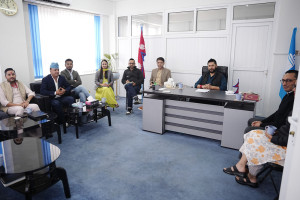
The party’s secretariat has directed its parliamentary party to initiate the process to impeach justices linked to the intermediary Inam Sapkota as party chair Rabi Lamichhane consults the law minister and lawmakers with legal backgrounds. Rabi Lamichhane chairs the meeting of the ruling Rastriya Swatantra Party’s secretariat in Kathmandu on Saturday. Nepal Photo Library
The ruling Rastriya Swatantra Party (RSP) is moving towards impeachment proceedings against Supreme Court judges embroiled in controversy over their links with the intermediary Inam Sapkota.
The party’s secretariat on Saturday directed its parliamentary party to pursue a parliamentary process to resolve the controversy surrounding the judges. An RSP office-bearer said the instruction to take the matter to Parliament was a reference to impeachment proceedings.
The decision follows revelations that Sapkota deposited money in the name of Chief Justice Manoj Kumar Sharma and exchanged WhatsApp messages with Supreme Court Justice Hari Prasad Phuyal about a case pending before the court. The RSP says the controversy should be addressed through constitutional procedures.
The RSP has 182 members in the House of Representatives, which has the authority to impeach Supreme Court judges. That is two short of the 184 votes needed for a two-thirds majority. The party’s strength in Parliament is among the factors shaping its consideration of impeachment.
After the secretariat meeting, RSP spokesperson and lawmaker Jagadish Kharel said Parliament was the constitutional way to restructure the judiciary.
“If we are to restructure the entire judicial sector, the constitutional route is through Parliament. The process must be taken through Parliament. The RSP secretariat has decided to direct the parliamentary party to move that process forward,” Kharel said.
He said the party had arrived at the conclusion because it believed that the judiciary needed restructuring and that any decision reached through the parliamentary process would be implemented.
The party has considered impeaching Justice Phuyal initially and then bringing other judges whose names emerge during investigations under the same process, according to an RSP office-bearer.
“There has been a deviation in the conduct of judges. One judge has already confirmed this deviation by acknowledging that he met an intermediary. That is why we decided to write to the parliamentary party to pursue impeachment,” the office-bearer said.
The parliamentary party will have to decide how to move against the judges, the office-bearer said. It will consider whether to begin with one judge or pursue action against all those implicated as evidence is examined.
“The parliamentary party has to play its role in the process. Directing it to take up the matter means that impeachment should be pursued,” the office-bearer said. “There are other judges as well. The parliamentary party will decide whether to start with one person or proceed against all those whose names have emerged. As we examine the evidence, we may find that others need to be impeached.”
Lamichhane consults lawmakers on options
RSP chair Rabi Lamichhane has also consulted party vice-chair and Minister for Law, Justice and Parliamentary Affairs Sobita Gautam; Mohanlal Acharya and Sulav Kharel, two lawmakers with legal backgrounds; and Samikshya Baskota, chair of the Law, Justice and Human Rights Committee of Parliament; and lawmaker Gajala Shamim Mikrani.
Three lawmakers who attended the meeting told Kantipur that the possibility of impeaching the judges and conducting an investigation into the allegations was discussed seriously.
Lamichhane had invited the minister, the committee chair and the lawmakers to his residence in Budhanilkantha on Friday. They reviewed the latest controversy surrounding the Supreme Court and discussed possible courses of action.
Lamichhane called the meeting to discuss the implications of the allegations against Supreme Court judges for the administration of justice and against the wider state apparatus.
Lawmaker Acharya said Lamichhane had sought suggestions on how the controversy surrounding the justices could be resolved.
“Lamichhane wanted to know what lay behind the allegations against Supreme Court judges, how the controversy could be resolved, and whether the party should intervene or leave the matter to the judiciary,” Acharya told Kantipur.
Three options were discussed, he said: the court addressing the matter internally, an investigation by the Judicial Council, and an impeachment motion in Parliament.
“The Judicial Council can investigate, but it cannot take disciplinary action,” Acharya said.
Another lawmaker who attended the meeting said the discussion focused largely on impeachment as a means of investigating the allegations.
“We discussed whether the matter should be investigated by the Judicial Council, examined by a committee or taken forward through impeachment,” the lawmaker said, requesting anonymity. Most lawmakers were of the view that the matter should go through the parliamentary Impeachment Recommendation Committee
A key question, the lawmaker added, was whether an impeachment motion should be registered by 25 percent of lawmakers, as provided for in the constitution, or whether some lawmakers should conduct an investigation before taking the process further.
Acharya said he and other lawmakers had offered Lamichhane suggestions on the options available under the constitution and existing practices.
“We discussed various options concerning the controversy in the judiciary and the conduct of the judges. The party chair will decide what to do and how to proceed after consulting others as well,” he said.
RSP spokesman Kharel said Lamichhane wanted to discuss ways to address the crisis in the judiciary.
“In the past, intermediaries used to meet judges. Now we have a situation in which judges are meeting intermediaries. We had a serious discussion on how it can be resolved,” Kharel said. “The chair said he would hold further consultations, including with legal professionals and other stakeholders.”
RSP lawmakers have been raising the issue of judicial reform for some time. Those with legal backgrounds have spoken in Parliament about their perceptions of disorder and corruption in the judiciary.
Questions were raised about the constitutional integrity of the judiciary, another RSP lawmaker said after the meeting.
RSP calls for investigation into police action against journalists
The RSP secretariat has also directed the government to investigate the arrest of journalists and police entry into newsrooms, and to take action against those responsible without delay.
The party said the government should establish why and how journalists were questioned or detained over their reporting and why police entered newsrooms.
“The party has directed the government to investigate why journalists were detained and police entered newsrooms, identify those responsible and hold them accountable,” Kharel said.
He said the party respected press freedom, freedom of expression, the rule of law and human rights.
“The Rastriya Swatantra Party will never compromise with anyone on press freedom, which is a fundamental right,” the party spokesperson said.
RSP chair Rabi Lamichhane said anyone who violates the constitution must be held accountable, regardless of their position.
“We have made it clear that no one is above the constitution or democracy. This is the RSP’s position, and it is my position too. There should be no room for doubt,” he said.
RSP joint-general secretary Asim Shah, who is also the prime minister’s chief political adviser, briefed the secretariat on the arrests of journalists. He said the government and the party shared the same position on press freedom and the protection of constitutional rights.




 16.66°C Kathmandu