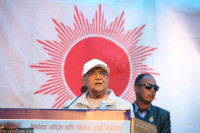
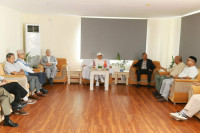
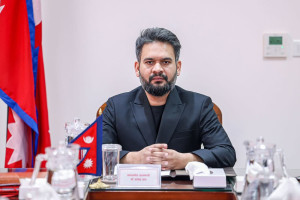
Addressing over 3,400 cadres in Kathmandu, party chief KP Oli warns of possible government reprisals and urges cadres to prepare for protests. UML chairperson KP Sharma Oli. Dipesh Darshandhari/TKP
Reeling from a drubbing in the March 5 House of Representatives elections, the CPN-UML is planning to launch an aggressive grassroots campaign, blending electoral mobilisation with street protests, ahead of the next year’s local elections.
During a national gathering that began in Kathmandu on Tuesday, party chair KP Sharma Oli instructed around 3,400 leaders and cadres to prepare for street protests against the Rastriya Swatantra Party (RSP)-led government while gearing up to reclaim lost political ground at the local level.
“Local and provincial elections are approaching consecutively, and we must win the immediate local polls,” Oli told the gathering. “This is no longer a time for a comfortable life; we must move forward with determination and commitment to achieve a grand victory as a message of internal party unity.”
The March parliamentary elections saw the RSP sweep to power on an anti-establishment wave, reducing established parties like the UML and the Nepali Congress to the opposition benches and sparking fierce internal debates over leadership succession within the UML. In September, however, the UML Central Committee decided to shelve internal restructuring disputes to focus entirely on the local polls, which the Election Commission is preparing to announce.
Addressing party activists, Oli claimed that there were coordinated political campaigns to corner the UML for his party’s March debacle. Warning that the current administration could target opposition figures at any moment, he urged party ranks to remain on high alert.
“Be prepared for protests now. The government can retaliate against anyone, or arrest and attack anyone,” said Oli. “This is not a government that follows rules, policies, the constitution, the law, or stays within boundaries. Therefore, we are watching everything closely.”
Accusing the government of sliding towards authoritarianism, Oli called on all “nationalist forces” to unite to defend the constitution promulgated by the Constituent Assembly. He also issued a sharp challenge to the head of the police force, without naming the inspector general, over reported remarks about arresting top politicians.
“I hear the IG saying, ‘I will lock up KP Oli, I will lock up Prachanda.’ Are KP Oli, Prachanda, and Sher Bahadur Deuba objects of mockery?” Oli asked, referring to Nepali Communist Party coordinator Pushpa Kamal Dahal and former Nepali Congress president Sher Bahadur Deuba. “We fought against an autocratic monarchy. How dare a policeman with a six-month tenure mock us?”
Oli also took a swipe at internal critics—including party General Secretary Shankar Pokharel, who had previously floated the idea of party restructuring—dismissing claims that the party was finished without him. “They talked about a UML without KP Oli, claiming it was over,” he said. “Nothing of that sort is going to happen. The UML will hold discussions and move forward united.”
The UML organised a national gathering while preparations are underway for an electoral alliance between the UML and the Nepali Communist Party for the local and provincial polls.
Candidate selection and digital push
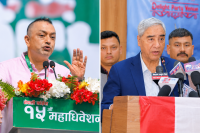
At the gathering, General Secretary Pokharel presented a comprehensive 15-point action plan focused on revitalising the party organisation. It was drafted on the basis of feedback from lower committees following the general election defeat, he said.
“The party rank and file must focus on local election preparations to present the party as a strong, organised, and people-oriented force,” Pokharel’s paper states. To execute this, the party has deployed central representatives to every local unit to reactivate dormant committees, update voter and member databases, and map local power dynamics, including households with members in foreign employment.
Under the new policy, the UML plans to finalise candidates well ahead of the election date, basing selections on integrity, public image, and grassroots popularity rather than factional loyalty or financial clout. “Suggestions from ward, municipal, and district committees must form the primary basis for candidate selection, supplemented by internal surveys to gauge public acceptability,” the action plan notes, vowing to curb last-minute ticket changes.
To counter rival narratives, the party will maximise its use of social media and establish a dedicated mechanism to promptly rebut misinformation and rumours with facts, says the paper. Ward and municipal committees have also been instructed to draft realistic, time-bound local manifestos backed by available resources, while Vice-chair Bishnu Paudel tabled an 18-page document highlighting infrastructure, economic, and social achievements of past UML-led governments.
Participants at the gathering will submit written feedback on the election strategy before the conclave concludes. In the 2022 local elections, the UML had won 207 mayoral and rural municipality chair seats nationwide.




 9.12°C Kathmandu