At Nepal tax awards, finance minister raises low investment paradox
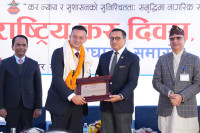
As the government honours top taxpayers for their fiscal contributions, businesses caution that structural bottlenecks, policy instability, and market risks continue to dampen long-term investment appetite. Finance Minister Wagle (right) honours Raj Bahadur Shah as the highest individual taxpayer. Nepal Photo Library
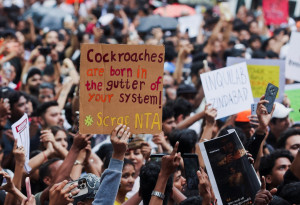
Superstore chain Bhat-Bhateni endured an unprecedented attack in September last year. Amid Gen Z protests and intense political uncertainty, several of the company’s outlets were targeted by arson and vandalism, leaving 12 stores completely gutted.
The unrest destroyed assets worth Rs11 billion and displaced over 5,000 jobs, paralysing normal business operations. Yet, beyond the massive physical losses, the most pressing question for the enterprise was how to move forward. Rather than retrenching, the Bhat-Bhateni Supermarket management chose not to lay off a single employee. Even while rebuilding the damaged superstores, the company continued to disburse regular salaries and allowances to its workforce.
Now, 10 of those 12 stores are fully operational, with work underway to reopen the Hetauda and Damak outlets by the new year. The company estimates that reconstruction alone will cost approximately Rs15 billion. It was this extraordinary display of corporate resilience that earned Bhat-Bhateni the ‘Exceptional Business Resilience’ honour from the government on National Tax Day 2026, nearly a year and a half later.
Panu Paudel, chief executive officer of Bhat-Bhateni Supermarket, said that while the firm does not yearn for accolades, such recognition from the state provides a vital morale boost.
“Our core objective is to generate extensive employment and become the country’s leading taxpayer. We have held the sector lead for many years, and our ultimate goal is to become the nation’s top taxpayer overall. We are working persistently towards that vision,” said Paudel. “The government has appropriately evaluated our efforts.”
According to Paudel, Bhat-Bhateni’s tax submissions totalled Rs1.04 billion in the fiscal year 2025-26. He noted that the entire Bhat-Bhateni family is encouraged by the recognition of their exemplary recovery and sustained high revenue contribution. The enterprise says that it currently employs around 10,000 people.
Honouring Bhat-Bhateni not merely for regular tax volume, but for weathering hostile conditions, raises a fundamental question: Is running a business in Nepal simply a matter of competing in the market and earning profits, or does it require a constant battle against political instability, policy unpredictability, and property security risks?
This query resonated strongly on Tuesday as the Inland Revenue Department honoured top taxpayers across various categories on the occasion of National Tax Day.
According to the department, Surya Nepal was honoured for paying the highest corporate income tax in the fiscal year 2025-26, while Raj Bahadur Shah received the individual income tax award. Surya Nepal Pvt Ltd, one of the multinational ventures and a prominent industrial enterprise in Nepal’s private sector, primarily manufactures cigarettes but has expanded into food, beverages, incense sticks, and other consumer goods.
In the individual income tax category, members of the Shah family have repeatedly triumphed, having previously been recognised in 2020, 2022, 2023 and 2025. Bijay Kumar Shah and his son are effectively following in the footsteps of Siddhartha Rana. Rana, chairman of Trading Pvt Ltd, has been honoured seven times by the government for paying the highest individual income tax. With Bijay Kumar Shah and Raj Bahadur Shah each receiving the honour three times, the family has claimed the title on six occasions.
Meanwhile, Third Eye International was recognised as the top taxpayer among proprietorship firms, while Dabur Nepal secured the award for commodity trade. Third Eye International is a proprietary firm engaged in the production and export of hand-knotted woollen carpets. Dabur Nepal, a subsidiary of Dabur India Limited, is a leading manufacturing and export-oriented multinational operating in Nepal.
Additional honourees included Infinite Software Solutions in the information technology sector, OCB Foods and Feeds in agriculture and livestock, and Nabil Bank in banking. Nobel Medical College Teaching Hospital was recognised among health and educational institutions, Soaltee Hotel Limited in tourism, CG Impex in goods trading and Food and Beverage Technology Research Centre Pvt Ltd in the turnover bracket of Rs500 million to Rs1 billion.
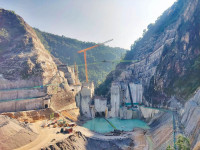
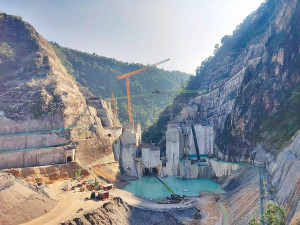
Furthermore, Bhote Koshi Power Company was honoured in the energy sector, IME Limited for remittances and money transfer, Imperial Securities Company for annual turnovers up to Rs500 million, and Varun Beverages for special industries. Bhote Koshi Power Company is a pioneer among private sector hydropower producers in Nepal and represents the country's first foreign direct investment (FDI) hydro project, operating the 45-megawatt Upper Bhote Koshi Hydropower Project in Sindhupalchok. IME Limited facilitates formal remittance channels and contributes to a group-wide employment network of 20,000 workers.
While these enterprises span diverse domains—manufacturing, financial services, exports, and remittances—they share a foundational commitment to the formal economy through consistent revenue contributions. However, tax compliance capacity and investment confidence are distinct metrics.
The private sector remains the backbone of Nepal’s economy, driving employment, production, trade, and taxation. Yet, overall investment momentum has lagged behind expectations.
Speaking at the tax day ceremony, Finance Minister Swarnim Wagle noted that while macroeconomic indicators remain favourable, investment has failed to pick up proportionately. He pointed out that interest rates are low and stable, liquidity in the banking system is ample, and foreign exchange reserves stand robust at around $30 billion, capable of sustaining 7 to 10 percent economic growth.
“Interest rates are low and stable, liquidity is sufficient, inflation is under control, and we possess foreign exchange reserves to support high economic growth,” said Minister Wagle. “Despite such an enabling environment, we must collectively deliberate on why investment volumes are not increasing.”
Conversely, industrialists frequently cite market uncertainty, administrative red tape, policy shifts, high operational costs, and inadequate infrastructure as major deterrents. At the same event, Anjan Shrestha, president of the Federation of Nepalese Chambers of Commerce and Industry (FNCCI), stressed that the current economic climate remains challenging and called for a downward revision of tax rates. Shrestha argued that Nepal’s tax rates remain high compared to other South Asian neighbours, placing an undue financial burden on businesses and urging tax relief to stimulate trade and industry.
For new investors, these hurdles represent not just operational costs, but risks that dictate whether capital is deployed or withheld. Viewed through this lens, the roster of honoured taxpayers underscores both the resilience and the vulnerability of Nepal’s private sector, prompting questions about the regulatory environment required for sustainable expansion.
Surya Nepal, operating since 1986, exemplifies the long-term industrial footprint in the country, contributing significantly to production, employment and tax revenue despite structural constraints. Similarly, Dabur Nepal illustrates both the potential and the operational complexities of export-oriented manufacturing.
In the banking sector, Nabil Bank—in which CG Corp Global (Chaudhary Group) holds a 51 percent stake—has received the tax honour for the ninth time, alongside sister concern CG Impex in goods trading. Nirvana Chaudhary, managing director of CG Corp Global, expressed immense pride in the recognition, noting that the conglomerate collectively contributes over 2.5 percent of Nepal's total tax revenue.
“This recognition belongs to our entire team, our valued customers, and our business partners,” said Chaudhary. “Our primary objective remains generating employment, expanding our commercial footprint, and contributing meaningfully to national development.”
Simultaneously, the recognition of IME Limited highlights the critical role of remittances in sustaining household incomes, foreign exchange reserves, and domestic consumption. However, economists note that heavy reliance on external labour underscores a persistent structural shortfall in domestic job creation.
In tourism, Soaltee Hotel Limited, operating since 1966, highlights the success of Nepal’s hospitality infrastructure. Vice President Sudarshan Chapagain noted that the group employs nearly 2,200 personnel across 11 properties under management and franchise agreements. To maximise tourism's economic multiplier, Chapagain emphasised the need to extend visitor stays by upgrading road and aviation infrastructure.
The recognition of Bhote Koshi Power Company draws attention to the energy sector's evolution from acute power shortages to exporting electricity to India and Bangladesh. While potential in hydropower is immense, developers continue to face formidable challenges regarding financing, transmission lines, and power purchase agreements.
Himalayan Distillery won the Value Added Tax compliance award for regular filings between 2020 and mid-July 2026, along with Chhimek Laghubitta in microfinance and Life Insurance Corporation (Nepal) in insurance.




 9.12°C Kathmandu