Indian national killed, New Zealander injured in mid-air chopper collision near Everest
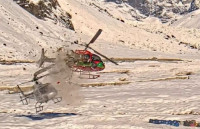
In what is believed to be Nepal’s first mid-air helicopter collision, two choppers struck each other while attempting to land at Pheriche, raising fresh concerns over flight safety and the growing number of helicopter operations in the Everest region. Screengrab
An Indian national was killed and a New Zealander of Indian origin injured when two helicopters collided while attempting to land in Nepal’s Everest region on Tuesday morning, the Civil Aviation Authority of Nepal said.
The deceased has been identified as Vasanth Kumar Balaramudu, who was aboard a Fishtail Air helicopter. Shailesh Krishna Patel, a New Zealander of Indian origin, and Rabindra Pradhan, the Fishtail Air helicopter’s pilot-in-command, were injured. They were airlifted to Nepal Mediciti Hospital in Kathmandu.
The collision occurred at around 8:12 am on Tuesday as both the helicopters were attempting to land at a helipad in Pheriche, a popular stop for trekkers and climbers at an altitude of approximately 4,371 metres in Solukhumbu district.
According to a statement issued by the Civil Aviation Authority of Nepal, one of the helicopters, an AS350 with registration number 9N-AOD, operated by Air Dynasty Heli Service Pvt Ltd, had flown from Lukla Airport to a helipad in Solukhumbu on a cargo flight.
The other helicopter, an AS350 with registration number 9N-AJR, operated by Fishtail Air Pvt Ltd, had taken off from Gorakshep in Solukhumbu carrying two foreign nationals.
A video circulating widely on social media shows the Air Dynasty helicopter making a rapid descent despite warnings from ground staff. As it approached the helipad, it collided with a Fishtail Air helicopter attempting to land from the opposite direction. The rotor blades of the Fishtail Air helicopter struck the passenger compartment windows of the Air Dynasty chopper when both helicopters were still 2–3 metres above the ground.
The exact cause of the collision is yet to be ascertained.
“Preliminary reports suggest miscommunication between the pilots, as the area is outside the coverage of Lukla Airport's air traffic control tower and pilots have to communicate with each other,” said Mukesh Dangol, director general of the Civil Aviation Authority of Nepal. “We are recording the statement of the injured pilot.”
Earlier in July 2023, a Manang Air helicopter crashed in the Lamajura area of Solukhumbu district, killing all six people on board — five Mexican tourists from the same family, comprising two men and three women, and Nepali pilot Captain Chet Bahadur Gurung.
The Manang Air AS350 B3e helicopter was returning to Kathmandu after a sightseeing flight in the Mount Everest region.
The latest collision comes amid longstanding tensions between helicopter operators and local communities over the growing number of flights in the Everest region, one of the world's most iconic mountain destinations.
On December 12, 2025, the local municipality and Sagarmatha National Park, home to Mount Everest, which stands at 8,848.86 metres, issued directives restricting helicopter flights over the park for sightseeing, while exempting rescue operations. The restrictions were scheduled to take effect on January 1, 2026.
Local youth clubs subsequently posted photographs on social media showing them planting flags and staking claims over helipads and other areas where helicopters frequently land. They also issued indirect threats to helicopter companies.
Local communities argue that the increasing number of helicopter flights in the national park has reached unsustainable levels, threatening the fragile ecosystem and tranquillity of the UNESCO World Heritage Site.
The noise from low-flying helicopters disturbs not only schools and offices in the region but also wildlife, which depends on the park's relatively undisturbed natural environment.
The tourism industry, meanwhile, has warned that a ban on Everest sightseeing flights could damage Nepal's high-end tourism market. An Everest sightseeing tour is a lifelong dream for many wealthy travellers who have the money but not the time to trek to the mountain.
The dispute remains unresolved.
Helicopter operators, however, already face restrictions on their flights in the region.
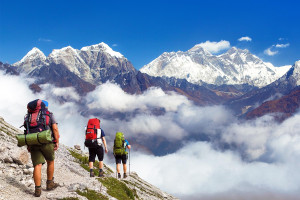
An $8,000 Everest helicopter sightseeing tour can accommodate up to four people as far as Lukla. However, only two passengers can fly from Lukla and land at Kala Patthar, at 5,644 metres, just below Everest Base Camp, which lies at 5,364 metres.
Helicopters are permitted to fly over the base camp but are not allowed to land there.They can, however, carry four passengers on the return journey.
Local communities have also complained that helicopter operators pick up trekkers on their return journeys, depriving local people of employment opportunities. A trek to Everest Base Camp typically takes around 14 days.
Helicopters in Nepal generally operate in challenging terrain, and flights conducted during adverse weather conditions are particularly risky.
At least 22 fatal helicopter crashes have occurred across the country since the aviation authority began maintaining records in 1966.
Sangam Prasain is Business Editor at The Kathmandu Post, covering tourism, agriculture, mountaineering, aviation, infrastructure and other economic affairs. He joined The Kathmandu Post in October 2009.




 22.81°C Kathmandu