India pledges Rs240 billion in fresh aid, but old loan remains a cautionary tale
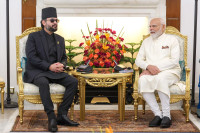
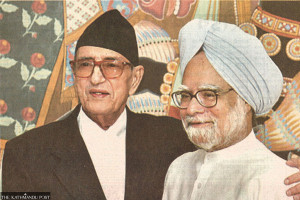
The package includes Rs56 billion in grants and Rs184 billion in concessional loans, but much of India’s previous earthquake reconstruction loan went unused due to restrictive conditions. Prime Minister Balendra Shah and Indian Prime Minister Narendra Modi hold talks in New Delhi, Monday. Nepal Photo Library
Students at Amrit Science Campus are still attending classes in ageing and dilapidated buildings damaged by the 2015 earthquake, nearly 12 years ago. The college has already spent Rs100 million preparing a master plan and a detailed project report for reconstruction. Yet construction has not begun.
Although the college was included in the list of institutions to be rebuilt with Indian assistance after the earthquake, it has been unable to construct the buildings using its own resources either. The reason is that an agreement with India’s Export-Import Bank (Exim Bank) for the reconstruction work remains in place.
The situation is similar across 39 units of Tribhuvan University. Because the concessional loan pledged by India could not be mobilised, colleges and health posts have waited for reconstruction for nearly a decade. Hom Bahadur Baniya, chief of Amrit Science Campus, said classes were still being held in old buildings considered unsafe.
Against this backdrop, India has announced financial assistance worth Rs240 billion to Nepal for reconstruction following the Bhotekoshi floods and for long-term development. Indian Prime Minister Narendra Modi announced the package in New Delhi on Monday during Prime Minister Balendra Shah’s visit to India. The assistance is expected to provide substantial resources for reconstruction and infrastructure development. However, the experience of an earlier commitment has raised questions about whether the newly announced funds will actually translate into projects on the ground.
According to a joint statement issued by Nepal and India following the visit, the new package comprises Rs56 billion in grants and Rs184 billion in concessional loans. The grants will be used for post-disaster reconstruction and new infrastructure projects, while the loans will be made available for projects in the energy sector. The two countries will decide which projects to select and how to mobilise the assistance through consultations, the statement said.
Modi said the assistance would help affected families return to normal life, create new opportunities and strengthen Nepal’s capacity to deal with future disasters. But Nepal’s experience shows that the challenge of foreign assistance lies not only in securing funds but also in preparing viable projects and implementation mechanisms capable of spending the money on time.
Following the 2015 earthquake, India had pledged $1 billion in reconstruction assistance to Nepal, comprising $250 million in grants and $750 million in concessional loans. According to Sushil Gyewali, former chief executive officer of the National Reconstruction Authority, the grant component was spent on reconstruction, but a substantial portion of the loan remained unused.
“An agreement had been signed to obtain the loan through India’s Exim Bank,” he said. “But it could not be implemented because the conditions of the agreement were not met.”
Nepal and India signed an agreement in September 2016 to mobilise the loan through Exim Bank. However, the arrangement required the use of Indian materials and the involvement of Indian contractors. According to officials involved at the time, at least 75 percent of materials, equipment and services, and 50 percent of materials used in civil construction, had to be sourced from India. These provisions made it difficult for Nepal to select and build projects according to its own needs and priorities.
The loan conditions also required approvals from various agencies in both countries, from project selection to procurement and implementation. Such procedures proved cumbersome for smaller projects spread across the country. Nepal had intended to use the loan for schools, health posts and other local infrastructure. But those projects did not fit the requirements concerning the use of Indian materials and contractors, officials involved in the process said.
“Their loan appeared to be focused on exporting their own materials. We wanted to use local materials as far as possible for reconstruction,” a former finance ministry official said. “They emphasised exports and stipulated that Indian construction materials be used and contractors also be brought from India.”
After the loan mobilisation process failed to move forward, the National Reconstruction Authority asked the finance ministry in 2018 to seek changes to the conditions. It proposed simplifying project selection and procurement procedures and exploring the option of using the loan for larger projects. But these proposals did not produce the expected breakthrough either.
Gyewali said Nepal needed to select projects that met the loan conditions and build the capacity of its workforce to implement them accordingly. A lack of direct coordination between Exim Bank representatives and the implementing agencies had also made progress difficult.
“We had suggested simplifying the investment process, stationing their representatives in Kathmandu, and establishing the fund-disbursement mechanism in Nepal itself,” Gyewali said. “We had proposed setting up an [Indian] Exim Bank contact office in Kathmandu.” He said implementation would have been more feasible had Nepal selected only projects that could meet the loan conditions.
Shankar Sharma, a former Nepali ambassador to India and an economist, also said concessional loans were better suited to large projects than to small ones.
“During the earthquake reconstruction, the loan could not be utilised partly because of the conditions attached to it. It is difficult to spend such funds on small projects,” he said. “This time, the government plans to use the money for large hydropower and transmission line projects. Mobilising funds for larger projects is easier.”
However, selecting large projects alone may not resolve the problem. Sharma said conditions concerning construction materials and manpower could again obstruct implementation.
“Local factors are also important in projects financed through these loans. Construction materials and workers are available locally. Requiring them to be brought from India may have created problems,” he said. “Even if the contractor is Indian, arrangements can be made for the work to be carried out through local contractors.”




 8.12°C Kathmandu