



 22.12°C Kathmandu

Sat, Nov 21, 2026
Money
Nepse loses ground as trading slows and investors favour select stocks
Banking and selected hydropower stocks show relative strength, but falling daily turnover and weak economic growth prospects limit the market’s recovery.
bookmark![]()
![]()
Pritam Bhattarai
Published at : November 21, 2026
Updated at : November 21, 2026 13:33
Kathmandu
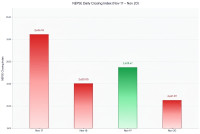
The Nepal Stock Exchange (Nepse) benchmark index fell 33.93 points, or 1.28 percent, over the four trading sessions from November 17 to 20, closing at 2,621.29. The relatively modest decline masks a sharper slowdown in trading activity, suggesting investors remain cautious despite pockets of strength in banking and hydropower stocks.
The comparison is with the last full five-session trading week, November 2–6, when the index closed at 2,655.22. The market had reopened for only one session on November 13 after the Tihar festival break, making that day unsuitable for a meaningful weekly comparison.
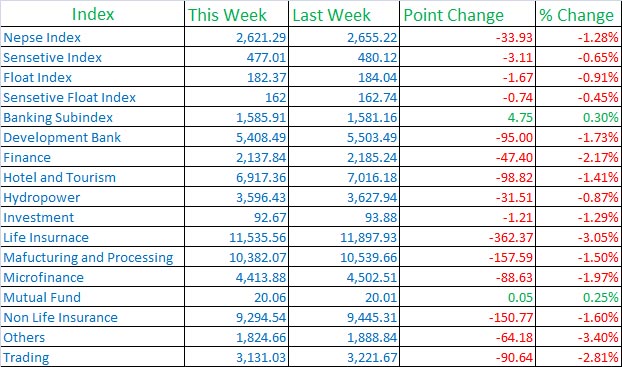
The Sensitive Index, which tracks Class A companies, fell 3.11 points, or 0.65 percent, to 477.01, while the Float Index declined 1.67 points, or 0.91 percent, to 182.37. Market capitalisation contracted by Rs60 billion, or 1.31 percent, from Rs4.57 trillion to Rs4.51 trillion.
Total turnover fell 43.02 percent to Rs16.09 billion across four sessions, from Rs28.24 billion over five sessions in the earlier week. Average daily turnover declined 28.78 percent, from Rs5.65 billion to Rs4.02 billion, indicating that the slowdown was not simply the result of fewer trading days.
Banking provides a cushion
Eleven of the 13 sectoral subindices ended the latest trading period in negative territory, underscoring the narrow base of market support.
Banking rose 0.30 percent to 1,585.91, while Mutual Funds gained 0.25 percent to 20.06. The Others subindex recorded the steepest decline, falling 3.40 percent to 1,824.66. Life Insurance lost 3.05 percent to 11,535.56, while Trading fell 2.81 percent to 3,131.03. Finance and Microfinance declined 2.17 percent and 1.97 percent respectively.
Market analysts said financial reports from life insurance companies had failed to meet expectations, prompting investors to reassess their positions. Banks have also begun selling life insurance shares, anticipating lower-than-expected dividends.
The sectoral performance suggests investors are favouring banking stocks over sectors more exposed to earnings disappointments and market sentiment. But the marginal gain in Banking is not enough to establish a broader rally.
Trading concentrates in select stocks
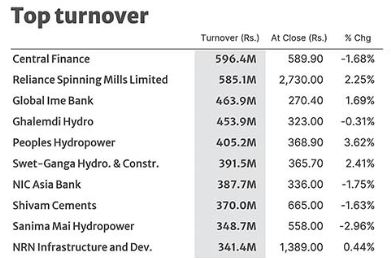
Despite lower overall turnover, selected stocks continued to attract substantial trading interest. Central Finance led turnover with Rs596.4 million, although its share price fell 1.68 percent to Rs589.90. Reliance Spinning Mills followed with Rs585.1 million, gaining 2.25 percent to Rs2,730. Global IME Bank recorded Rs463.9 million, rising 1.69 percent to Rs270.40.
Hydropower companies Ghalemdi Hydro and Peoples Hydropower completed the top five turnover rankings, with Rs453.9 million and Rs405.2 million respectively.
In share volume, Global IME Bank led with 1.737 million units traded, followed by Ghalemdi Hydro (1.383 million), NIC Asia Bank (1.135 million), Peoples Hydropower (1.110 million) and Swet-Ganga Hydropower (1.101 million).
Bottlers Nepal (Terai) was the week's top gainer, rising 7.84 percent to Rs12,833. Upper Lohore Khola Hydropower gained 6.54 percent and Dolti Power 6.17 percent. Everest Colour Limited fell 15.93 percent to Rs1,050, while Prabhu Mahalaxmi Life Insurance dropped 11.90 percent and Palpa Cement Industries 10.55 percent.
The divergence in individual stock performance highlights the importance of stock selection, with investors showing interest in selected companies rather than buying broadly across sectors.
Resilience, but liquidity remains a concern
Chartered accountant and market analyst Manish Aryal said he remained positive about the market, citing the government's favourable stance and policy environment.
He said Nepse’s sideways movement was encouraging because it had absorbed substantial share supply from bonus issues and rights offerings without suffering a deeper decline, despite the absence of large institutional investors.
Share-backed margin loans from banks and financial institutions have reached around Rs172 billion, according to Nepal Rastra Bank data, providing potential support for market liquidity, he said. Banking stocks and selected hydropower companies with strong fundamentals appear to be attracting investors.
Aryal expects banking stocks to perform positively in the coming week. Given the sector's relatively large weight in Nepse, gains in bank shares could help lift the overall index. He said banks could lead the next bull run, but sustained growth would require daily turnover of at least Rs6 billion, well above the current average of Rs4.02 billion.
Market analyst Ajay Singh Thapa said Nepse could swing towards 3,000 points, but sustained growth would be difficult without an improvement in the economy.
Nepal’s growth outlook remains weak, with the Asian Development Bank projecting 4.1 percent growth and the World Bank 3.7 percent for the current fiscal year, both reflecting the economic impact of the August 26 floods.
Thapa said investors remained hesitant despite excess liquidity in the banking system, as banks struggled to expand lending amid weak demand from businesses reluctant to borrow. Plans by the Securities Board of Nepal to introduce new instruments, including short selling, have also added to uncertainty among investors.
Nepse’s resilience and selective buying offer some support, but declining turnover, weak growth prospects and limited participation suggest the market remains in a consolidation phase. A sustained recovery will require stronger participation, improved corporate earnings and an economic recovery capable of translating banking liquidity into investment and business activity.



Most Read from Money
Nepal and India have revived stalled air route talks. Here’s what you need to know
How Nepal’s tile makers have gained ground against Chinese and Indian imports

Indian anti-dumping duties put Nepal’s jute industry under pressure
Kathmandu airport unable to collect Rs1.5 billion from 42 entities
How India’s delay is set to leave Rs135m of Nepal’s electricity unsold daily
Editor's Picks

Old differences continue to weigh on Nepal-India ties

For NPL cheerleaders, cold nights, catcalls and modest pay

At Seto Gumba, there’s more to being a nun than prayer and meditation
Nepal and India have revived stalled air route talks. Here’s what you need to know
Kathmandu is going digital. Its birds and animals are paying the price
E-PAPER | November 21, 2026

×