Resettling disaster survivors takes more than finding them new homes
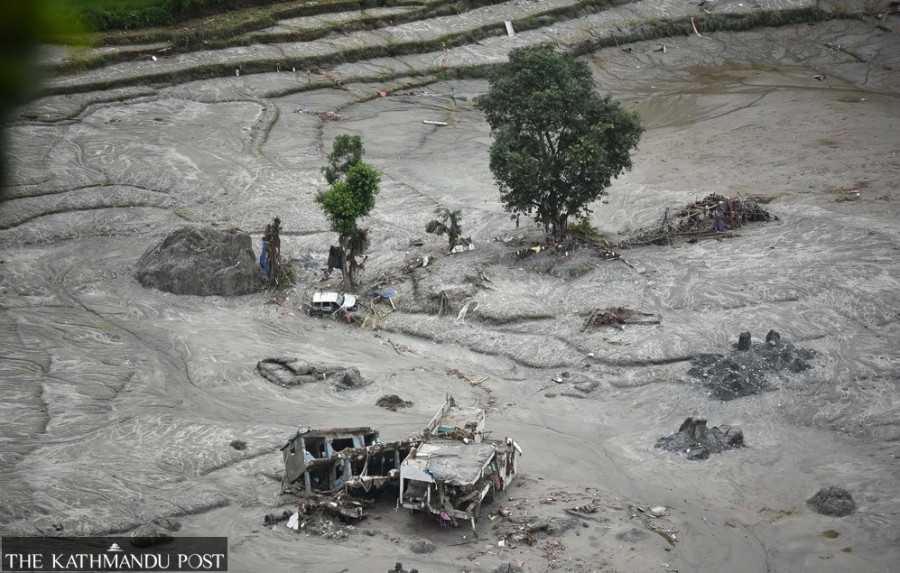
Past relocation schemes have left families in unsafe settlements or driven them home. A 55-year-old settlement in Kanchanpur offers lessons as the government plans to relocate Bhotekoshi flood survivors. Flood-damaged houses lie in ruins as survivors face uncertainty over resettlement, with the government yet to finalise plans for relocating communities displaced by the disaster. Post File Photo
Chegu Tamang of Khalte in Rasuwa’s Uttargaya Rural Municipality lost 14 relatives in the August 26 floods. The 2015 earthquake had already forced him from his home. Now, the floods have left him with nowhere to return. He initially sheltered at a holding centre at Shivalaya Basic School in Uttargaya but is now staying at Himalaya Academy in Bidur, Nuwakot.
Khalte had 257 households, and preliminary estimates put the death toll at around 400. The village had already been badly damaged by the 2015 earthquake, which displaced residents and left the settlement vulnerable. Geologists had warned that it was unsafe for habitation.
“We were displaced by the earthquake and moved to Bogatitar. Some families put up temporary shelters in Satbise and Naubise,” Tamang said. “We spent three years in Bogatitar, but the authorities never moved us somewhere safe. Eventually, we built our own shelters near the river in Khalte because we had nowhere else to go. The government failed to find us safer ground in time, and now the whole village has paid the price.”
Khalte is far from the only example. Time and again, disaster survivors have been left without safe places to settle, forcing many to return to areas still exposed to risk. The failures of past resettlement efforts have done little to change how the government or affected communities prepare for the next disaster.
The government says it has begun work on relocating settlements rendered uninhabitable by the Bhotekoshi flood. One option is to move families to other districts, while another is to identify vacant land within their own districts. But the troubled history of resettlement after the 1993 floods and the 2015 earthquake suggests that rebuilding lives will be far more difficult than finding land and constructing houses.
The floods and landslides of July 1993 killed 1,336 people across Makawanpur, Chitwan, Sarlahi, Rautahat, Sindhuli, Kavre and Dhading, while causing widespread physical damage. More than 408,000 people were affected. The Bagmati river corridor was among the worst-hit areas, according to the Nepal Disaster Report 2011.
With support from Taiwan, some families displaced by the floods were resettled in newly built homes in Hariwan, Sarlahi. But many eventually returned to their original homes once the floodwaters receded, said Bhojraj Pokharel, the then home secretary. “A model settlement was built along the Bagmati for flood-displaced landless people and squatters, but the project failed to take off,” Pokharel said. “People returned to their villages because that was where their farms and social networks were.”
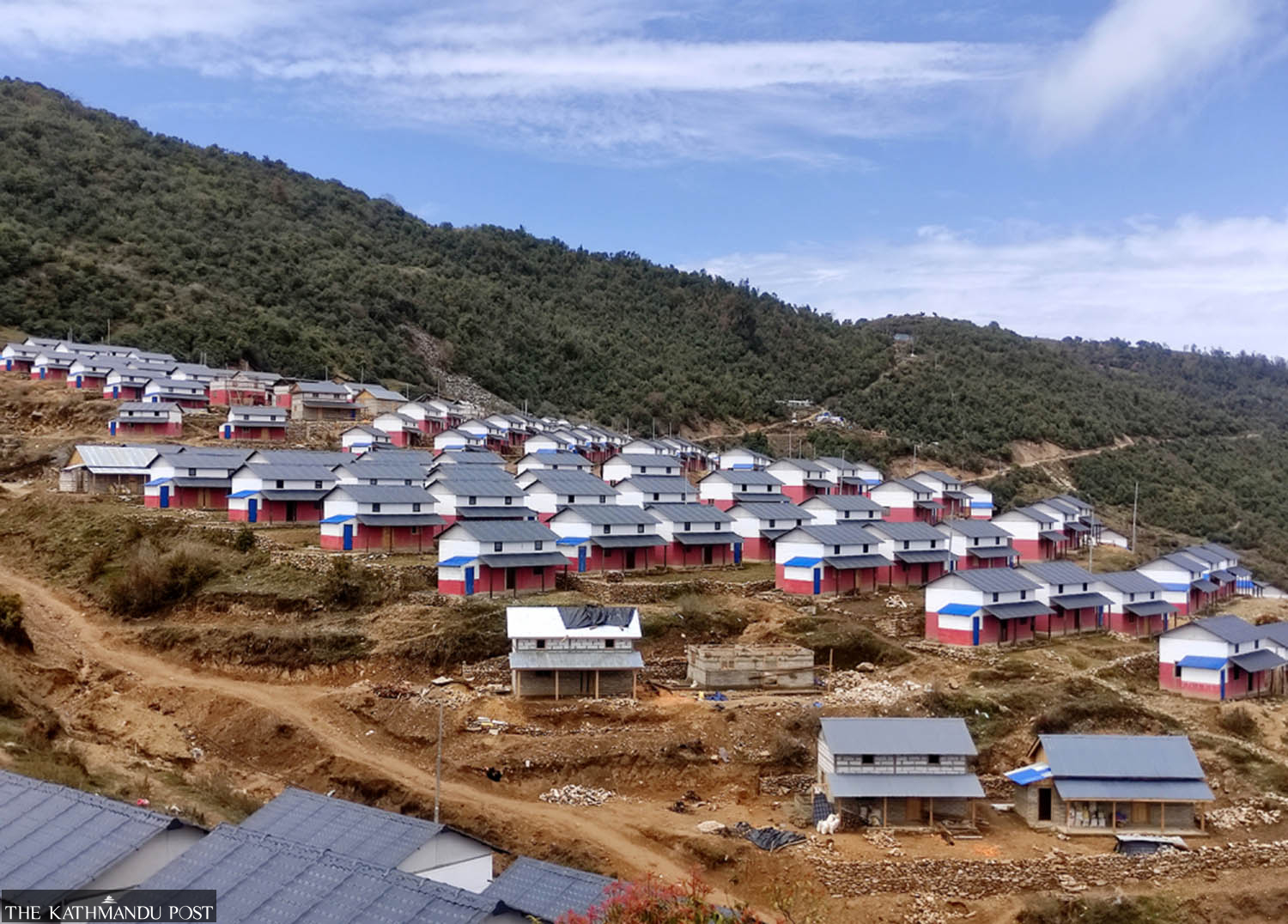
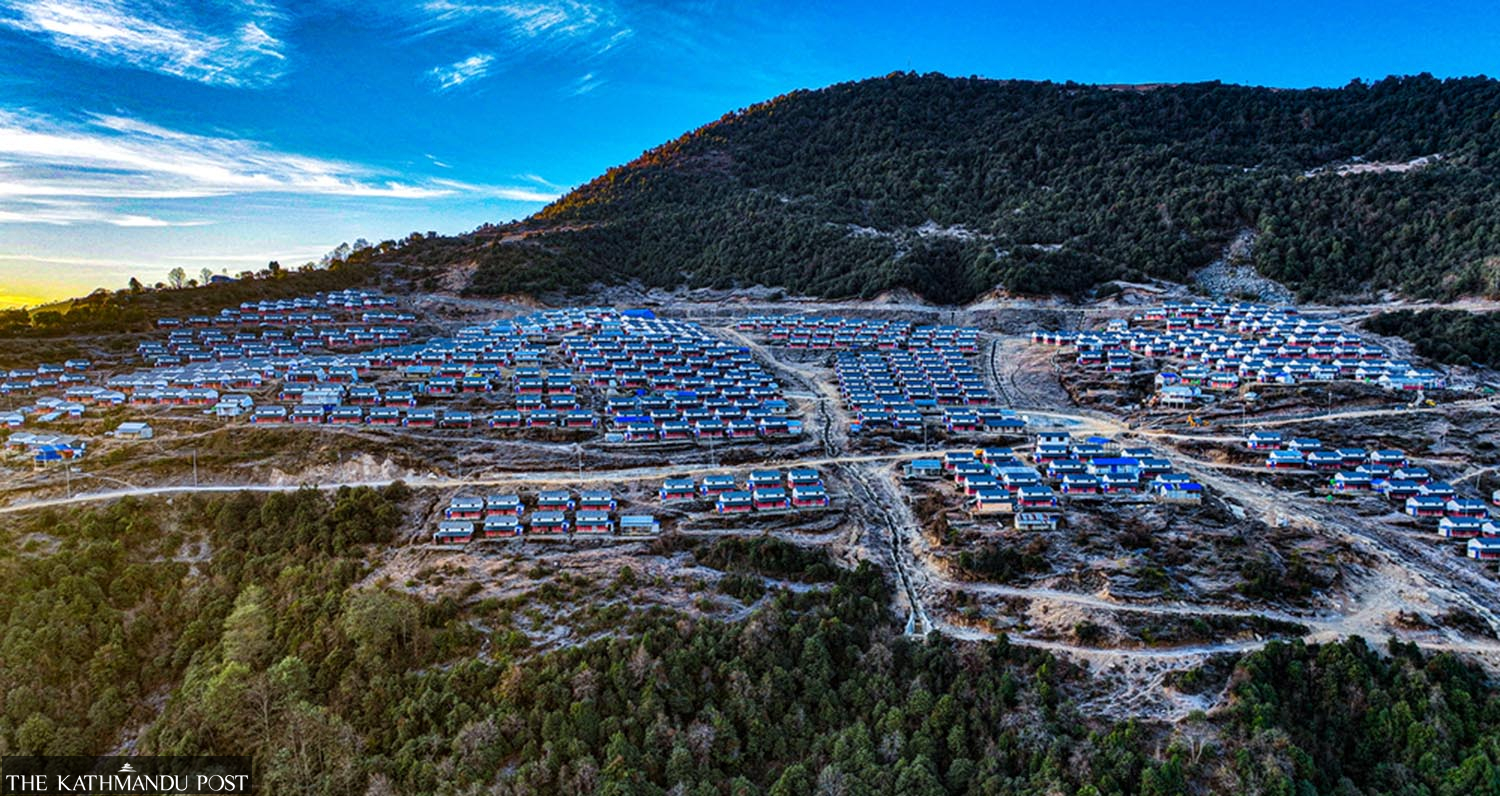
The 2015 earthquake offers another example of the challenges of resettlement, even when people are provided with new houses and land. After the earthquake, the entire village of Laprak in Gorkha was moved to Gupsi Pakha. The Non-Resident Nepali Association built 602 houses, intending to create a model settlement. But many of the houses now lie empty, while residents continue to live in their earthquake-damaged homes in Laprak. According to the Ministry of Urban Development, another 46 settlements were relocated after the earthquake. Even there, many people were reluctant to move.
Experts involved in post-disaster reconstruction say resettlement plans must take into account people's livelihoods, social and economic ties, and exposure to future risks. Pokharel, who was involved in the response to the 1993 floods, says Bhotekoshi survivors should have a say in where they are relocated. “Moving displaced families far away from their original settlements can cut them off from schools, healthcare, markets, jobs and farmland. Those needs must be considered,” he said. “Providing financial assistance and moving people to a place that happens to be convenient for the government does not absolve it of its responsibility.”
Purna Bahadur Ghale of Khalte, who lost seven relatives in the flood, is also hoping the government will do more than make promises. He is currently staying at the holding centre at Shivalaya Basic School. “I barely survived the 2015 earthquake,” he said. “I went to Singha Durbar again and again, pleading with the government to move us somewhere safer. Officials kept promising to do so, but nothing ever happened. Now I have lost my family.” He wants the government to provide survivors with safe housing and a way to earn a living. “Survivors must be relocated to a safe place where they can also sustain their livelihoods,” he said.
The August 26 flood swept away nearly 15 large and small settlements across Rasuwa, Nuwakot and Dhading. A preliminary report by the National Disaster Risk Reduction and Management Authority says 1.6 million people were directly affected.
The government has begun identifying settlements that are no longer safe for habitation, said Dharam Raj Uprety, chief executive of the authority. “People cannot return to settlements swept away by the floods,” he said. “The government has formed teams and started work to relocate them to safer places. We will announce a resettlement plan soon.”
But Madhav Prasad Aryal, chair of Uttargaya Rural Municipality, fears that the process could drag on just as it did after the earthquake. In his assessment, the failure to resettle earthquake-displaced families contributed to the even greater loss of life in the latest disaster
Gunakar Bhatta, vice-chair of the National Planning Commission, said the government had begun planning for recovery following a post-disaster needs assessment. “Alongside rebuilding damaged infrastructure, we will prepare a comprehensive master plan for settlement development and broader reconstruction,” he said. Gopal Sigdel, secretary at the Ministry of Physical Infrastructure Development, which has been tasked with infrastructure work, said the government would draw up a long-term plan for resettlement once road connections to affected areas were restored.
The model settlement at Gupsi Pakha in Gorkha, built to house earthquake-displaced families. Many residents have since returned to their old homes. Post File Photo
“We plan to relocate families to areas that are safe from future floods. Whether they receive grants to build their own homes or are provided with houses will be decided in the detailed reconstruction plan,” he said. “Rebuilding in the damaged areas is not an option. The government should acquire land in safer locations and build new settlements there.”
Former prime minister and urban planner Baburam Bhattarai has urged the government to learn from past failures and design lasting resettlement plans that respect people's livelihoods and community ties. A settlement, he says, is more than a collection of houses; it is shaped by people's way of life and generations of history. “Moving an entire settlement hundreds of kilometres away, or relocating people from the mountains to the plains, is not the answer,” he said. “The Bhotekoshi flood should force us to rethink outdated building standards and recognise that floods can reach much higher ground than we once thought.”
Sushil Gyewali, former chief executive officer of the National Reconstruction Authority, also cautioned against moving communities too far away or keeping them close to their original homes at the cost of their safety. After the 2015 earthquake, the authority studied around 300 earthquake-affected settlements and identified 64 as being at risk. It developed 46 of them into integrated settlements and undertook protection measures in another 19. Gyewali says the government should draw on both the strengths and shortcomings of that experience. “After the earthquake, we learnt from efforts to relocate around 50 settlements that people cannot simply be moved elsewhere and expected to rebuild their lives,” he said. “Their livelihoods, economic and social ties, cultural connections and access to their land all matter. Rebuilding homes must go hand in hand with restoring people's livelihoods and social lives.”
He said the authority had also struggled to find enough suitable land when relocating some settlements in Rasuwa after the earthquake. The same constraint could complicate the current resettlement effort. “We carefully assessed land availability in Rasuwa but found very few suitable sites,” he said. “Given the shortage of land across the district, the first step should be to identify safe sites near the destroyed settlements.”
Rather than moving people far away, the government should look for safe sites nearby that allow them to continue their livelihoods and production, he said. But proximity must never take precedence over safety. “Protecting people's lives comes first. They must not be forced to remain in places that are still exposed to flood risks,” he added.
Amid the record of failed resettlement schemes and questions over how the government should proceed, however, one project from 55 years ago offers a different example. Some stakeholders say the resettlement of families from Dhading to Kanchanpur could provide useful lessons for the current effort.
Jullaar Tamang, 73, has lived in Buddha Basti in Kanchanpur’s Punarbas Municipality for decades. When he left Jharllang in northern Dhading for Kanchanpur in 1971, the heat and malaria were major concerns. The area was covered in dense sal forest, trees and undergrowth. Even drinking water was hard to find. “Many families who came from Jharllang eventually returned because of those difficulties. Only a few of us stayed,” he said. What was once forest is now home to around 65,000 people. Its first residents were families displaced by landslides in Jharllang, Dhading, more than five decades ago.
According to the National Housing Company Ltd, King Mahendra launched the resettlement programme in 1963. Its aim was not only to provide new homes for people displaced by landslides, floods and other disasters, as well as landless families. It was also intended to establish organised settlements in the country’s eastern and western border regions, strengthening the state's presence in those areas. Buddhi Bahadur Budhathoki, who served as planning chief for the Nepal Resettlement Company for 13 years from 1971, said the company was established in Dumkauli, Nawalparasi, in February 1963, before the Land Reform Act was introduced.
The government transferred a 31-year-old agricultural officer, Dhan Bahadur Gurung, known as DB Gurung, from the agriculture office and sent him to Kanchanpur with a clear assignment: clear the forest and establish settlements.
Initially, land was distributed to people from Bajhang and Doti in Sudurpaschim Province, as well as families displaced by landslides in Jharllang, Dhading. Priority was given first to people displaced by floods and landslides, followed by landless families and then Nepalis living abroad who wished to return.
The model settlement at Laprak in Gorkha, built for earthquake-displaced families. Post File Photo
As the programme expanded, the settlements began to attract not only landslide survivors from Dhading but also landless people, squatters, former soldiers and families from different parts of the country.
The plan was to settle more than 4,000 landless families across around 28,000 bighas ( 189.6 square kilometres) of land. That meant clearing forests, preparing farmland, opening roads, building villages and finding ways to bring together people from different geographic and social backgrounds.
The Nepal Resettlement Company initially began work in the Parasan area. Its office was set up as land distribution got underway. But simply taking people to an empty forest and showing them a plot was not enough to create a functioning settlement. The villages were classified as A, B, C and D, with each designed to accommodate around 100 to 150 families and include a market. The plan for organised settlement development was drawn up with Israeli technical assistance. Former soldiers were also settled in the border areas. Gurung said families were required to build a shelter within a month of receiving land and clear the forest to prepare farmland within nine months. In his memoir, he recalled regularly visiting settlements to check whether families were actually living there and cultivating the land they had been given.
In the early years, the World Food Programme supplied flour, ghee, egg powder, powdered milk and sugar. Families also received rations, including porridge mix and powdered milk. But free land and food supplies attracted not only genuinely landless families but also people seeking to take advantage of the programme. Gurung wrote that identifying those attempting to claim land fraudulently was among the most difficult aspects of the project.
He recounted the case of a family from India's Assam region that claimed to be a mother and son to obtain two plots. An investigation found that their claim was false, and the land was reclaimed.
Tara Lama Tamang, a resident and former economic affairs minister of Sudurpaschim Province, said people from almost every district except Manang and Mustang now live in the area. According to Mayor Toya Prasad Sharma, the settlement has grown into a multicultural community, bringing together people from Mechi in the east to Mahakali in the west.
People from the mountains and the plains now live side by side. Their different languages, ethnic backgrounds and traditions have become part of the settlement’s identity.
Over time, the institution responsible for the programme also changed, evolving from the Nepal Resettlement Company into the Rural Housing and Settlement Development organisation and later the National Housing Company.
The sal forest has become a town. Areas once associated with malaria, snakes and bandits now have markets, schools and roads. A place where the state once had little presence has become home to thousands of families. More importantly, it did not remain merely a refuge for people displaced from elsewhere. It developed into a permanent and diverse community.
As the government prepares to resettle families left homeless by the Bhotekoshi flood in Rasuwa, Nuwakot and Dhading, the central question is once again not simply where to put people, but how to help them build sustainable lives there.
The Kanchanpur experience from 55 years ago offers part of the answer. A roof over one's head is essential, as is land to farm. But neither is enough to make resettlement work. People also need roads, drinking water, schools, healthcare and jobs. Above all, they need a reason to put down roots in their new home.
Suraj Kunwar is a senior correspondent with over two decades experience covering Aviation, Tourism and Mountaineering. He received the IFJ Tolerance Award in 2005.




 14.12°C Kathmandu