Buddha Air revives plan to launch international jet flights from Pokhara
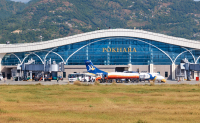
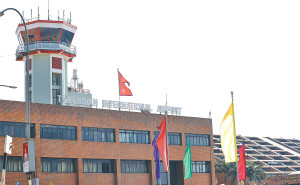
New air routes and satellite-based navigation could improve connectivity, but the bigger challenge will be attracting enough passengers to make the underused airport commercially viable. Representatives from Airbus and Boeing are expected to visit Nepal to assess the feasibility of operating their aircraft from PokharaInternational Airport (pictured), Buddha Air chief Birendra Bahadur Basnet said on Tuesday. Shutterstock
Buddha Air has revived its plan to launch international flights with jet aircraft from Pokhara, betting that improved air connectivity, new navigation technology and the region’s tourism potential could finally give the underused international airport a commercial purpose.
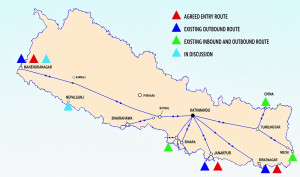
The renewed interest comes as Nepal and India have agreed to develop an additional air entry route through Bhairahawa, while the Civil Aviation Authority of Nepal is preparing to install a satellite-based navigation system at Pokhara airport to improve flight reliability in challenging weather conditions.
Together, these developments could address two longstanding constraints on Nepal’s international aviation ambitions: restricted air access and operational limitations. But they do not resolve the more fundamental question of whether there will be enough passengers to sustain regular international services from Pokhara.
Buddha Air is now conducting a technical assessment of aircraft for international operations from the tourist city. The company is also examining whether Pokhara could serve as a regional aviation hub.
“We are conducting the technical evaluation of the aircraft for international operation from Pokhara. After the evaluation, we will study the potential markets,” Birendra Bahadur Basnet, chairman of Buddha Air, said at an interaction organised by the Institute for Integrated Development Studies (IIDS) in Kathmandu on Tuesday.
The proposed jet operation, however, will not be undertaken directly by Buddha Air. Instead, the company is considering setting up a separate entity, potentially under a public-private partnership or through an initial public offering. The ownership and financing structure have yet to be finalised.
Basnet said representatives from Airbus and Boeing are expected to visit Nepal to assess the feasibility of operating their aircraft from Pokhara.
“We need at least 1.5 million passengers annually to make the operation financially feasible from Pokhara,” he said, adding that the plan would initially involve three jets.
The proposed investment signals renewed private-sector interest in an airport that has struggled to attract international airlines since opening nearly four years ago. But it also exposes the gap between Nepal’s ambitions to expand aviation connectivity and its ability to generate sufficient passenger demand.
Pokhara International Airport was originally expected to be completed by July 10, 2021. Its opening was delayed until January 1, 2023. Even after construction was completed, international commercial operations remained constrained by the lack of suitable air routes and navigation facilities.
In 2017, Buddha Air had announced plans to operate international flights from Pokhara using Airbus A320 aircraft once the new airport was completed. That ambition failed to materialise as the airport project faced delays and the necessary aviation infrastructure remained incomplete.
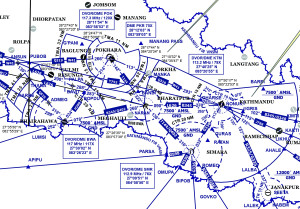
The proposed installation of Required Navigation Performance with Authorization Required (RNP-AR), an advanced satellite-based navigation procedure, could remove one of the remaining operational constraints.
The system enables aircraft to follow highly precise flight paths, including curved approaches, into airports surrounded by difficult terrain, obstacles or congested airspace. This is particularly relevant to Pokhara, where surrounding hills and weather conditions can complicate aircraft approaches.
Once installed, the procedure is expected to allow flight operations at visibility levels of around 1,500 metres, compared with the current requirement of 2,800 metres.
Bikram Gautam, spokesperson for the Civil Aviation Authority of Nepal, said installation of the RNP-AR system would be completed within a month. He said it would significantly reduce flight delays and cancellations, particularly those caused by weather.
The improvement could make Pokhara more attractive to airlines by increasing operational reliability. However, better navigation alone cannot guarantee commercial viability. Airlines will still need sufficient passenger traffic, competitive operating costs, and access to viable international markets.
Industry stakeholders estimate that Pokhara International Airport needs at least 30 landings and take-offs daily, or approximately two flights an hour, to become financially viable.
The airport currently has very limited international connectivity, with Fly Dubai operating the only regular international service. The $216 million facility has yet to develop into a regional aviation hub envisioned when the project was conceived.
The problem is not confined to Pokhara. Nepal's other international airport, Gautam Buddha International Airport in Bhairahawa, has also failed to attract sustained commercial operations.
Built at a cost of more than Rs35 billion and inaugurated on May 16, 2022, the airport currently has no regular international flights, despite receiving a handful of chartered operations in its initial period.
The two airports represent a significant investment in expanding Nepal's aviation infrastructure. Yet their inability to attract airlines has raised questions about whether infrastructure development has been adequately matched by air-service agreements, route planning, tourism promotion, and passenger-demand projections.
Speaking at the interaction entitled 'Operating from Pokhara International Airport', tourism specialist Gyaneshwar Mahato said Nepal had the potential to attract five million tourists annually if it improved international air connectivity.
Such an increase, he argued, could generate annual revenue of $8 billion.
“We have Pokhara and Lumbini international airports. They are like white elephants right now,” Mahato said, questioning why the government had failed to operationalise the two facilities.
His argument was that Nepal's aviation infrastructure should be viewed not simply as airport construction but as part of a wider economic strategy linking tourism, employment, agriculture, and regional development.
If tourist arrivals reached five million annually, Nepal would need an additional 150,000 room nights, according to Mahato. The expansion could generate direct and indirect employment in a one-to-one ratio and create annual demand for around 64,000 tonnes of quality food.
“Generating tourists will create demand for high-value jobs and agricultural products,” he said.
The economic implications are particularly significant for Bhairahawa, where investors had poured billions of rupees into hotels and resorts in anticipation of international air traffic.
Santosh Neupane, chief executive officer of Siddhartha Hospitality, which operates a portfolio of luxury hotels and resorts across the country, said the absence of regular international flights had left hospitality investors struggling to recover their investments in Bhairahawa.
“Investors have spent billions in the hospitality industry, hoping that the new international airport will bring tourists and make the hospitality sector vibrant,” he said.
The outcome has been disappointing. Hotel occupancy in Bhairahawa remains below 30 percent outside the wedding season, Neupane said.
The airport development announcement had transformed the once sleepy town into an investment destination, prompting a rush to build hotels and resorts. But several projects remain unfinished, with construction abruptly halted as expectations of rising tourist arrivals failed to materialise.
Neupane said Nepal needed to diversify its tourism marketing instead of concentrating almost exclusively on Everest Base Camp and Annapurna Base Camp.
“There are many more tourism potentials, which need to be explored and diversified,” he said.
His company has also held discussions with several international airline operators, but commercial operations from Bhairahawa remain difficult to secure.
This illustrates a wider problem confronting Nepal's tourism and aviation sectors: infrastructure and accommodation capacity have expanded ahead of demand, while the country has struggled to convert its tourism potential into sustained international passenger traffic.
Tourism entrepreneurs also warned that Nepal's international connectivity was increasingly serving migrant workers and students rather than a growing leisure-tourism market. With large numbers of Nepalis leaving the country for employment and education, they said the economy risked losing both its workforce and domestic consumer base.
They cautioned that continued outmigration could eventually weaken demand for hotels, restaurants, and domestic airlines, further undermining investments made in the tourism industry.
The concerns come at a time when Nepal has substantial financial resources within its banking system but limited private-sector investment demand.
Foreign exchange reserves have reached record levels, while annual remittance earnings have climbed to $16.19 billion. As of November 2026, banks and financial institutions were sitting on excess loanable funds estimated at between Rs783 billion and Rs1.56 trillion, reflecting strong deposit inflows and subdued private-sector credit demand.
Basnet argued that tourism was among the few sectors capable of generating large numbers of jobs relatively quickly.
“India and other countries are generating employment opportunities, but Nepal is not. At least 350,000 jobs should be generated per year. Lack of jobs means a push for foreign employment. Nepal’s is a lost generation, a frustrated generation. We should admit this fact,” he said.
He argued that tourism expansion could help mobilise idle domestic capital while creating employment opportunities across multiple sectors, including aviation, hospitality, agriculture, and transport.
The challenge, however, is translating such potential into commercially sustainable operations. Nepal's experience with two international airports shows that building infrastructure and announcing ambitious tourism targets are not enough to attract airlines.
Airlines require predictable operating conditions, viable passenger volumes, competitive routes, and reliable aviation facilities. Tourism businesses, meanwhile, need regular connectivity to justify investment in hotels and other services. Without coordination between these elements, the airports risk remaining underused.
Mukesh Dahal, deputy director of the Air Traffic Management Department at the Civil Aviation Authority of Nepal, said the immediate priority should be to make the two airports operational rather than continue debating the decisions behind their construction.
“The two international airports have been built. We should not waste time on who built them. We should stop the blame game over why international flights are not being conducted,” he said.
“Let's focus on how we can make them operational. We have to create demand, as other airports normally do. We should stop the blame game.”
Sangam Prasain is Business Editor at The Kathmandu Post, covering tourism, agriculture, mountaineering, aviation, infrastructure and other economic affairs. He joined The Kathmandu Post in October 2009.




 7.12°C Kathmandu