



 8.12°C Kathmandu
Tue, Nov 24, 2026
National
Longstanding disputes set aside, progress on development projects and economic aid
Nepal and India agreed on development projects and Rs240 billion in Indian assistance, while longstanding disputes remained unresolved.
bookmark![]()
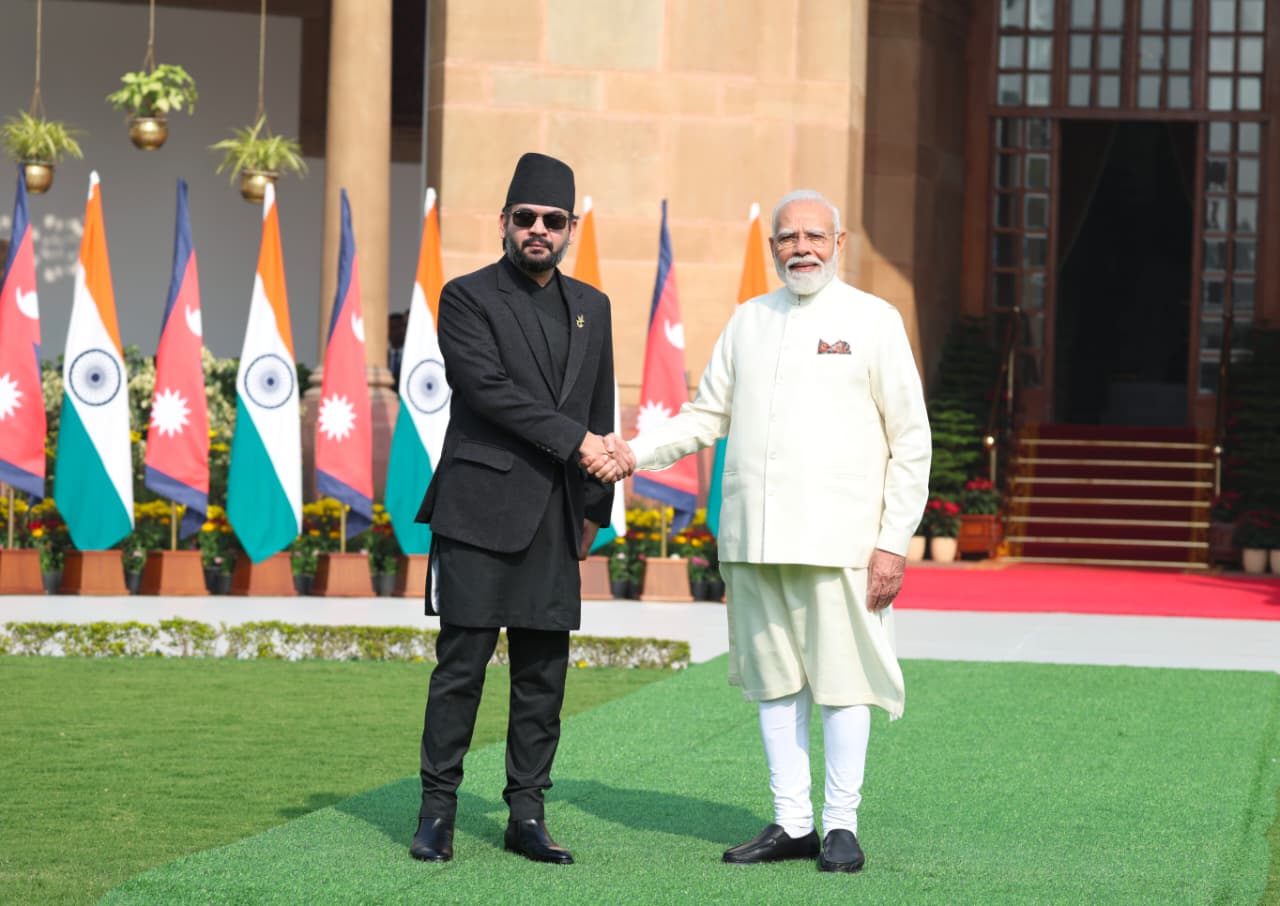
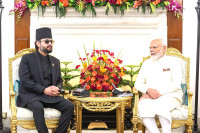
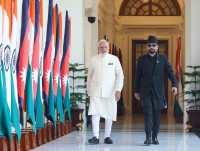
Prime Minister Balendra Shah is welcomed by Indian Prime Minister Narendra Modi at Hyderabad House in New Delhi, Monday. Photo: Courtesy of PM Shah’s secretariat
Anil Giri & Rajesh Mishra
Published at : November 24, 2026
Updated at : November 24, 2026 07:18
New Delhi/kathmandu
Prime Minister Balendra Shah’s first state visit to India has produced a substantial package of development assistance and progress on connectivity, energy, and infrastructure projects. But the two-day visit, which concluded Monday, left many of Nepal’s most sensitive bilateral concerns largely untouched, including the boundary dispute, revision of the 1950 Treaty of Peace and Friendship, the Eminent Persons Group (EPG) report, and the stalled Pancheshwar Multipurpose Project.
Indian Prime Minister Narendra Modi announced development assistance worth Rs240 billion for post-disaster reconstruction and long-term development in Nepal. The package comprises Rs56 billion in grants for reconstruction and new infrastructure and Rs184 billion in concessional loans for energy projects. Specific projects and the modalities for disbursing the assistance will be finalised through consultations between the two governments.
The outcome has revived questions about the priorities of Prime Minister Shah, who had previously spoken strongly about Nepal’s territorial claims. On August 30, 2025, when he was Kathmandu mayor, Shah urged then prime minister KP Sharma Oli, who was preparing to visit China, to remind Beijing that Lipulekh belonged to Nepal.
“The India-China agreement to resume trade through Nepal’s Lipulekh pass is an infringement on our sovereignty,” Shah said. “Please don’t forget to remind China that the territory belongs to us. All the best. We have full confidence in you.”
Yet after meeting Modi in New Delhi, Shah returned without publicly raising the boundary question or securing a new political commitment to resolve it. The disputes concern areas including Susta, Kalapani, Lipulekh and Limpiyadhura. A Nepali diplomat said both sides had agreed in advance not to raise the border issue during the visit.
“That does not mean we have abandoned it forever,” the diplomat said.
The joint press statement, the leaders’ public remarks, and the 10-point vision document contain no new political agreement on settling the boundary dispute. Instead, the joint statement repeats a familiar commitment to have the foreign secretaries work on outstanding boundary matters.
Former Nepali ambassador to India Nilamber Acharya said the visit had not delivered the political breakthrough expected from a meeting between the two prime ministers. “There are boundary disputes between Nepal and India, and issues concerning the review of treaties and agreements remain pending,” he said. “Talks on these matters didn’t take place.”
Matters that have remained stuck at the technical level need political direction, Acharya added, but the meeting had not untied those knots. He said India had continued to avoid discussion of the border, the 1950 treaty, the EPG report, and the revival of the South Asian Association for Regional Cooperation (SAARC) process.
Nepal now has a stable government with a nearly two-thirds majority and a five-year mandate, making the absence of progress more disappointing, he said. “Only by resolving these issues can we strengthen mutual friendship,” he said.
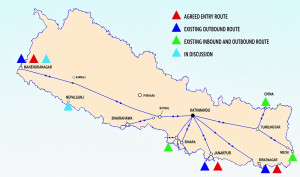
There were, however, tangible progress in aviation, energy, infrastructure, petroleum supply, and transport. The two sides agreed to make the Kathmandu-Bhairahawa-Lucknow air route, currently operating in one direction, bi-directional. The agreement is included in paragraph eight of the joint statement, although technical studies and procedures must be completed before it can be implemented.
Speaking to Kantipur, Tourism Minister Khadak Raj Paudel described the agreement as historic and significant.
The leaders also stressed improving cross-border connectivity through railways, bridges, integrated check posts, and petroleum pipelines. They jointly inaugurated two projects, handed over one completed project, and broke ground for three others.
They flagged off the ‘Sarayu-Kamala Express’, a new train service connecting Ayodhya in India with Janakpur in Nepal, and jointly inaugurated a motorable bridge linking Darchula in Nepal with Dharchula in India.
Ground was broken for the 669-megawatt Lower Arun hydropower project, Siliguri-Jhapa petroleum pipeline, and an integrated check post at Banbasa. India also handed over the second phase of the completed Motihari-Amlekhgunj petroleum pipeline to Nepal.
These projects are intended to improve the movement of people and goods and strengthen cross-border infrastructure. The financial assistance announcement is also significant for a country facing the enormous cost of rebuilding after the devastating Bhotekoshi-Trishuli floods. However, the announcement does not mean immediate disbursement. The two governments must still agree on project selection and the modalities for using grants and concessional loans.
Why were border and treaty issues not prioritised?
Point number 15 of the joint statement says the foreign secretaries have been instructed to take necessary steps to settle outstanding boundary matters.
Both the countries expressed satisfaction with progress on joint field work to repair and restore boundary pillars.
Similar language appeared after Modi’s first visit to Nepal on August 3-4, 2014, when he met then prime minister Sushil Koirala. The two leaders then acknowledged that nearly 98 percent of boundary work had been completed and instructed their foreign secretaries to address the remaining issues, including Kalapani and Susta.
Acharya said the wording in the latest statement was routine and suggested that the prime ministers had not given the dispute fresh political attention. The contrast is notable because Shah, as Kathmandu mayor, had displayed a ‘Greater Nepal’ map behind his chair and criticised what he saw as Indian encroachment.
During his tenure as prime minister, he had also reiterated Nepal’s position that Limpiyadhura, Lipulekh, and Kalapani, all of which lie to the east of the Mahakali river, are Nepali territory. However, he left the issue unaddressed during his two-day visit to India.
Indian control continues over the Nepali territories of Kalapani, Lipulekh, and Limpiyadhura. The Sugauli Treaty, supplementary treaties, historical maps, and other documents establish that these areas belong to Nepal. The Nepal government has consistently maintained that Kalapani, Lipulekh and Limpiyadhura are Nepali territory.
After India announced plans to facilitate the Kailash Manasarovar pilgrimage through Lipulekh, Nepal’s Foreign Ministry protested on May 3 and sent diplomatic notes to both India and China. The Shah government maintained that the area was an integral part of Nepal.
Addressing the House of Representatives on May 31, Shah said his government favoured resolving the dispute through talks and diplomatic channels. Acharya said the India visit offered no visible initiative to translate that position into progress.
Nepal has repeatedly objected to Indian road construction, pilgrimage activities, and border trade in the disputed territory. India, however, has continued to advance infrastructure and other activities there despite Kathmandu’s protests.
Former Nepali ambassador to India Deep Kumar Upadhyaya said the instruction to foreign secretaries was not new. Although the two sides have repeatedly agreed that the officials should settle outstanding boundary questions, a meeting with a clear mandate to resolve them has not taken place. “A meeting of the foreign secretaries was important, but that does not appear to have happened,” he said.
Nepal has repeatedly requested such a meeting, Upadhyaya added, but India has put it off. He said the joint statement contained no fresh approach to the disputed issues.
The one-on-one between Shah and Modi might still build trust, Upadhyaya said, but its value would have to be judged by what follows. “There are examples of things promised within six months remaining unresolved for 30 years,” he said.
Upadhyaya questioned whether the language in the statement reflected a genuine intention to settle problems or was included merely to meet diplomatic expectations and ease pressure in Nepal. He said the leaders might have discussed important matters privately, but subsequent action would determine whether the meeting had produced meaningful results.
The 1950 treaty did feature in the 10-point vision document. It says existing bilateral agreements, including the Treaty of Peace and Friendship, may be reviewed on the basis of mutual consent.
Nepal has long sought a revision of the treaty, signed on July 31, 1950, between the newly independent Indian government and the Rana regime, which was nearing its end. Critics in Nepal have long considered the treaty unequal and outdated.
In January 2016, the two governments formed the EPG, comprising four members from each country, to review bilateral arrangements and recommend changes suited to the 21st century realities.
The group completed its report in July 2018 and proposed replacing the 1950 treaty with a new framework, alongside recommendations on other areas of disagreement. Nepal is ready to receive the report, but India has not accepted it, leaving it in limbo for eight years.
The report was intended to provide recommendations on the overall relationship, including border management, trade, transit, security, and water resources. Its recommendations were expected to help both governments address longstanding differences and update bilateral arrangements.
Madhendra P Lama, an Indian member of the EPG, viewed Shah’s visit positively. He said Modi had spoken openly at the joint press conference and that the important task now was to implement the understandings reached by the two governments.
“The main question is how the understandings reached between the two sides will be implemented. This is a good beginning,” said Lama.
SAARC, Pancheshwar, and trade deficit also left off priority list
Another issue Nepal could have raised was of the SAARC, which has not held a summit since its 18th meeting in Kathmandu in 2014.
The 19th summit of the eight-member regional organisation was postponed amid tensions between India and Pakistan, and no subsequent summit has been held. Six summits should ordinarily have taken place in the intervening 12 years. As chair, Nepal has been unable to convene a meeting or hand over the rotating leadership. The issue did not feature prominently during Shah’s visit.
The Pancheshwar Multipurpose Project, another long-delayed undertaking, also saw no ‘breakthrough’. The joint statement again called on the Pancheshwar Development Authority and the Joint Water Resources Committee to finalise the detailed project report (DPR) quickly and begin implementation. The two countries have repeated similar commitments for years, but differences over water sharing, costs and the distribution of benefits have prevented agreement on the report.
The project, conceived under the 1996 Mahakali Treaty, is designed to generate electricity while also providing irrigation and flood-control benefits to both countries. Its proposed capacity is 6,480 megawatts.
Nepal and India have struggled to agree on how to calculate the benefits each country would receive, particularly from irrigation and flood control. The disagreement is important because the Mahakali Treaty provides that project costs should be shared in proportion to the benefits accruing to each side.
Acharya said political-level understanding was needed to move the project forward, but no significant progress had been made during the visit.
There was also no clear progress on reducing Nepal’s trade deficit with India or ensuring easier access for Nepali goods to the Indian market. Business and diplomatic observers have long identified market access and trade imbalance as major concerns in the relationship.
Foreign policy analyst Chandra Dev Bhatta argued that the visit should be judged partly by whether it created conditions for future discussion.
“There was an atmosphere of distrust between the two countries and their leaders. There was no environment for discussing political issues,” he said.
Nepal, in his view, had moved strategically to rebuild that environment.
“I think Nepal has moved forward strategically. An environment has been created, and discussions can take place in the coming days. Everything cannot be achieved in a single visit,” said Bhatta.
He considered the meeting a positive step towards rebuilding political trust, reviewing bilateral concerns, and exploring new areas of economic cooperation. The visit should be seen as a move away from political rhetoric towards developing relations on practical grounds, he added.
The length of the leaders’ private meeting also attracted attention. Their one-on-one talks at Hyderabad House, initially scheduled for 30 minutes, lasted about an hour and a half.
Ministers, officials, and journalists waiting for the joint press conference were surprised by the delay. A Nepali official said there had been no disagreement and that the extended discussion reflected an exchange on issues of mutual interest.
“We were also surprised that the two prime ministers took so long to arrive at the venue. But after learning that there was no misunderstanding between them, we were relieved,” the official said.
A member of the Nepali delegation said Shah had shown particular interest in tourism, sports, and infrastructure.
“Our prime minister was particularly interested in tourism, sports, infrastructure and other areas of cooperation. They exchanged views on various issues of mutual interest,” the official said.
Modi praised Shah’s leadership, saying he had seen signs of his vision when the Nepali prime minister addressed the United Nations General Assembly in September.
“A few months ago, when he addressed the United Nations as the world’s youngest prime minister, we saw a clear glimpse of his visionary leadership. In our discussions over the past few hours, I have also sensed his clear vision and firm commitment to Nepal’s future and Nepal-India relations,” said Modi. He added that the historic mandate given to Shah by Nepali voters reflected the hopes and aspirations of the younger generation.
Shah described the relationship as firm as the Himalayas and wide as the ocean. “Mutual respect, unwavering trust and continued goodwill are the pillars of Nepal-India relations. The people of both countries are at the centre of our unique relationship. Nepal-India relations are as firm as the Himalayas and as vast as the ocean. Their depth is difficult to express in words alone,” he said.
Shah said the talks had reviewed the two countries’ centuries-old relationship with the aim of making it stronger and more relevant to modern needs. Both sides, he added, had held open, meaningful and forward-looking discussions on different aspects of their partnership, reached important understandings and inaugurated or launched major infrastructure projects.
Anil Giri
Anil Giri is a Chief Sub Editor covering diplomacy, international relations and national politics for The Kathmandu Post. Giri has been working as a journalist for more than two decades, contributing to numerous national and international media outlets.

Most Read from National
Traffic resumes on Prithvi Highway after overnight landslide
Delhi positive on $2 billion Nepal aid proposal, new air route yet to be agreed
For Mamta Kafle’s family, a guilty verdict is not enough
India likely to announce $1.5 billion package for Nepal, air-route deal under discussion
Nepal celebrates Bhai Tika, the final day of Tihar
Editor's Picks
NPL’s third season was a spectacle. It was also a reality check.

Why a viral TikTok about ‘baddies’ has struck such a nerve in Nepal
Old differences continue to weigh on Nepal-India ties
What happens to passengers’ belongings after a road accident?
Nepal and India have revived stalled air route talks. Here’s what you need to know
E-PAPER | November 24, 2026

×