Karnali to host National Games, but not all sports will be played there
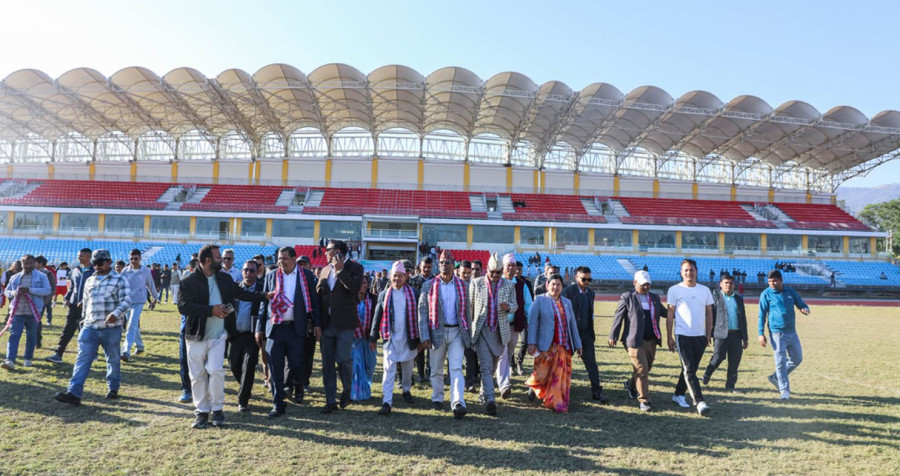
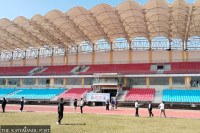
About 6,500 athletes will compete in 384 events, though the province lacks facilities for several sports. Government officials and stakeholders were taken on a tour of the Karnali Province Stadium on Monday. The newly constructed stadium still lacks facilities for several sports. Post Photo
For the first time since the country adopted federalism, Karnali Province will host the National Games, a 20-day tournament starting Tuesday.
Around 6,500 athletes from 11 teams (the seven provinces, three departmental sides and the Non-Resident Nepali Association) will compete in 384 events across 32 sports. The 10th edition will be formally inaugurated on December 2 at the Karnali Province Stadium in Birendranagar and will run until December 13. Some events will begin before the opening ceremony.
Hosting the Games is a matter of pride for the remote province. But its infrastructure, management capacity and athletes’ preparedness remain real challenges. Even with a new stadium, the province lacks the facilities for several sports, and swimming, shooting, tennis and kho-kho will be held in neighbouring Lumbini Province.
Stadium handed over
The construction company, MAC GSL JV, handed the stadium over to the provincial government on Monday in the presence of Chief Minister Mangal Bahadur Shahi, former chief minister Jeevan Bahadur Shahi and other provincial ministers and officials.
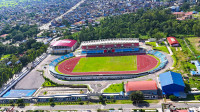
Built at Rs1.59 billion, the stadium sits on about 15 acres of land. It has a 10,000-seat stand, an international-standard football field, an eight-lane synthetic athletics track, a swimming pool and a multipurpose covered hall that can seat 1,500.
Jeevan Bahadur Shahi, who laid the foundation stone in 2021, said the structure had been completed after years of hard work and would be tied to Karnali’s future. Chief Minister Shahi acknowledged that running and maintaining a facility of this scale would be difficult. He said the provincial government and the Provincial Sports Development Council would draw up standards and procedures to manage it.
Where the sports will be held
According to the schedule released by the National Sports Council, 23 of the 32 sports will be held in Surkhet, including athletics, football, cricket, hockey, volleyball and boxing. Karnali Province Sports Development Council member-secretary Rabin Chand said about 70 percent of the sports had been concentrated in Surkhet, with only those lacking suitable facilities moved elsewhere.
The rest are spread across five districts—ITF taekwondo in Dailekh, chess in Kalikot, judo and wrestling in Salyan, bodybuilding in West Rukum, swimming and shooting in Banke, and tennis and kho-kho in Bardiya.
The semifinals and finals of men’s and women’s football will be played in the remote district of Jumla.
Early starts
Ten sports will begin Tuesday, ahead of the opening ceremony: men’s and women’s cricket, men’s football, men’s and women’s handball, tennis and swimming. The remaining 22 will begin after the inauguration.
National Sports Council member-secretary Ramcharitra Mehta said the early start was meant to ease the movement and accommodation of athletes. About 3,500 athletes are expected to arrive before the opening.
A total of 1,337 medals are at stake: 384 gold, 384 silver and 569 bronze. In individual events, gold medallists will receive Rs20,000, silver medallists Rs15,000 and bronze medallists Rs8,000. In team events, the prize money is Rs15,000, Rs10,000 and Rs8,000, respectively.
Accommodation and security
Accommodation is among the biggest challenges for the event. The province’s Social Development Minister Jit Bahadur Malla said around 150 hotels across the province had set aside 5,500 beds for athletes. Athletes from departmental teams will stay in barracks and offices of their respective security agencies. Minister Malla said all hotels had been mapped and security arranged, along with food and transport to the venues.
Around 2,000 security personnel will be deployed, said Karnali Province Police chief DIG Jayaraj Sapkota. CCTV cameras will monitor 15 venues, and separate teams will be assigned to protect dignitaries, escort convoys, guard hotels and secure athletes’ accommodation. An integrated security plan has been prepared for the duration of the Games.
Health desks with specialist doctors have been set up at the stadium and other venues, Mehta said. Ambulances and health workers will be on standby. He added that sports equipment and kits had already reached Karnali. Fourteen subcommittees have been formed to oversee preparations.
Torch and culture
The Games torch will be lit from the natural flame at Shristhan in Panchakoshi, Dailekh, according to Jeevan Bahadur Shahi, who said the National Sports Council had informed him of the plan. Youth and Sports Minister and council chair Sasmit Pokharel has also pushed the idea. Olympians will carry the torch through the districts of Karnali, a route meant to publicise the Games and showcase the region’s religious, historical and cultural identity.
The opening ceremony will feature tableaux, dances, songs and traditional costumes from all 10 districts, including a performance by the Raute community, Chand said.
“We want to change the perception that Karnali cannot host big events or provide basic facilities such as food, lodging and water.”




 13.12°C Kathmandu