RSP chief questions government conduct as tensions mount
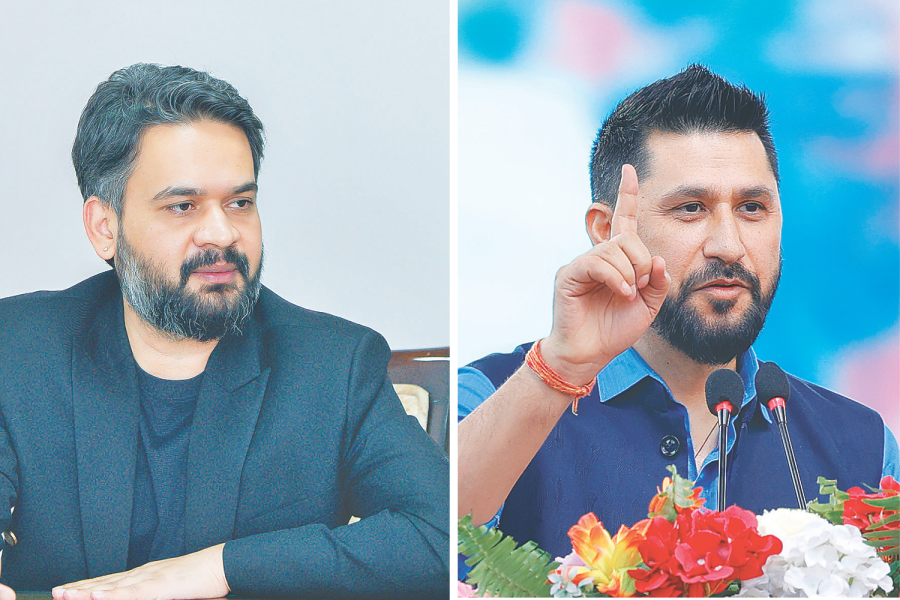
Rabi Lamichhane says the party will continue to scrutinise government decisions, while a senior party leader points to poor coordination between the two sides.(From left) Prime Minister Balendra Shah and RSP Chairman Rabi Lamichhane. RSS & Post File Photo
Rastriya Swatantra Party (RSP) chairman Rabi Lamichhane has stepped up criticism of the government’s conduct, questioning whether due process was followed in sensitive decisions, including the detention of journalists and the removal of Nepal Police chief Dan Bahadur Karki.
His remarks come amid reports of police entering newsrooms to detain journalists and the government’s decision to transfer Karki to a newly created post of prime minister’s special security adviser and appoint Manoj Kumar KC as inspector general.
Speaking at a gathering in his home district of Chitwan on Friday, Lamichhane said the government must avoid giving the impression that it lacks the maturity to exercise power.
“The RSP believes in the rule of law. We must be careful not to send the message that we have become immature or that we are incapable of running the government,” he said. “Our conduct, actions and activities must contribute to establishing the rule of law. Democracy is not just about outcomes; it is also about the process. We must pay attention to that process because other political parties, civil society and the international community are watching us.”
Lamichhane said he and the party would continue to raise concerns about the government’s conduct, adding that such scrutiny should not be portrayed as a dispute within the leadership.
“When the party occasionally nudges the government, there is no need to portray it as a disaster, as though we have started attacking one person or another,” he said. “The RSP will keep speaking. Rabi Lamichhane will keep speaking. We will continue to speak, not out of fear, but by raising our voices.”
Former prime minister Baburam Bhattarai said recent statements by Lamichhane and government actions pointed to growing differences between the party and the government.
“Publicly airing disagreements between the government and the party within a newly established ruling party is not a good sign for the country or democracy,” Bhattarai said.
He urged the RSP, a party dominated by younger leaders that emerged from the Gen Z uprising, to learn from the mistakes of previous political movements rather than repeat them.
In a social media post, Bhattarai said internal conflicts within political parties after the 1951 political change had harmed the country, democracy, and the public. He warned that if the RSP repeated those mistakes, Nepal could once again face similar consequences.
The government abruptly removed Karki and appointed KC as police chief at a cabinet meeting on Wednesday, fuelling questions about the relationship between the ruling party and the administration.
A day earlier, at a briefing on Tuesday’s cabinet decisions, government spokesperson Sasmit Pokharel said police had entered newsrooms to investigate how misleading information about the prime minister seeking the police chief’s resignation or preparing disciplinary action had circulated. He also said the cabinet had neither discussed Karki nor sought his resignation.
However, accounts from government and party spokespersons subsequently diverged over the police leadership change.
“The party had also instructed the government to do something about the sensitive matter. That is why the responsibility was changed,” Pokharel told journalists on Wednesday.
RSP spokesperson Jagadish Kharel, however, said the party had not instructed the government to remove Karki or appoint KC.
“We have not instructed the government on whom to remove or retain. We learnt about the government’s decision through the media,” Kharel told Kantipur.
Lamichhane says party and government need not agree on everything
Lamichhane said on Thursday, also in Chitwan, that the party and government would not automatically endorse each other’s decisions.
He said the government was responsible for explaining the police leadership change because it concerned a sensitive security institution.
“The change in responsibility involving the security forces is extremely sensitive. The government will certainly explain its justification at an appropriate time,” he said.
The RSP chairman also criticised the detention of journalists, and warned against underminingconstitutional and democratic institutions.
Speaking on Friday, he said Nepal’s freedoms and institutions had been secured through struggle and sacrifice, not simply through political slogans.
“Our freedoms, a free press, human rights, and independent institutions were secured through years of struggle and sacrifice. No one has the right to undermine what people fought and died for,” he said.
Lamichhane said democracy was his highest priority and that everyone should defend it. He added that criticism of the government should not be interpreted as a sign of division within the party.
Senior RSP leader points to lack of coordination
A senior RSP leader close to Prime Minister Balendra Shah said the public exchanges reflected poor coordination between the party and the government.
The leader, who requested anonymity, said the party secretariat had instructed the government to act over the detention of journalists and the government had complied. Subsequent public statements by RSP leaders, however, had left party leaders wondering whether the criticism was directed at them.
“The party secretariat gave a direction regarding the detention of journalists, and the government followed it. The statements that came afterwards made us wonder whether they were aimed at us,” the leader said.
The leader said the party’s vice-chairmen, senior ministers, general secretary, and other top leaders had failed to play a coordinating role, allowing the disagreement to surface publicly.
“There appears to be a lack of coordination and discussion between the party and government leadership,” the leader said.
The leader added that the two sides needed to align their understanding of government decisions and party instructions. The party, the leader said, was not always informed of the government’s reasoning, while the government was not consulted about decisions made by the party secretariat.
“That is where the mismatch has emerged. Some are expressing their views publicly, while others are posting their positions on social media,” the leader said.
The leader said second-tier leaders in the party and the government should take the initiative to resolve the differences before they deepen.
Analyst calls for coordination behind closed doors
Political analyst Ram Gurung said the party leadership and government needed to maintain a balance in their public statements and actions.
He argued that the party chairman should avoid publicly commenting on government decisions and instead address concerns within the party.
“The party chairman should not publicly express views about the government. He should not publicly comment on the government’s decisions. The party chairman is the government’s guardian and should resolve issues internally,” Gurung said.
He added that Lamichhane could guide the prime minister, whom the parliamentary party meeting had proposed, while the government should coordinate with the party.
“The chairman himself proposed the prime minister in the parliamentary party. He can give directions to the prime minister. The government should also act in a balanced manner and coordinate with the party,” he said.
Gurung said recent statements and actions suggested a lack of coordination between the party and government, although he did not believe the situation had reached a point where differences needed to be aired publicly.
“From the outside, it appears that there is a lack of coordination. But I don’t think the situation has reached a point where they need to go out and speak publicly about it,” he said.
Lamichhane warns against misuse of state machinery
Lamichhane said the party must not misuse its public mandate or turn the administration and police against political opponents.
He recalled how RSP members had faced harassment and legal cases when the party was small and its leaders were campaigning independently.
He said businesses owned by party supporters had been shut down, cases filed against them and inspections used to intimidate them. But he warned that the party must not repeat those practices now that it was in power.
“When we were still a small party campaigning with the ‘bell’ symbol, we faced considerable humiliation. Many of our colleagues were dragged into legal cases, denied official recommendations, had their businesses shut down, and were harassed through inspections,” he said.
“But now, if we start invoking our identity as members of the ruling party or the RSP and use political influence over the administration and police to settle scores, we will get nowhere. We must remain grounded and not lose sight of reality.”
He said the party needed to demonstrate greater responsibility now that it had received a public mandate.
Lamichhane warned party members against becoming arrogant because of their control over state institutions.
“The more power we have, the greater our responsibility to act and speak responsibly. History will judge us by that. We must not assume that being a large party means we can control the police, chief district officers, and every state institution. We must not become arrogant.”
RSP says there is no disagreement with government
RSP spokesperson Kharel denied that Lamichhane’s statements reflected dissatisfaction with the government.
He said the party chairman remained in a position to guide and support the government, and that the party did not expect the government to agree with every party decision.
“The party led by him is running the government. There is no dissatisfaction or disagreement with the government,” Kharel said.
“If the chairman or the party feels that something needs to be done differently, he is always in a position to provide guidance, give instructions, and offer support.”
Kharel also said the party and Lamichhane had the same position on the police chief controversy.
“The chairman expects the government to explain the matter because the change in the police leadership is sensitive. That expectation should be taken as natural,” he said.
Lamichhane had also said that the public’s assessment of the government’s conduct should be treated as a mirror rather than an attack.
“The public has shown us where we stand. We should not attack those who hold us accountable. That is not how politics should work. We must rise to the standards expected of us and honour the trust people have placed in us,” the RSP chief said.




 12.94°C Kathmandu