



 8.12°C Kathmandu
Thu, Nov 26, 2026
Columns
Was PM Shah’s visit to India really grand, or was it illusory?
Modi would have been quite relieved that Shah was more interested in cricket than brickbats.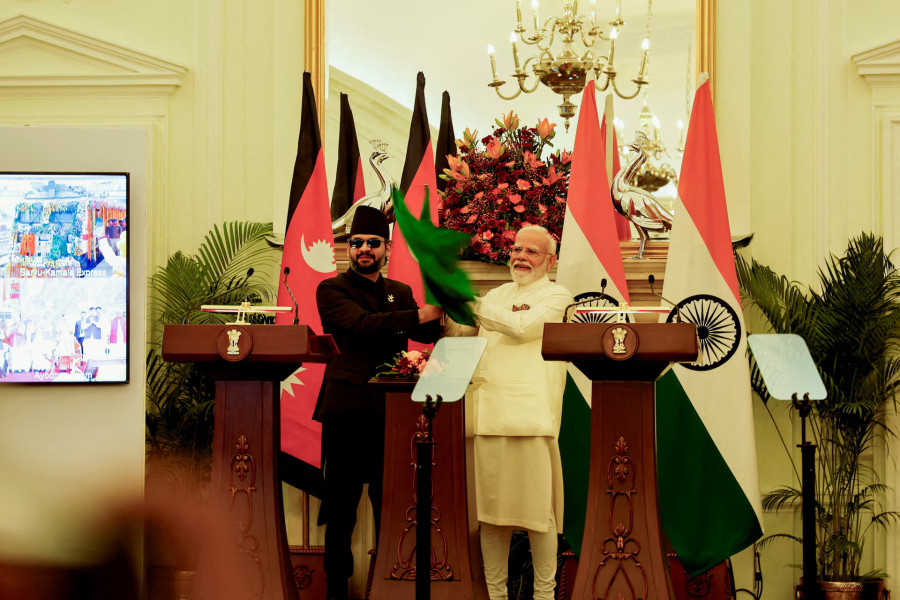
bookmark
Deepak Thapa
Published at : November 25, 2026
Updated at : November 25, 2026 21:26
Prime Minister Balendra Shah’s whirlwind of a trip to India is over, and the inevitable parsing of its significance has begun. Op-ed writers have begun peddling their wisdom, even as journalists seek quotes to spice up their stories. Views will be mixed as to what was gained—or not. Party hacks will toe the party line while spouting opinions. Supposedly neutral analyses will begin by sounding charitable but end up critical about what was left out in the discussions. That is how it has always been.
I would venture that the most significant aspect of the trip is that it took place at all. Having put off the obligatory pilgrimage to New Delhi for months, Shah was forced to bow to the reality of our history and geography. Of course, it is also in the interest of the Indian establishment to learn as much as they can about this enigmatic figure whose thoughts can only be deduced from the occasional cryptic social media post. I am not sure if the Indians came out any wiser at the end, but at least they will have seen the man up close, albeit with his eyes shielded by the trademark shades.
One does wonder though if Shah was able to provide his Indian counterpart, Narendra Modi, a better measure of himself during their private conversation. The two prime ministers share one singularity though—an aversion to talking to the media—along with a fondness for a brand of nationalism tinged with the majoritarianism common to both countries, very overt in Modi’s case and more subtle in Shah’s. Slotted just half an hour, the shmooze lasted an hour longer, signalling that some bonhomie must have developed between the young political outsider and the seasoned elderly politician.
Shah did manage to wrangle a fairly tidy sum of Rs240 billion (~$1.6 billion) from India. This part-grant-but-mostly-loan appears to be the main achievement of the visit in material terms. For those who would like to understand for themselves the gist of what transpired during Shah’s stay in India, the Indian foreign ministry has a very useful webpage entitled ‘List of Outcomes: State visit of the Prime Minister of Nepal to India’.
Accordingly, Shah’s short Delhi sojourn had three categories of outcomes. The first were the projects launched such as the train service between Ayodhya and Janakpur and the foundation-laying of the Lower Arun hydro project. The second were the eight MoUs between different institutions in the two countries, ranging from subjects as varied as forensic science to livestock and urban development. Third were the announcements, including the said grant-cum-loan, the opening of cargo access at two more ports, and plans to set up a campus of the world-renowned IIT (Indian Institute of Technology) in Nepal. Tellingly, the Indians did not even bother to note the one outcome of the visit that perhaps has received the widest coverage in Nepal, namely, that aeroplanes will be allowed to both enter and exit Nepal using the Kathmandu-Bhairahawa-Lucknow air route (from the current arrangement that permits only exit).
The view from India
Around the time Shah was landing back in Kathmandu, the Ministry of External Affairs in New Delhi was already in conversation with the press. Led by the foreign secretary Vikram Misri himself, the deliberations of the press meet are somewhat instructive, particularly since it provides a glimpse of what the Indian media believes are the issues that tie Nepal–India relations and the sticking points that constrain them. I present below some takeaways that struck me.
In his opening statement itself, Misri made sure that the journalists understood this was Shah’s first bilateral visit since becoming prime minister, notwithstanding an earlier trip to attend the UN General Assembly. Thus, the importance of Nepal’s leaders being in New Delhi’s good graces was underscored once again.
Misri indicated that the proposed IIT Nepal is likely going to partner with IIT Kanpur. If that indeed turns out to be the case, future Nepali students will stand to benefit a great deal since the IIT at Kanpur is considered among the better ones. We can only hope that plans do not change and we are not fobbed off one of the lesser IITs.
One subject that had generated some level of interest in Nepal prior to Shah’s visit was the recruitment of Nepalis into the Indian army. With the introduction in 2022 of the Agnipath Scheme that had essentially upended the lifetime security provided by service in the Indian army, the Nepali government had halted recruitment from Nepal. Various calls have since been made to engage with the Indian government on providing some kind of waiver from the terms of the scheme. Responding to a query on Gorkhas and Agnipath, Misri gave what he called a “short answer: issue did not come up in the discussions today”.
On the dispute regarding Lipulekh Pass and the India–China commerce through it, Misri reaffirmed the Indian line that it has nothing to do with Nepal. He said, “Lipulekh did not come up today; it wasn’t discussed between the two sides.”
What seems to have been discussed in detail was cricket. In Misri’s words: “Prime Minister Balen Shah is obviously very passionate about promoting sports and, in a sense, empowering the youth through sports, and this is something that was echoed in full by the Prime Minister himself, and he joined his voice to this aspiration of the Prime Minister of Nepal on intensifying sporting contacts between the two countries and seeing how sport could be used as yet another bridge between the two countries.”
Misri did not disclose if cricket featured during the formal bilateral discussions or during the Shah–Modi tête-à-tête. But one can be certain that Modi would have been somewhat relieved that Shah was more interested in talking cricket than in exchanging brickbats. He must have had a field time leading the youngster up and down the metaphorical pitch and sent him off with a somewhat insignificant ‘howzzatt’ in the form of the financial package to show off back home.
Envisioning the future
Queried about the Eminent Persons Group report finalised eight years to recommend updates to various frameworks undergirding Nepal–India relations, The Indian foreign secretary was surprisingly rather dismissive “You referred to the—what’s it called—Eminent Persons Group report…the report that you have mentioned is not relevant; it pertains to the past. We need to look ahead, we need to look forward, in keeping with the forward-looking vision of the Joint Vision document that’s been announced by the leaders today.”
From the sound of it, we are likely to hear a lot about the ‘joint vision’ in the future. With the title, ‘Viksit Bharat and Samunnat Nepal: Re-imagining the Partnership’, it captures the promises Modi and Shah have made to their respective countries—a ‘Developed India’ and a ‘Prosperous Nepal’. It is the subtitle that says it all though and Misri had just confirmed its intent.
Commenting on Shah’s trip, the doyen of Nepal studies scholars in India, SD Muni, was quite succinct on X: “Balen’s India visit was great on optics and promises, expected on substance, without any breakthroughs and mutually acceptable on concrete outcomes. The vision document is India’s diplomatic tool kit. It’s implementation would depend on political climate between Nepal and India.” Basically, Muni was saying that the vision document is just that: a vision, with neither side bound to implement it. Since India is always the giver and Nepal always the taker, translating the vision into reality will continue to depend on how far Kathmandu is able to serve Indian interests.
For now, I end with this response to Muni’s reference to the substance bit: “Substance was great…24,000 crore he [Shah] begged after posting f___ [I]ndia.” I don’t know if Shah begged or not, but that quip would have been highly accurate if the user had said ‘bagged’ instead.
Deepak Thapa
Deepak Thapa has been a fortnightly columnist with The Kathmandu Post since 2009, writing on a range of topical social and political issues.





Most Read from Columns
Are Nepal’s celebrated technocrats serving the country or global capital?
International recognition is no proof of serving global capital
Who is the real prime minister?

How Mamta Kafle case shows why digital records matter when a Nepali disappears abroad
Nepal’s psychedelic mushrooms need experts, not hype
Editor's Picks

The killings have a name: Femicide. Nepal’s law does not recognise it
Seven takeaways from Prime Minister Balendra Shah’s India visit
Why buying a first home is becoming a distant dream for young Nepalis
Buddha Air revives plan to launch international jet flights from Pokhara

Why a viral TikTok about ‘baddies’ has struck such a nerve in Nepal
E-PAPER | November 26, 2026

×