Nepal’s fossil fuel push clashes with its clean energy ambitions
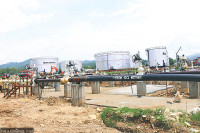
As the country seeks climate finance and promotes hydropower exports, new petroleum pipeline projects risk locking it into decades of fossil fuel dependence. This petroleum storage facility at Amlekhgunj in Bara district receives fuel through a 69-kilometre pipeline from Motihari, India. Post File Photo
Despite pledging at national and international forums to transition to clean energy and seeking climate finance to address the impacts of climate change, Nepal continues to pursue investments in petroleum infrastructure, potentially deepening its long-term dependence on fossil fuels.
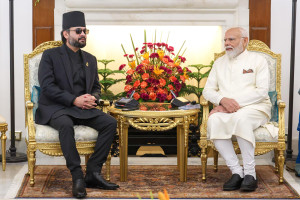
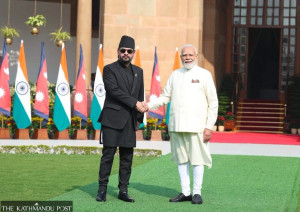
On Monday, Prime Minister Balendra Shah and his Indian counterpart Narendra Modi virtually laid the foundation stone for a petroleum terminal in Jhapa and stressed the need for starting work on a petroleum pipeline connecting Siliguri in India to Charali in Jhapa. The two sides also agreed to explore cooperation in constructing gas pipelines between the two countries.
Separately, India handed over the second phase of the Motihari-Amlekhgunj petroleum pipeline project to Nepal. The facility, which came into operation in August last year, includes two vertical petrol storage tanks of 4,100 kilolitres each. It also has 24 automated tank-truck loading gantries, a terminal automation system, a quality-control lab, and fire-control facilities.
The expansion of petroleum pipelines, storage terminals and liquefied petroleum gas infrastructure has raised questions about the government's energy priorities. Experts say such investments could lock Nepal into fossil fuel dependence for decades, undermining its commitments to reducing carbon emissions and exploiting its vast hydropower potential.
Their concern is that long-term investment in fossil fuel infrastructure creates an economic and institutional incentive to continue importing and consuming petroleum products, even as the country seeks to replace them with electricity. It could also divert resources from transmission lines, substations, and distribution networks needed to expand domestic electricity consumption.
Petroleum products remain among Nepal's largest import commodities and contribute substantially to the country's trade deficit.
Experts say the millions of dollars being invested in new fossil fuel infrastructure could instead be directed towards accelerating the transition to electric mobility, electrifying household cooking, and strengthening the domestic power distribution system. Both of Nepal's immediate neighbours, including India, which is helping build the new petroleum infrastructure, are also moving towards cleaner energy and transport systems.
“Nepal should focus and prioritise hydropower, construct transmission lines, and export clean energy. We should not invest in petroleum or gas pipelines. At home, it is high time we strengthened electricity distribution to ensure regular supply, which will ultimately replace dependence on fossil fuels,” said Uttam Bhlon Lama, senior vice-president of the Independent Power Producers' Association, Nepal.
Nepal has set a target of developing 30,000 megawatts of electricity by 2035, banking on growing electricity markets in India and Bangladesh. But expanding generation capacity alone will not deliver the country's clean energy ambitions. It also requires investment in transmission infrastructure, reliable distribution networks and policies that encourage households, factories, and transport operators to switch from imported fossil fuels to domestically generated electricity.
Nepal has committed to achieving net-zero greenhouse gas emissions by 2045 under its Long-term Strategy for Net-zero Emissions and its third Nationally Determined Contribution (NDC 3.0). The roadmap envisages interim emission reductions through clean energy expansion, electric mobility, forest conservation, and technological improvements across major economic sectors.
The 2045 net-zero strategy also seeks to secure recognition and potential benefits for Nepal’s contribution to global emission reductions through cross-border clean electricity trade. It envisions policy reforms, social transformation, and technological advancement to create a carbon-neutral, inclusive, and climate-resilient economy.
But the scale of the challenge is substantial. Nepal's carbon dioxide emissions stood at 23 million metric tonnes in 2019 under the reference scenario. They are projected to increase to 34 million tonnes by 2030 and 79 million tonnes by 2050 if the country does not make substantial changes to its energy consumption and production patterns.
The government's own long-term strategy identifies fossil fuel substitution as central to achieving its climate targets. In the residential sector, it calls for reducing the use of liquefied petroleum gas and promoting electric cooking appliances and biogas.
In transport, the strategy envisages a transition to zero-emission vehicles for intercity, intracity, and freight movement across public and private transport systems. The brick industry needs to adopt zigzag and tunnel kiln technologies before eventually shifting to fully electric heating.
Energy-efficient technologies are also expected to reduce emissions in agriculture. The strategy calls for powering industrial, commercial and agricultural activities through renewable energy and hydrogen technologies. Electricity generation, meanwhile, is expected to come entirely from renewable sources, primarily hydropower and solar photovoltaic systems.
By 2030, Nepal aims to make electric stoves the primary cooking technology in 25 percent of households. Achieving these targets will require an estimated investment of $25 billion.
There are already signs that the transition is gaining momentum, particularly in the transport sector. The number of registered electric vehicles in Nepal crossed 63,000 by the end of fiscal year 2025-26. Tax incentives, financial benefits and easier financing options have accelerated adoption, with EV imports rising rapidly.
More than 70 percent of private cars imported into Nepal are now electric, according to the policy document. Based on the market share of new electric vehicle sales, Nepal in 2024 also emerged as the world's second-largest EV market, behind Norway.
“The rise in the use of EVs and electric stoves provided some relief to people when petroleum prices rose sharply due to the West Asia conflict. This shows how effectively we can manage an energy crisis when alternatives are available,” said Lama.
He said Nepal needs infrastructure that reduces dependence on imported cooking gas and saves billions of rupees in foreign currency. Instead of investing in petroleum pipelines, the government should prioritise upgrading transmission lines and substations to make electricity more accessible and reliable.
The government's latest initiatives, however, suggest that it is expanding the infrastructure and commercial reach of fossil fuels rather than accelerating the transition towards domestic energy production and consumption, Lama said.
The contradiction is particularly striking at a time when Nepal's hydropower sector is struggling to recover from extensive damage caused by the devastating Bhotekoshi floods of August 26.
Energy experts say the reconstruction of damaged hydropower projects has been left largely unresolved. Many affected projects were not insured, and uncertainty remains over how they will mobilise the resources needed to resume operations. Private developers also face difficulties accessing damaged sites because of disrupted roads, transmission lines and the need to secure environmental clearances again.
Environmentalists say the government needs to establish a clear national energy strategy before committing to further investments in fossil fuel infrastructure.
“Discussing plans to reduce dependence on fossil fuels while investing in oil pipeline infrastructure is an irony,” said Bhusan Tuladhar, an environmentalist. “It is high time we had clarity on our overall energy strategy. There should be a wider discussion before committing to importing fossil fuels.”
He said Nepal should prioritise clean energy if its objective is to reduce emissions and build a sustainable economy. The damage to hydropower infrastructure caused by the Bhotekoshi floods has further exposed the vulnerability of the sector and raised questions about the confidence of investors.
The government should therefore prioritise restoring and strengthening the hydropower sector, Tuladhar said.
He acknowledged that importing petroleum products and maintaining the necessary infrastructure would remain unavoidable during the transition to renewable energy. But he cautioned against building infrastructure designed to sustain fossil fuel consumption over the long term.
“It is understandable that we need to import fuel until we shift more towards renewable energy. But building fossil fuel infrastructure for long-term use is paradoxical given Nepal's commitment to clean energy,” he said.
The scale of damage to Nepal's hydropower infrastructure underlines the urgency of the issue. A preliminary Rapid Damage and Needs Assessment prepared by the government estimates that damage and losses to hydropower facilities and transmission infrastructure amount to Rs151 billion, making it the single most expensive sectoral loss recorded in the assessment.
Reconstructing damaged power plants and transmission lines is expected to cost Rs390.62 billion.
The government's response to the climate crisis also shows the growing financial challenge. Nepal is set to receive $20 million in climate finance under a mechanism established to support countries vulnerable to climate change. The funding was approved under the Barbados Implementation Modalities, established within the architecture of the Fund for Responding to Loss and Damage, based on proposals submitted by Nepal earlier this year.
At last year's UN climate conference, countries also discussed the need to gradually phase down fossil fuels. Nepal's commitment to net-zero emissions by 2045 makes the direction of its energy investments particularly consequential.
Meanwhile, the country's dependence on imported petroleum continues to impose a heavy burden on its external sector. According to the Department of Customs, Nepal imported petroleum products worth Rs349.73 billion in the last fiscal year.
Krishana Prasain is a business reporter for The Kathmandu Post covering markets. Before joining The Kathmandu Post in 2018, she spent 3 years in New Business Age magazine covering business.




 10.12°C Kathmandu