Shah-Modi interaction suggests a shift in Nepal-India relations
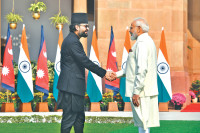
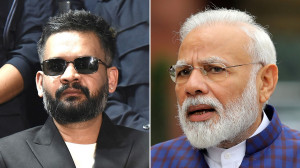
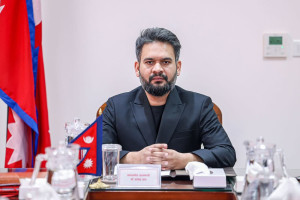
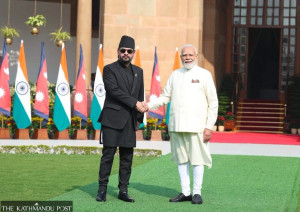
A longer-than-planned one-on-one meeting helps secure an air-entry route for Bhairahawa, while contentious bilateral issues remain unresolved. Prime Minister Balendra Shah (left) meets his Indian counterpart Narendra Modi at Hyderabad House in New Delhi, India, on Monday. AP/RSS
The meeting between Prime Minister Balendra Shah and his Indian counterpart Narendra Modi in Hyderabad House on Monday was scheduled to last 30 minutes, with the two of them expected to exchange views before their respective delegations took up substantive discussions.
However, the meeting lasted much longer. The two leaders spent an hour and a half together, discussing several issues central to Nepal-India relations. They reached an understanding on some longstanding concerns, while leaving others for future discussions.
Two Nepali officials, speaking to the Post on condition of anonymity, said the personal rapport that developed between the two prime ministers helped secure Nepal's long-standing demand for an additional air-entry route through Indian airspace to Bhairahawa.
"But both prime ministers engaged in such a way that we missed the time for holding the delegation-level talks. What our prime minister had discussed with the Indian prime minister is not known, but it was the prime minister who insisted on securing at least one air-entry route. Later, we came to know that there was no need for delegation-level talks as both prime ministers had reached an agreement and the talks were called off,” said an official who was part of the delegation.
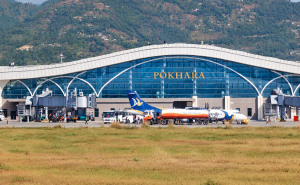
The two leaders discussed Nepal's political changes, Shah's political priorities and ways to strengthen bilateral relations. One of Nepal's key priorities during the visit was securing an additional air-entry route for Bhairahawa. The move is intended to improve international connectivity to Gautam Buddha International Airport and establish Bhairahawa as a gateway for tourists visiting Lumbini, the birthplace of Gautama Buddha.
According to the officials, Nepal secured an understanding on bidirectional flights to and from Bhairahawa, without restrictions on altitude. A technical-level meeting will now work out the operational details.
A second phase will involve further negotiations over an additional entry route through Mahendranagar. In return, one official said, Nepal would consider allowing Indian flights to use Nepali airspace for Bagdogra airport.
Kathmandu has so far resisted India's request for airspace access to Bagdogra, particularly for military flights. The Indian side has reportedly said that only civilian flights to and from Bagdogra airport will use Nepali airspace.
Some Indian experts have interpreted Nepal's reluctance through the lens of regional geopolitics. Professor SD Muni, a prominent scholar of Nepal affairs, wrote on X that India's request to use Nepali airspace for Bagdogra flights was also intended to test Nepal's response to India's security concerns regarding China.
Nepal's growing engagement with China has long been a source of concern in New Delhi. “ New Delhi is the first responder in every crisis outside and inside Nepal,” said a senior Indian journalist. “But when Nepal brings China and approaches soft towards them, then it becomes an irritation in any relations between India and vice versa.”
The more contentious issues in Nepal-India relations also figured in the discussions. The two sides exchanged views on the 1950 Peace and Friendship Treaty and the boundary dispute. However, they did not discuss the report of the Eminent Persons' Group (EPG), which was prepared to review bilateral relations.
"It is true that we did not discuss the EPG report, but we exchanged ideas on resolving boundary disputes and reviewing all old treaties with India, which will begin soon," the official said. "In 2027, we have decided to hold a meeting of the joint commission at the foreign minister level, where we will do the homework on this. Since our prime minister has invited Modi to visit, we hope to reach further understanding during his visit."
The official argued that the broader agreement to review existing treaties had effectively taken the EPG discussion forward. "The EPG is related to the review of the Peace and Friendship Treaty. So there is no need to discuss this matter again,” he said.
The review of existing treaties is included in the vision document announced on Monday. The boundary issue, meanwhile, is specifically mentioned in the joint commission's agenda.
In a statement, Nepal's Ministry of Foreign Affairs said the vision document had opened the way for amending existing treaties, agreements and understandings, if necessary, to advance cooperation on emerging issues. It added that the document had created an opportunity to discuss older treaties, including the 1950 agreement, and review arrangements to reflect changing circumstances and give bilateral relations a new dimension.
The joint communiqué also noted progress in joint fieldwork to maintain and repair boundary pillars and directed the foreign secretaries to work on outstanding boundary issues.
Another member of the Nepali delegation said the directive meant the two foreign secretaries would discuss the unresolved disputes concerning Susta, Kalapani, Lipulekh, and Limpiyadhura.
"These are not abstract issues. We have always referred to the boundary dispute as outstanding boundary issues," the delegation member said.
The lack of specific details in the communiqué and vision document has prompted differing assessments of what Shah's visit achieved. Indian newspapers on Tuesday largely highlighted the $1.6 billion economic assistance package, describing the prime minister's first bilateral visit as the beginning of a new chapter in relations.
The proposed Janakpur-Ayodhya railway, cooperation in digital technology, energy, education and connectivity, and the shared vision of Vikasit Bharat and Samunnat Nepal [Developed India and prosperous Nepal] featured prominently in their coverage.
Muni, who has been critical of the Modi government's foreign policy, however, does not see any breakthrough in the visit. "Balen's (Shah) India visit was great on optics and promises, expected on substance, without any breakthroughs and mutually acceptable on concrete outcomes," he wrote on X on Tuesday. "The vision document is India's diplomatic tool kit. Its implementation would depend on the political climate between Nepal and India," the post added.
Contrary to Muni, others viewed the visit as a potentially important turning point. Dhananjay Tripathi, associate dean of the Faculty of International Studies and former chairperson of the Department of International Relations at South Asian University, New Delhi, said the visit was significant not merely for its diplomatic symbolism but also for the opportunity it created to take bilateral relations in a new direction. The proposed Janakpur-Ayodhya railway link, he said, carried both practical and symbolic value, but the visit's success would ultimately depend on translating summit-level discussions into concrete outcomes.
Rishi Gupta of the Asia Society Policy Institute described the visit as a departure from the conventional approach to Nepal-India relations. Both countries, he said, needed to move beyond historical baggage, and the EPG report should not become an obstacle to progress.
He cited India's assistance package, the proposed IIT Kanpur campus in Nepal and cooperation in digital technology, connectivity and energy as foundations for a development-oriented partnership. He also cautioned against viewing the visit primarily through the lens of India-China competition, arguing that its success should be judged by the quality of cooperation and implementation rather than the number of agreements signed.
Constantino Xavier of the Centre for Social and Economic Progress, who closely follows India's neighbourhood policy, offered a more nuanced interpretation of Shah's visit.
New Delhi, he told the Post, saw Shah as "a pragmatic foreign policy realist, focused on tangible gains for Nepal's reformist and growth-oriented vision, rather than chasing waterfalls in India". The outcomes suggested that Shah viewed India as "the only indispensable and inescapable partner towards Naya [new] Nepal".
"It is not easy for a Nepali leader to resist the temptation of victimhood and political posturing when dealing with India to score political points at home, especially with a young and impatient electorate," Xavier said. Shah could have raised bilateral disputes and irritants publicly but "pragmatically chose to act as a statesman by raising these privately".
Indian foreign affairs experts see Nepal’s ruling Rastriya Swatantra Party (RSP) as a force more interested in pursuing opportunities with India than in confrontation. They noted that RSP President Rabi Lamichhane had advocated "development diplomacy" during his visit to India in May, and that the latest agreements reflected a similar approach.
Xavier said both neighbours needed to recognise the political investment made by their leaders in the visit.
"I hope New Delhi realises how much political capital Shah invested in preparing for this visit and ensuring its positive outcomes," he said. "Similarly, I hope Kathmandu also understands that Prime Minister Modi personally invested in this visit, overriding lingering concerns about the RSP-led government and Nepal's new Gen Z."
But he also pointed to lingering questions in New Delhi about Shah's political approach and the durability of the new engagement.
"The successful visit helped build a personal rapport with Prime Minister Modi, but may have ironically contributed to Indian puzzlement about Shah the political enigma: Is the vision for a new Nepal-India relationship his own, or is he just being well advised and under economic and political pressure to make nice with India?" Xavier said.
"Time will give more concrete answers but, for now, India will choose to believe that this visit marks the birth of Shah the diplomat and the beginning of a new era in bilateral ties."
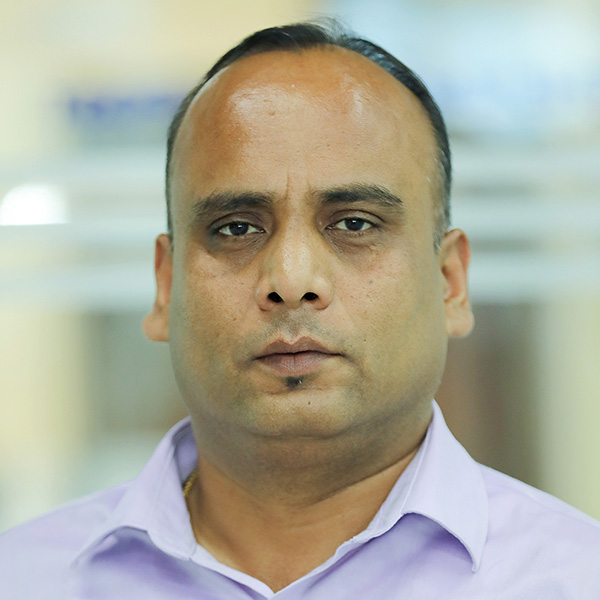
Anil Giri is a Chief Sub Editor covering diplomacy, international relations and national politics for The Kathmandu Post. Giri has been working as a journalist for more than two decades, contributing to numerous national and international media outlets.




 10.12°C Kathmandu