Government plans more ordinances before convening Parliament
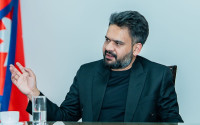
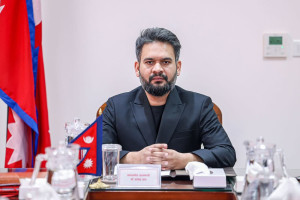
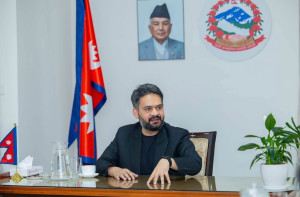
The move is aimed at removing legal hurdles to projects to be showcased at an infrastructure conference in Kathmandu on December 9-10. Prime Minister Balendra Shah Photo: Courtesy of Prime Minisster's Office
The government plans to issue several more ordinances before convening the winter session of the Federal Parliament, seeking to remove legal obstacles to projects ahead of the Nepal Infrastructure Summit scheduled for December 9 and 10 in Kathmandu.
Speaker DP Aryal has consulted with Prime Minister Balendra Shah and Minister for Law, Justice and Parliamentary Affairs Sobita Gautam about convening the parliamentary session. “The government has informed us that it needs to issue some ordinances for the investment conference. The plan is to convene the parliamentary session immediately afterwards,” Speaker Aryal told Kantipur.
Law Minister Gautam said the government would introduce only those ordinances considered essential to facilitate the infrastructure conference. “We are examining which existing laws could obstruct the implementation of projects to be showcased at the infrastructure conference. We will amend those provisions through ordinances,” Gautam said. “The government plans to convene the parliamentary session afterwards.”
The budget session of the Federal Parliament ended on October 2. Since then, the government has recommended eight ordinances to President Ramchandra Paudel, of which five have been issued.
The five ordinances already issued are the Nepal Academy of Science, Technology and Innovation Ordinance, 2026; the Science, Technology and Innovation Ordinance, 2026; the Forest-Related Some Nepal Acts Amendment Ordinance, 2026; the Land-Related Some Nepal Acts Amendment Ordinance, 2026; and the Ordinance to Amend Some Nepal Acts Related to Disasters, 2026.
Two other ordinances recommended by the government are still under consideration at the President’s Office. They seek to amend the Press Council Nepal Act, 1992, and various other laws relating to culture, tourism and civil aviation.
The President’s Office has also yet to issue the Gen Z Movement Incidents Investigation, Compensation and Reparation Commission Ordinance, 2026, which the Cabinet recommended at its meeting on November 20.
Bishma Raj Angdembe, a Nepali Congress leader from the main opposition party, said Parliament should be convened without further delay, as lawmaking is one of its primary responsibilities. He also said the government had not consulted opposition parties about the timing of the winter session.
“The Speaker had told us that the winter session would begin on December 1 or 2. There has been no discussion since then,” Angdembe said. “The government should not be talking about ordinances when it is time to convene Parliament. Bypassing parliamentary procedures rather than working through them is neither good for parliamentary norms nor for democracy.”
Finance Minister Swarnim Wagle has said the government is preparing to amend 59 Acts ahead of the infrastructure conference. Speaking at a programme organised by the Kantipur Media Group in Biratnagar on Friday, Wagle said the government was working on the necessary legal amendments for the conference.
Angdembe said the government had not held any discussions with the main opposition about its plans to introduce ordinances for the investment conference. “There is a need to form a high-level parliamentary committee to investigate several issues, so the session should be convened without delay,” he said.
Jagdish Kharel, Rastriya Swatantra Party spokesperson and lawmaker, said there was no reason to delay the parliamentary session. “There has been no discussion within the party so far about convening the session. It is the government's responsibility to call it. The Speaker must also be taking the initiative,” Kharel said.
Some ministers and RSP leaders have also argued that Parliament should be convened to initiate the process of judicial reform.
At a meeting on October 31, the RSP's secretariat had instructed its parliamentary party to take decisive steps towards cleaning up the judiciary. The party said serious cases of misconduct and improper dealings involving some justices had raised grave questions about the judiciary's impartiality, independence and institutional integrity.
“These incidents have further reinforced the agenda of judicial reform and accountability that the Rastriya Swatantra Party has championed since its establishment. The parliamentary party is instructed to take decisive action through Parliament to address these irregularities within the judiciary in accordance with due process and bring the issue to a definitive conclusion,” the secretariat's decision said.




 13.12°C Kathmandu