Panic in bureaucracy, police and judiciary amid abrupt dismissals, political pressure
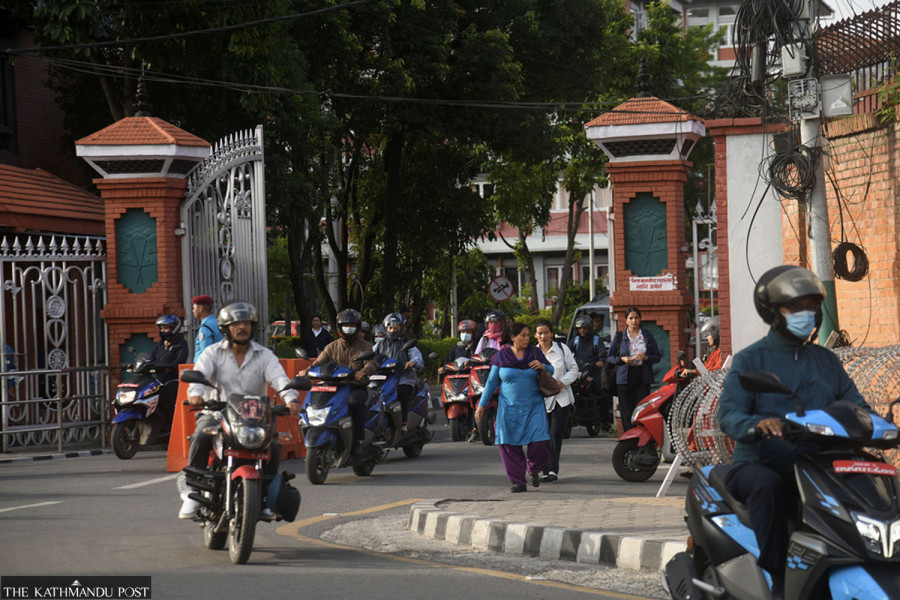
Heavy-handed tactics, leadership purges, and talk of impeachment have deeply unsettled civil servants, law enforcement, and top judges. Employees leave Singha Durbar in Kathmandu in this undated file photo. Deepak KC/TKP
State mechanisms across the country are grappling with profound anxiety, institutional instability, and a pervasive climate of fear following a series of controversial government interventions, abrupt leadership removals, and emerging judicial scandals.
Civil servants, police personnel, and judicial bodies find themselves trapped in an atmosphere of constant apprehension regarding arbitrary executive actions.
The sequence of events began on October 30 when Dinesh Rajauriya, director general of the Department of Water Resources and Irrigation, travelled to Siraha for project monitoring. Police arrested him on the spot and rushed him overnight to Kathmandu. On the same day, Krishna Prasad Rijal, director of the Sunakoshi Marin Diversion Multipurpose Project, was detained in Sindhuli and similarly brought to the Capital. Both officials were handed over directly to the Prime Minister’s Secretariat.
The detentions were leveraged to secure compliance regarding the cancellation of a controversial tender for building a dam and powerhouse of the multipurpose project. Once the secretariat successfully pushed through the cancellation, Rajauriya and Rijal were released on October 31, and the official notice cancelling the tender was promptly issued.
Scarcely a week later, on November 5, an urgent Cabinet meeting summarily removed Inspector General of Police Dan Bahadur Karki. The Prime Minister’s Secretariat had grown increasingly dissatisfied with Karki for raising legal questions regarding ‘extra-judicial’ directives on individual arrests. The removal came on the heels of leaked reports revealing that the Prime Minister’s chief adviser, Kumar (Ben) Byanjankar, had withheld the mobile phone of a fixer named Inam Sapkota for two days prior to forensic testing amid an active police investigation.
Concurrently, WhatsApp chat screenshots surfaced showing exchanges between the fixer Sapkota and Supreme Court Justice Hari Prasad Phuyal, in which Sapkota claimed that the prime minister took a personal interest in a case sub judice in court. Chief Justice Manoj Kumar Sharma also faced allegations of financial transactions involving Sapkota.
In response to the escalating crisis in the judiciary, the ruling Rashtriya Swatantra Party (RSP) weighed parliamentary impeachment proceedings, while the Supreme Court convened a full court meeting to urge relevant bodies to conduct an impartial investigation in accordance with the constitution and law.
These heavy-handed tactics, sudden leadership purges, and talk of impeachment have left civil servants, law enforcement officers, and judges deeply unsettled.
Adding to the bureaucratic panic is the government’s preparation to force early retirement on civil servants who have completed 30 years of service or reached 55 years of age. Although a bill containing these provisions was registered in the House of Representatives a month prior, rumours have intensified that the government intends to enact the measure via an ordinance.
Interactions with a dozen civil servants across various ranks reveal deep dissatisfaction with the administration. Officials note that the new government’s attitude towards the bureaucracy has been adversarial from the outset.
“There is a clear trend within the government of keeping bureaucrats in a state of fear and tension to force decisions,” said a joint secretary on condition of anonymity. “The arrest of the Department of Water Resources and Irrigation director general and his coerced compliance inside the Prime Minister’s Office proves this”.
This incident echoes similar actions in the past months. In June, Tirth Raj Aryal, then director general of the Department of Passports, was handed over to the police directly from the Prime Minister’s Office after Chief Commissioner Prem Rai and other commissioners of the Commission for Investigation of Abuse of Authority (CIAA) were summoned and pressured to fast-track corruption investigations into passport procurement.
Earlier in May, former secretary Krishna Hari Pushkar was briefly detained and released by police on allegations of sending a text message to Prime Minister Balendra Shah.
Senior administrators admit that they feel entirely helpless in the face of executive overreach. Former chief secretary Bimal Koirala said results cannot be extracted by terrorising civil servants and keeping them under psychological duress.
“Several behaviours and incidents occurring under the name of the Prime Minister’s Office have a profoundly adverse effect on the entire civil service,” said Koirala. “The policies and programmes formulated by the government must be implemented through bureaucrats. Keeping administrative machinery in perpetual confusion and fear will ultimately backfire on the government itself.”
Koirala stressed that the executive must engage with civil servants through proper administrative procedures, laws, and regulations. “Relevant secretaries and the chief secretary must apprise political leadership of the negative fallout these behaviours create within bureaucratic circles and demand immediate course correction.”
A sitting secretary told Kantipur that senior officials no longer enjoy an environment where they can make independent decisions based on statutory authority. “There is no certainty about what will happen next. Repeated instances of police mobilisation against civil servants and aggressive behaviour by members of the Prime Minister’s Secretariat evoke deep humiliation,” the secretary said. “If anyone violates the law or commits corruption, established legal processes must be followed. Instead, we see systemic intimidation and threats.”
Another joint secretary described their position as walking on a razor's edge. During a routine secretaries' meeting called by Chief Secretary Govinda Bahadur Karki, officials expected a discussion on the anxiety generated by ordinance rumours and the detention of two joint secretaries. Instead, according to participating officials, the issues were entirely ignored.
“To be honest, we feel completely without guardians,” one secretary lamented. “Our primary guardian is the chief secretary, but even from that office, no active role has been played to mitigate the pervasive climate of fear and confusion.”
An under secretary at the Ministry of Land Management, Cooperatives, Federal Affairs and General Administration noted that the government's hostile approach has triggered an unprecedented wave of resignations.
“While departing staff cite personal reasons on paper, the primary catalyst is undeniably the government's erratic conduct,” the official said. The looming threat of the service-term ordinance further accelerates departures.
Under the proposed civil service bill, employees fulfilling the 30-year service or 55-age threshold would face mandatory retirement, while pension calculations would remain capped at 30 years regardless of total service duration. “The psychological terror that this provision might be enacted overnight via ordinance is driving experienced hands out of the service,” the under secretary added.
According to the Department of National Personnel Records, 464 civil servants have resigned since mid-July. The total includes 4 special-class (secretary level) officials, 33 joint secretaries, 72 under secretaries, and 98 section officers. Furthermore, 137 non-gazetted staff and 120 unclassified personnel have stepped down, following the departures of 225 employees in mid-June to mid-July alone.
Professor of political science Lok Raj Baral noted that recent developments have systematically fostered a psychology of fear and mental instability across key state institutions.
“The government’s operational methods lack democratic norms and procedures,” Baral observed. “There is a glaring immaturity in statecraft, which bodes ill for governance. Such high-handedness was hardly expected from a government that enjoys overwhelming popular support.”
Baral emphasised that because the judiciary is independent of the executive branch, its internal crises must be viewed through a separate lens, though public disclosures have severely shaken public trust.
Justice Hari Prasad Phuyal has openly acknowledged meeting the fixer Sapkota alongside other judges in a hotel, maintaining that Sapkota did not influence judicial verdicts and that the judges themselves tipped off the Prime Minister’s Secretariat, leading to Sapkota’s arrest on September 30.
This controversy follows the high-profile midnight detention of former chief justice Cholendra Shumsher Rana on September 27, when police took him under control from his Maharajgunj residence citing security concerns before releasing him later that afternoon.
Former Supreme Court justice Balaram KC warned that direct contacts between judges and intermediaries inflict lasting damage on public faith in the judiciary.
“Whisper campaigns and allegations that judicial outcomes can be fixed leave thousands of litigants feeling profoundly insecure,” said KC. “It is an extremely dangerous state of affairs. To preserve public faith in the judiciary, the Supreme Court must take proactive measures, backed by a unified commitment and resolve from all its justices.”
The former justice also said that there was no need to drag the government into controversies regarding the court.
Within the security sector, high-ranking police officials reported that executive overreach has begun crippling the internal chain of command. “Following the Gen Z protests last year where the police force bore the brunt of public anger, morale was painstakingly rebuilt to successfully conduct the general elections,” said a senior police officer. “Yet, the very government brought to power by those elections is now dismantling and destabilising the police institution. Field commanders are under constant duress.”
Another police officer pointed out that pressure is mounting to run the police organisation based on the whims of select individuals rather than statutory guidelines. “When we face conflicting demands—pressures from external power centres to bypass legal protocols to arrest individuals versus the professional obligation to abide by standard operating procedures—the police organisation is squeezed into an impossible corner,” he explained.
Kantipur talked to three senior police officers above the rank of first class. They shared that recent events have severely dented their morale.
“Direct orders from extra-institutional power centres demanding the immediate detention of specific targets create an untenable working environment,” said one of the officers. “Police officers operate within strict legal boundaries, and arrests must be dictated by statutory necessity. Constant interference from outside the chain of command strips the police of its functional autonomy.”
Baral reiterated that whimsical governance has thrown state agencies into instability. He stressed that the executive must remain accountable for incidents involving the press, police, and civil service, warning that degrading state functionaries yields destructive long-term outcomes.
Baral also strongly criticised the recent police crackdowns on newsrooms, calling them a direct violation of the constitutional spirit and democratic processes. On October 30, police arrested journalists Bishwa Mani Subedi of Nepal Press, Shobharaj Baral, editor of Motivate News, and Dheeraj Basnet, editor-in-chief of DNA Khabar, while officers entered the offices of the Naya Patrika daily in an attempt to detain reporter Nawaraj Mainali.
While police officers initially claimed the journalist arrests were executed under direct instructions from the Prime Minister’s Secretariat, the PM's Office later disavowed prior knowledge of the operations and claimed that it had ordered the immediate release of the detained media personnel following swift public backlash.




 12.8°C Kathmandu