Police continue recording Sapkota’s statement as he alleges coercion
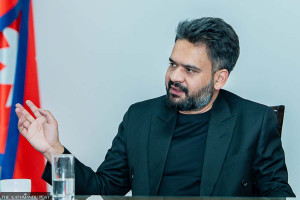
The District Police Range, Kathmandu, is looking into money laundering and offences under the Nepal Rastra Bank Act allegedly committed by him. Inam Sapkota. File Photo
Alleged fixer Inam Sapkota has sparked a major controversy after filing a petition at the National Human Rights Commission claiming that police blindfolded and threatened him during interrogation.
Police, however, have rejected the allegation, saying that Sapkota’s statement is still being recorded in the presence of officials from the government attorney’s office. An officer involved in the investigation said Sapkota’s statement is being recorded in the District Government Attorney Office in Kathmandu.
“There is uproar outside claiming that he was blindfolded during questioning, when in fact his statement is being taken inside the chamber of the chief of the District Government Attorney’s Office,” the officer said. “Forget blindfolding—he is being questioned comfortably while sipping tea.”
According to the investigator, the questioning centres on seized documents, suspicious bank transactions, call detail records and WhatsApp conversations recovered from two mobile phones.
“Statements included in the final investigation report submitted with a prosecution opinion are always recorded in the presence of a government attorney. Blindfolding during such statements is out of the question,” claimed the officer.
“We are recording supplementary statements as new facts emerge. More individuals have been arrested following his statements.”
The District Police Range, Kathmandu, is investigating Sapkota for money laundering and offences under the Nepal Rastra Bank Act. Under money laundering laws, police can hold a suspect for up to 90 days into custody with court approval.
“Two months have already passed. In this period, we have corresponded with Nepal Rastra Bank and other agencies to obtain financial records,” said the investigation officer, adding that investigators have also recorded a statement from Sapkota’s wife, Kabita Pandey.
The police Special Bureau arrested Sapkota at the Tribhuvan International Airport on September 30 while he was preparing to board a flight. In the petition submitted to the human rights commission through his wife, Sapkota alleged that he was held blindfolded at an undisclosed location and pressured to implicate prominent figures.
According to the petition, interrogators told him that he faced no personal liability and threatened him to testify against former Chief Justice Cholendra Shumsher Rana, Rana’s brother and son, Nepali Congress President Gagan Thapa, Congress leader and businessman Umesh Shrestha, Bhat-Bhateni Supermarket owner Min Bahadur Gurung, Hotel Himalaya owner Nabin Tuladhar and some Supreme Court justices.
Superintendent Dan Bahadur Thapa, chief of the District Police Range, Kathmandu, said police had received no official notification regarding the human rights complaint.
“Nobody has informed us about it. Recording statements falls under the purview of the investigating officer,” said Thapa. “The law allows up to 90 days for investigation, though we can submit our report earlier if inquiries conclude.”
According to investigating officers, Sapkota’s statements led to the arrest of former Investment Board Nepal chief executive officer Sushil Bhatta on October 17. Police allege that Sapkota was actively lobbying to secure the release of controversial businessman Deepak Bhatta, who is in judicial custody on money laundering and banking offence charges, and had communicated with Sushil Bhatta regarding the effort.
On November 14, police also arrested Mahesh Shrestha, brother of Congress leader Umesh Shrestha. Financial records obtained by investigators revealed unusual transactions in Sapkota’s bank account over the past year. Out of Rs63.1 million deposited into a single account within a year, Mahesh Shrestha was the single largest depositor, transferring Rs14.25 million. Police arrested Mahesh based on those bank records and Sapkota’s statement.
During questioning, Sapkota claimed that he knew Umesh Shrestha because Shrestha founded Little Angels’ School where Sapkota studied. “In his statement, Sapkota claimed most of the funds were personal loans. We are verifying the source of all funds,” a police source said.
Investigators also uncovered WhatsApp exchanges between Sapkota and Umesh Shrestha concerning land deals. “Photos of land ownership certificates were exchanged,” the officer said. “We have expanded our investigation to Umesh Shrestha as well, and he may be arrested if necessary.”
Police further discovered that Rs2 million was transferred to Sapkota’s account from Janamaitri Foundation, where Shrestha is a board member.
Reports have also surfaced alleging that Sapkota’s mobile phone went missing from police custody for two days following his arrest, though police have declined to comment. Investigators maintain that evidence gathered so far indicates Sapkota built networks and extorted money by promising to fix court cases, with former Chief Justice Rana appearing at the centre of the network.
“We are connecting the dots,” an investigating officer said.
The investigation into suspected judicial manipulation to free Deepak Bhatta began with Rana. Police detained the former chief justice from his residence at midnight on September 27 and took him to the Kathmandu Valley Crime Investigation Office in Teku, where his phone was examined.
Investigators subsequently traced Sapkota as a key intermediary linked to Rana. “Investigators uncovered the connection through phone records. Information that Sapkota was attempting to flee came from higher authorities, prompting a team to intercept him,” a senior police officer said.
Initially arrested on charges of indecent behaviour, Sapkota was later investigated under the Nepal Rastra Bank Act and money laundering laws after a habeas corpus petition was filed on his behalf. The recovery of conversations with senior police and Armed Police Force officers, judges, politicians, businesspeople and litigants from his phones fuelled suspicions.
Armed Police Force Additional Inspector General Banshiraj Dahal was dismissed over his links to Sapkota, facing accusations of leaking sensitive information regarding the prime minister’s movement and seeking Sapkota’s help to extend his tenure. Investigations also revealed Dahal visited the Teku police office the night Rana was detained.
Inspector General of Nepal Police Dan Bahadur Karki was removed on November 4 amid mounting controversy over his contact with Sapkota, with the Cabinet appointing him security adviser to the prime minister and naming Manoj KC as police chief. Karki challenged his removal at the Supreme Court, which declined to issue an interim order.
Meanwhile, leaked screenshots of WhatsApp messages between Sapkota and Supreme Court Justice Hari Prasad Phuyal—in which Sapkota claimed the prime minister had an interest in a court case—raised serious questions over judicial independence. Phuyal acknowledged communicating with Sapkota but insisted it had no bearing on judicial decisions.




 9.12°C Kathmandu