Private firms issue quality certificates to community schools without government oversight
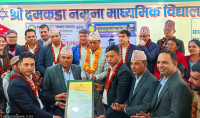
Schools have paid up to Rs500,000 for ISO certification, but education officials question the companies’ authority to assess them.Shree Damkada Secondary School in Palpa receives ISO certification. Madhav Aryal/TKP
Private companies are issuing quality certificates to Nepal’s community schools without the knowledge of government agencies responsible for assessing educational standards. Some schools have paid as much as Rs500,000 to obtain International Organisation for Standardisation (ISO) certification, raising questions about the companies' authority and the certificates' value.
Two community schools in Palpa announced last Monday that they had received international quality certificates from a private consultancy. Similar certification activities have been reported in Dhading, Kapilvastu, Surkhet, Khotang and Rupandehi, among other districts.
The schools say the certification process helps improve institutional management in line with international standards. In Palpa alone, 15 secondary schools say they have received ISO logos and begun improving their academic and administrative systems. They have paid consultancy firms up to Rs500,000 each. Two of them, Shree Ramtulasi Secondary School and Shree Damkada Secondary School, have already received certificates.
The practice has raised questions about the legal authority of private organisations to assess public schools and issue certificates claiming to recognise international quality standards. Education experts have questioned the certificates’ authenticity, credibility and value, particularly because government agencies are responsible for evaluating the quality of school education.
Teachers say schools have joined the certification process after companies promised to help make them internationally recognised institutions. Educationists, however, argue that the exercise is aimed more at attracting students and parents than improving actual learning outcomes.
The concerns come as many community schools continue to struggle with shortages of subject teachers, classrooms, toilets, drinking water, laboratories and libraries. Student learning outcomes and overall academic performance have also come under scrutiny.
Peshal Khanal, a professor at Tribhuvan University’s Faculty of Education, questioned the legal basis and procedures under which private organisations issue quality certificates to community schools.
Khanal said the Education Review Office (ERO) was legally responsible for assessing the quality of school education. He questioned how private organisations could issue certificates based on standards of their own making and who had authorised them to do so.
“How can a private organisation set its own standards and certify community schools? Who has given these companies the authority to issue such certificates?” he asked.
Khanal said academic audits of educational institutions were possible, but should not be confused with certification of their overall educational quality.
“Quality is determined by what students learn and how much their learning improves. Schools cannot be certified as providing quality education simply by examining buildings, classrooms and other physical facilities,” he said. “Maintaining standards in other sectors and assessing the core purpose of education are two different things.”
He said the credentials of the organisations issuing the certificates, the indicators they use and the qualifications of the personnel conducting the assessments should also be investigated.
Section 7 of the Education Act, 1971, provides for the establishment of the ERO to assess the quality of school education. Schools are regulated by agencies under the Ministry of Education and local governments. Yet the ministry and other relevant government bodies appear unaware of the private certification being offered to community schools.
Two companies, Global Quality Assurance Certification Pvt Ltd and Global Quality Council Pvt Ltd, have been issuing such certificates to schools across the country.
Sudip Sharma, national director of the council, said the organisation assesses schools on their academic activities, teaching and learning, physical infrastructure, institutional management and performance. Certificates are issued to institutions that meet its prescribed standards.
Sharma said the organisation was registered with the Office of the Company Registrar and had so far certified 100 schools, while another 300 were undergoing the process.
“We assess schools, hospitals and municipalities and issue certificates. We prepare three-year programmes and send experts to conduct evaluations. Certificates are awarded once institutions meet the prescribed international indicators and standards,” he said.
The companies charge up to Rs500,000 per school for certification and up to Rs100,000 for renewal. The certificates are valid for three years, after which schools must renew them, Sharma said.
“We are running programmes in 40 districts, from Palpa and Khotang to Surkhet,” he said.
According to Sharma, the process begins with a feasibility study after a school expresses interest. The company then informs the local government before proceeding with certification. He said the Department of Education had also been informed, but had shown little interest in developing a procedure to regulate the practice.
Shree Prasad Bhattarai, spokesperson for the Ministry of Education and Sports, said the ministry was unaware that private organisations were issuing quality certificates to community schools.
Bhattarai said the ERO was the only body legally authorised to assess educational quality, questioning how private companies had assumed that role. “Who authorised these companies to issue such certificates, and how are schools paying for them?” he said, adding that the ministry would investigate the matter.
Jevan Acharya, the ISO focal person at Shree Damkada Secondary School in Palpa, said the certification process had benefited the school. However, he was unsure whether the organisation issuing the certificate was officially recognised or had government approval.
The school has 930 students and 65 teachers and other staff members, but only 26 hold permanent positions.
Bal Krishna Lamsal, headteacher of Shree Ramtulasi Secondary School in Rampur, said the certificate mainly demonstrated that the institution had met the management systems and procedural standards set by the certifying organisation. Whether students had actually improved their learning was a separate matter, he said.
Government representatives have also attended ceremonies at which schools receive ISO logos and certificates. Some have delivered speeches and congratulated the schools. Yet the agencies concerned remain unclear about the certificates’ legitimacy and official recognition.
Chandra Kant Bhusal, executive director of the ERO, said the office did not know the distribution of ISO logos to schools.
“The office has so far received no information about ISO logos being distributed to schools,” he said. “Consultancy service providers may have been carrying out such activities under various pretexts. This is something we will need to look into.”
The ERO assesses students’ learning outcomes, school performance, teaching and learning practices, and management. It has also conducted academic audits of secondary schools across the country.
Bhusal said the office examines how much students learn, the overall academic condition of schools and what needs to improve in teaching and learning. It also conducts the National Assessment of Student Achievement.
Prem Raj Kharel, chief of the Education Development and Coordination Unit in Palpa, said the ERO is the government body authorised to assess schools’ educational quality. He said, however, that he had little information about the process or validity of the ISO logos being distributed.
“I attended the programme because the school invited me. I do not know much about this matter. It seemed to me that education was being treated like a commodity,” he said. Kharel added that he would raise the issue with the ERO.
The Nepal Bureau of Standards and Metrology is responsible for developing and implementing national standards. Its list of standards includes NS/ISO 21001, which covers management systems for educational organisations.
However, the consultancy firms issuing certificates to schools have neither coordinated with nor approached the bureau, officials said.
Prabhat Kumar Singh, spokesperson for the bureau, said the government’s assessment of educational quality and certification of international management systems were separate matters. A certificate issued by a foreign organisation could not replace the government’s assessment of a school’s educational quality, he said.
“We also carry out certification work. But no consultancy firm has approached us saying it intends to provide this service,” he said.
Singh said organisations did not need to go through a consultancy to work with the bureau. Companies, institutions and other bodies could contact it directly.
Satish Yadav, chief of the education section at Tansen Municipality, said a school’s quality could not be determined solely by its buildings, records, management and administrative procedures.
What students learn, how teachers teach, what support is provided to struggling students and what schools do to improve learning outcomes are equally important, he said.
“We have not seen any official recognition for such certification from the municipality, provincial or federal governments,” he said.
Yadav said a foreign or non-governmental organisation did not acquire the authority of Nepal’s public education agencies simply by issuing an ISO certificate. Nor could such certification replace the government’s own assessment of educational quality.




 18.12°C Kathmandu