Nepal yet to decide on one-year extension of MCC projects
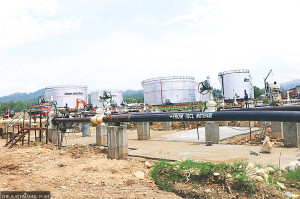
Without more time, projects cannot be completed by the August 2028 deadline, says an MCA-Nepal official. Courtesy of Millennium Challenge Account-Nepal
The Millennium Challenge Account Nepal (MCA-Nepal)’s request for a one-year extension of US-funded infrastructure projects has been stalled for more than six months.
In mid-May, MCA-Nepal submitted the proposal to the Finance Ministry, asking it to formally approach the Millennium Challenge Corporation (MCC) on Nepal’s behalf for an extension of the $747 million compact. The projects include the construction of a 315-kilometre transmission line and the upgrading of a section of the Mahendra Highway.
MCA-Nepal officials in Kathmandu say that despite repeated informal assurances that Nepal is not opposed to the extension, the government has yet to make a decision.
“In informal conversations, ministry officials say they are positive about extending the term, but that has yet to translate into a decision,” said an MCA-Nepal official.
Finance Ministry officials say they have taken the matter to the Prime Minister’s Office, but there has been no progress. The Cabinet must endorse the extension before the government can formally forward the request to the MCC. Amid the prolonged delay, the US Embassy in Kathmandu and senior MCA-Nepal officials have also raised the issue with Finance Minister Swarnim Wagle and senior ministry officials.
The extension request followed the Donald Trump administration’s decision to suspend MCC operations worldwide after taking office in early 2025, disrupting project implementation. In early January, the United States Senate also passed legislation allowing the terms of MCC compacts in Nepal, Indonesia, Kosovo and Senegal to be extended by up to one year. Nepal must approve the extension for it to take effect.
“The extension was proposed to make up for the disruption midway through implementation,” said a senior MCA-Nepal board member who is not authorised to speak to the media.
Under the compact, the projects are scheduled for completion by August 30, 2028. If the extension is approved, MCA-Nepal will have an additional year to complete them.
“The MCC headquarters is positive about the proposal because our reasons are well-founded and valid. The Trump administration has also introduced a new law allowing a one-year extension for projects under implementation in four countries,” said the MCA official.
In its letter to the Finance Ministry, MCA-Nepal cited several circumstances beyond its control that had affected implementation. These included Trump’s decision in July 2025 to suspend foreign assistance and halt MCC payments, leaving the projects in uncertainty for several months before the US administration allowed MCC operations worldwide, including in Nepal, to resume.
The transmission line component has faced additional delays. In October 2023, MCA-Nepal cancelled the bids for the construction of the 315-km, 400kV transmission line after all bidders quoted prices substantially higher than the estimated project cost, forcing it to restart the procurement process.
“Without an extension, neither of the two projects undertaken by MCA-Nepal will be completed by the August 2028 deadline,” said another MCA-Nepal official. An early decision, the official added, would help maintain momentum in implementation and ease pressure to meet the deadline.
A senior Finance Ministry official said the request was under consideration, although no decision had been taken.
“There should be no issue with extending the grant project. I believe the political leadership is also positive about it,” said the official.
MCA-Nepal officials argue that given the frequent delays in completing development projects in Nepal, a one-year extension should not be viewed negatively if it helps ensure the compact's completion.
The MCC compact is a joint initiative of the governments of Nepal and the United States. Nepal is contributing $197 million, while the United States initially committed $500 million through the MCC. In November 2025, the US government announced an additional $50 million grant for the Nepal compact.
MCA-Nepal, the government agency responsible for implementing the compact, is governed by an executive board chaired by the secretary of the Finance Ministry.
The five-year compact was signed between the governments of Nepal and the United States in September 2017.
Despite intense political controversy, the compact was ratified by Nepal’s House of Representatives in February 2022 and officially entered into force on August 30, 2023.
Anil Giri is a Chief Sub Editor covering diplomacy, international relations and national politics for The Kathmandu Post. Giri has been working as a journalist for more than two decades, contributing to numerous national and international media outlets.




 12.12°C Kathmandu