Oli wants some chief ministers to go. Provincial partner against removal ‘so close to elections’
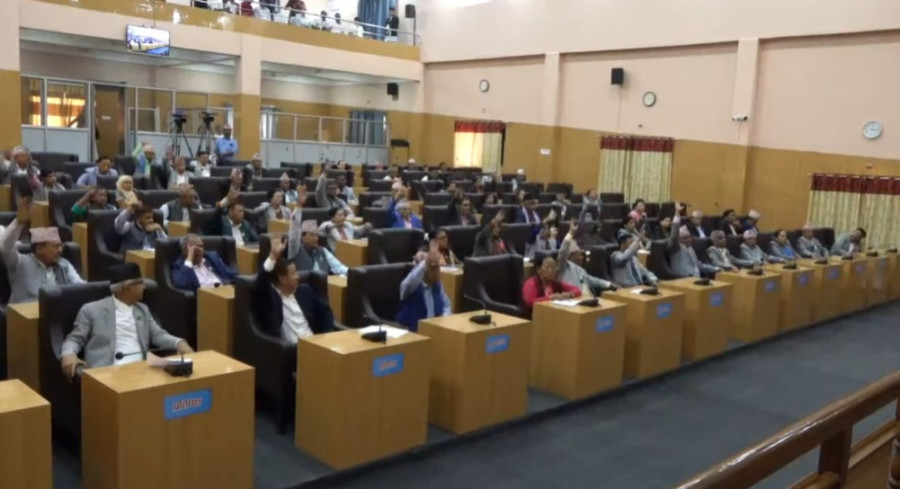
Disputes within the UML have put the chief ministers of Koshi and Lumbini under pressure to quit as heat grows against the chief minister in Sudurpaschim over budget.Post File Photo
Political parties are once again pushing provincial governments towards instability, just four months after the CPN-UML and the Nepali Communist Party (NCP) agreed to form ruling coalitions in the provinces ‘for ensuring’ political stability.
The July agreement led to changes in government in several provinces. But internal disputes in the two parties and disagreements over government leadership have once again unsettled provincial politics.
In Koshi and Lumbini, Chief Ministers Hikmat Kumar Karki and Chet Narayan Acharya are facing growing pressure to resign from within their own party, the UML. Party chair KP Sharma Oli had asked both to make way for other leaders before Dashain after they supported calls for restructuring the party’s policies and leadership.
Oli argued that other provincial lawmakers should also get an opportunity to lead the government. Karki, however, refused to step down, saying the party needed to take a formal decision and that resigning without a compelling reason would give rise to instability.
The NCP, the UML’s coalition partner in both provinces, has also advised the chief ministers against resigning. But an Oli confidant said the UML chair had renewed pressure on Karki to step down immediately after Tihar.
UML secretary and Koshi province in-charge Sherdhan Rai said Karki had agreed before Dashain to resign and that the understanding would now be implemented.
“He had apparently told the party chair that he would step down after Tihar. Karki will now give another colleague an opportunity,” Rai said.
Oli’s dissatisfaction with Karki stems largely from the latter’s position in the UML’s internal power struggle. At a central secretariat meeting in September, Karki, who is also a party secretary, had called for restructuring the party’s policies and leadership to rebuild the organisation, siding with General Secretary Shankar Pokhrel.
Karki was once considered close to Oli. His support for leadership restructuring, however, displeased the party chair.
Following Oli’s instruction, Karki sought the NCP’s advice on whether to resign. The NCP’s provincial parliamentary party advised him against stepping down, arguing that changing the chief minister so close to elections without a compelling reason would invite criticism and undermine stability.
NCP spokesperson Prakash Jwala said changing the chief minister at a time when elections were approaching would be inappropriate.
“We are in favour of stable provincial governments,” he said.
Rajendra Rai, the NCP’s Koshi in-charge, also said it was inappropriate to destabilise the provincial government because of the UML's internal disputes.
“There is not much time left before the next provincial elections. We should allow the incumbent chief minister to continue working,” he told the Post. “It would be wrong to destabilise a provincial government because of conflicts within the UML. We have already made our position clear.”
Karki held consultations with NCP provincial leaders in Biratnagar on Tuesday. After they expressed support for the continuation of his government, he gained further political backing to resist pressure from within his own party.
Indra Bahadur Angbo, leader of the NCP’s parliamentary party in Koshi, said Karki had sought their advice on how to respond to pressure to resign.
“We told him that we were not in favour of his resignation. We do not want to destabilise the province or invite criticism. We support the continuation of his government,” Angbo said.
Some UML leaders have denied that Oli pressured Karki to resign. Provincial Minister for Economic Affairs and Planning Bidur Kumar Lingthep said he had heard that the chief minister was called to Kathmandu but was unaware of any instruction to step down.
Karki’s decision to consult leaders of another coalition partner without first discussing the matter with his own party’s provincial leadership has also caused resentment within the UML. Some party leaders have framed the issue as one of party discipline and the chief minister's relationship with the leadership.
Madhesh government remains incomplete
The Madhesh provincial government, formed under the leadership of the Janata Samajbadi Party Nepal (JSP-Nepal), still lacks clarity on which parties will support it.
Although Chief Minister Saroj Kumar Yadav has pledged to form an all-party government, discussions among the parties have yet to take place.
Yadav became chief minister after the government led by Nepali Congress’s Krishna Prasad Yadav collapsed following the withdrawal of support by the UML and the NCP.
Madhesh Province Chief Surendra Labh Karna had initially invited parties to claim government formation under Article 168(2) of the constitution, which provides for a government backed by two or more parties. As no party came forward within the deadline, he appointed JSP-Nepal’s parliamentary party leader Saroj Kumar Yadav the chief minister under Article 168(3), which allows the leader of the largest party to form the government.
Yadav took the oath of office and secrecy on Sunday.
JSP-Nepal spokesperson Manish Suman said the party was preparing to hold discussions with other parties, seek a vote of confidence next week and expand the Cabinet.
Formal discussions on forming an all-party government are due to happen, Suman told Kantipur.
NCP lawmaker Yubaraj Bhattarai also said discussions on completing the government had not begun.
“The chief minister has not held any discussions,” he said.
The Janamat Party is discussing whether to support the government, while other parties have yet to make their positions clear.
UML moves to replace Lumbini chief minister
Lumbini Chief Minister Chet Narayan Acharya is also under pressure from Oli to resign. Acharya had backed general secretary Shankar Pokhrel’s position on restructuring the party’s policies and leadership.
Oli had sought Acharya’s resignation when the UML and the NCP reached a power-sharing agreement in July. In discussions involving former chief minister Leela Giri, Oli had reportedly agreed that Acharya would remain in office until Dashain before making way for Giri.
Acharya, who is considered close to Pokhrel, is unwilling to step down.
After Giri’s faction pressed the party leadership to honour the earlier understanding, discussions on changing the chief minister have resumed. Sources said Oli had summoned Chhabilal Bishwakarma, the UML’s Lumbini province in-charge, to Kathmandu for talks on the provincial government.
Pokhrel, meanwhile, is opposed to replacing the chief minister.
The NCP, a coalition partner in the provincial government, has consistently opposed a change in leadership. Indrajit Tharu, an NCP minister in the Lumbini government, said replacing the chief minister while parties should be preparing for local elections would send a wrong message.
“This is not the right time to change the government leadership. The party leadership needs to think carefully,” he said.
UML secretary Bishwakarma, NCP leaders Barshaman Pun and Baldev Khanal, and parliamentary party leader Jokh Bahadur Mahara, a former chief minister, have also held discussions on the issue.
During the discussions, Mahara said the NCP could not support a change in government leadership under the present circumstances.
Bishwakarma said the UML would consult the party leadership before making a decision.
“We are still discussing and consulting. We will assess the circumstances and make a decision at an appropriate time,” he said, adding that discussions on the provincial government would continue.
The Lumbini government currently includes the UML, the NCP and the JSP-Nepal. JSP-Nepal has internal disagreements over its participation in the government, while the NCP is also dissatisfied over the allocation of ministerial portfolios.
NCP lawmakers seek to oust Sudurpaschim chief minister
In Sudurpaschim, which has seen five changes of government in four years, efforts are under way to remove Chief Minister Khagraj Bhatta. Lawmakers from his own party, the NCP, have started collecting signatures to press for his resignation.
Disputes over the provincial budget have spilled over the functioning of the government. A budget presented by the previous government led by the Nepali Congress, with the UML as a partner, on June 15 failed to pass, eventually bringing down the government.
The current UML-NCP coalition was formed after the Congress-UML alliance broke down. But the new government has also faced disputes over its budget from the outset.
After a three-month impasse, the government presented a budget on October 11. Opposition from its own lawmakers threatened to prevent its passage. Chief Minister Bhatta then agreed in writing to form a parliamentary study committee to examine the budget and introduce a supplementary budget by November 17. Lawmakers subsequently agreed to pass the budget.
However, two UML lawmakers, Dharma Raj Pathak and Bir Bahadur Thapa, defied their party whip and stayed away from the provincial assembly session on the day the budget was passed.
Provincial Minister for Economic Affairs Chakra Bahadur Malla acknowledged errors in the budget from the assembly rostrum, saying it needed proper financial planning.
Speaker Bhim Bahadur Bhandari also announced the formation of an assembly committee to investigate the budget. He directed the committee to submit its report by November 6 and the government to introduce a supplementary budget.
Neither the government’s written commitment nor the speaker’s directive has been implemented. The parliamentary committee has not even been formed.
Bhandari said the committee could not be formed because the main opposition Nepali Congress had refused to nominate its members. Kamal Bahadur Shah, leader of the Congress parliamentary party, said his party did not consider it appropriate to join a committee that, in his view, was intended to whitewash the government's irregularities.
The budget dispute has also deepened divisions within the NCP, the party leading the government.
The party had issued a circular directing its leaders and cadres to conduct a nationwide awareness campaign from November 26, extending from provincial and district levels to local governments and wards. But the campaign has been postponed in Sudurpaschim because of the continuing budget dispute, said Bhanubhakta Joshi, the NCP's provincial in-charge.
Dissatisfied NCP lawmakers are now demanding that Bhatta resign.
“The government has already lost its justification for remaining in office. It first acknowledged irregularities in the budget through a Cabinet decision before presenting it to the provincial assembly. The same Cabinet then approved the budget and presented it to the assembly. The parliamentary party subsequently decided to form a study committee and introduce a supplementary budget, but the government is now ignoring its own decisions. This is unacceptable,” said NCP lawmaker Man Bahadur Dhami.
“The chief minister should resign on moral grounds. We are also working to gather enough numbers to remove him.”




 8.12°C Kathmandu