Chitwan’s rhinos escape poachers but face other deadly threats
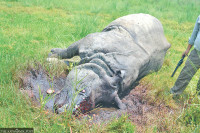
The park has recorded no poaching for more than three years, but 64 rhinos have died from other causes, including electrocution and encounters with security personnel.A dead rhino in Jagatpur, Chitwan. The latest census recorded 752 rhinos across the country, with 694 living in Chitwan National Park, its buffer zone and surrounding forests. Post File Photo
Chitwan National Park has recorded no confirmed rhino poaching for more than three years, marking a significant achievement in wildlife conservation.
But while anti-poaching efforts have curbed illegal hunting, electric fences, encounters with security personnel and shrinking habitats continue to threaten the one-horned rhinoceros.
Poaching cases were last confirmed in 2023. On August 30 that year, a rhino skeleton was found in the Harda Khola area of the park. Although much of the remains was intact, the horn was missing. An examination found that the nasal bone and the front part of the skull had been cut away, confirming that the animal had been killed for its horn.
On November 16, 2023, two more rhinos were found dead in a pit in the Chaparchuli area of the park’s eastern section, both with their horns removed. They were the last confirmed victims of poaching in Chitwan, said Dil Bahadur Purja Pun, a former chief conservation officer at the park.
No more poaching has been recorded since. However, 64 rhinos have died from other causes since the last confirmed incident, including three electrocuted by farm fences and one shot by security personnel after attacking an army patrol.
According to park records, 72 rhinos have died in Chitwan National Park and its buffer zone since the fiscal year 2023-24. The annual toll was 21 in 2023-24, 28 in 2024-25, 20 in 2025-26 and three in the current fiscal year. Eight of the deaths in 2023-24 were recorded between mid-July and November 15. These included the three rhinos killed by poachers.
Conservation officer Ganesh Tiwari, also the park’s information officer, said the three rhinos lost in the current fiscal year had died of natural causes in the park and its buffer zone. More than 1,100 days have passed without a confirmed poaching incident, he said.
One of the rhinos caught in an electric fence was a 13-year-old female found dead in Bhagedi, ward 27 of Bharatpur Metropolitan City, on July 23, 2024. An investigation found that it had been electrocuted by a live wire fence installed by a farmer to protect crops.
A similar threat to rhinos emerged from electric fencing around farmland. On May 16, 2025, a rhino was found dead by electrocution in a maize field in Syauli, ward 1 of Kawasoti Municipality, near Lokaha in Nawalparasi East.
Another rhino died on August 5, 2025, after coming into contact with an electric fence installed to protect paddy fields in Bhairavpur, ward 2 of Madi Municipality.
Of the three rhinos electrocuted since November 2023, two died in the park’s buffer zone and one in a national forest outside it.
The animals have also died in encounters with security personnel. On April 9, 2026, a rhino attacked a Nepal Army patrol returning from Seri post, leaving one soldier seriously injured. The park said soldiers were forced to fire in self-defence, killing the animal.
“Regular patrols and intelligence gathering are essential to controlling rhino poaching,” said Kamal Jung Kunwar, a former chief conservation officer of Chitwan National Park who has extensive experience in anti-poaching operations.
He said security personnel needed to cover the entire park regularly, including its remote corners, and establish temporary camps in difficult locations for several days at a time.
“Patrols must prevent unauthorised entry into the park. Outside its boundaries, informants must be effectively mobilised to ensure that poachers and traffickers cannot operate,” he said.
Without regular patrols and intelligence gathering, cases of poaching may come to light only after suspects are arrested, Kunwar added. This means illegal hunting can go undetected even during periods officially declared free of poaching.
Chitwan National Park has previously celebrated several poaching-free years and milestones of more than 1,000 days without illegal hunting. But political instability has historically made rhinos more vulnerable.
During the Maoist insurgency, the declaration of a state of emergency led to a reduction in the number of security posts inside the park. Poachers killed as many as 37 rhinos in a single year in 2001. The situation remained difficult in the aftermath of the 2006 people’s movement.
Poaching gradually came under control. On January 4, 2012, the park held its first major celebration marking a year without rhino poaching. Although incidents increased somewhat during the Covid-19 pandemic, poaching is now under control, according to park officials.
Alongside regular patrols, the park has increasingly turned to technology, including drones and surveillance cameras, to monitor suspicious activities.
On July 13, 2025, a surveillance camera detected two men entering the park dressed in army uniforms and carrying weapons and bags. The footage was transmitted to the park’s control unit. One of the men was identified as Ram Sharan BK, who had served a prison sentence in a rhino-related case.
Park authorities arrested one of the men immediately, while BK was apprehended five months later. The park has installed surveillance cameras at 25 locations.
Kunwar said technology, intelligence networks and regular patrols were all essential to apprehending poachers and preventing illegal hunting. But he stressed that rhino deaths from other causes also required attention.
While deaths from old age and natural disasters are part of the natural cycle, some are directly linked to the management of the park, he said.
“When rhinos enter farmland and die after being electrocuted, that is a management issue,” Kunwar said.
Kunwar said the park needed sufficient grasslands and ponds to keep rhinos and other wildlife within its boundaries and reduce their dependence on farmland for food and water.
Grasslands inside the park have been shrinking, while those that remain are not being properly managed. Ponds and wetlands have also been filled in or dried up. As a result, animals venture outside the park in search of food and water, increasing encounters with farmers who try to protect their crops.
Recognising the problem, the park has drawn up a plan to restore and manage 1,650 hectares of grassland. Work has been completed on 125 hectares so far, Tiwari said. The park also plans to renovate 12 existing ponds and build four new ones.
Chitwan National Park covers 952 square kilometres. Grasslands once accounted for as much as 20 percent of its area, but their share has now fallen to around 10 percent. The park previously had 58 ponds and wetlands.
Shivaji Gayak, chair of the Chitwan National Park Buffer Zone Management Committee, said farmers were compensated for crop damage caused by wildlife. Authorities have also built walls and erected fences to keep animals away from farmland.
However, residents have continued to complain that the compensation and preventive measures are inadequate. The park paid Rs2.108 million in compensation for crop losses last year alone, Tiwari said.
Chitwan National Park is home to the largest population of rhinos in Nepal. The latest census recorded 752 rhinos across the country, with 694 living in Chitwan National Park, its buffer zone and surrounding forests.
The one-horned rhinoceros is a protected species under Nepal’s law. Anyone found killing a rhino, trading its body parts or transporting them can face up to Rs1 million in fine, a prison sentence of up to 15 years, or both.




 10.12°C Kathmandu