Book Review: Rethinking Nepal’s geopolitical choices in an uncertain world order
In his new book, political scientist Lok Raj Baral challenges conventional ideas of geopolitical balancing and examines how Nepal can safeguard its strategic autonomy.
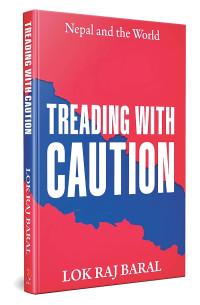
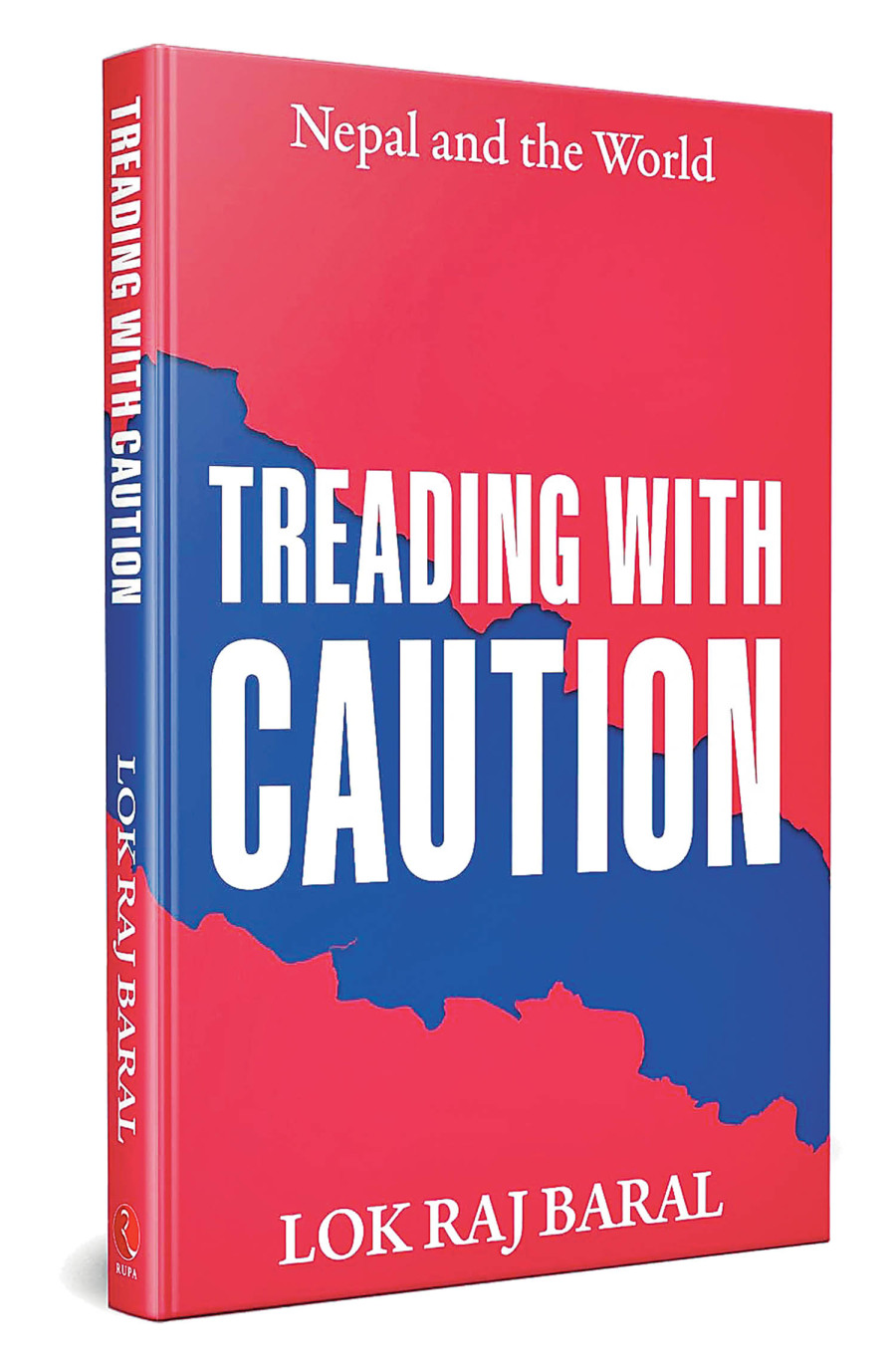
Professor Lok Raj Baral’s new book ‘Treading with Caution: Nepal and the World’ (Rupa, 2026) is set to hit the shelves Monday. Baral is a Nepali political scientist of international repute. Beginning with his pioneering work ‘Oppositional Politics in Nepal’ (1977), he has authored more than a dozen books and edited a comparable number of volumes. Aptly titled ‘Treading with Caution’, his latest book offers a comprehensive perspective on Nepal's foreign policy in the context of an uncertain international order and an increasingly complex geopolitical setting. At its core, the book addresses a fundamental question: How can a relatively small and economically vulnerable state like Nepal preserve its foreign policy autonomy while operating in a strategically sensitive and complex geopolitical environment?
It is relevant to situate this book within Professor Baral’s broader intellectual contribution. He has not merely been an observer of national and international politics; his works have consistently engaged with the relationship between state formation, democracy, political institutions and geopolitics. The significance of this book, therefore, should be assessed not simply in terms of whether it offers new policy recommendations, but also in terms of how it advances our understanding of the relationship between Nepal’s domestic political order and its international position.
The book is organised in six main chapters in addition to an introduction, a conclusion and an epilogue containing relevant historical documents as annexures. In the introduction, the author sets out the context and motivation for writing the book, acknowledging that his enthusiasm was stimulated by reading various books and articles. His enduring commitment to reading and writing is inspiring. This book, too, as the author admits, was partly inspired by his engagement with contemporary literature on changing global patterns of international relations and domestic politics.
The first chapter examines the changing world order, which the author prefers to characterise as a state of ‘disorder’, largely because of the arrogance of major powers towards relatively smaller states. In his view, such states are confronting a ‘survival challenge’, and as a consequence, have become ‘pliant to big powers’. However, the definition of a small state is itself debatable. For instance, in terms of geographical size and population, Nepal may not necessarily be categorised as a small state. Nevertheless, its geopolitical location vis-à-vis its giant neighbours, India and China, exposes it to what may be called a ‘small-state syndrome’.
The second chapter, which deals with the broader context of geopolitics, appropriately explains the constraints of states like Nepal both in the domestic and international arena. The next two chapters focus on Nepal’s relations with its immediate neighbours—India and China. Chapter Five examines demographic linkages and their influence on Nepal’s foreign relations, while Chapter Six looks beyond the neighbourhood to discuss Nepal’s relations with the United States, European countries, Japan and multinational organisations including the United Nations.
The book stimulates important debates within Nepal’s intellectual and political communities on three interconnected issues—nationalism and sovereignty, the relationship between domestic politics and foreign policy, and the future of small states in an increasingly competitive international system.
Nepal’s location between India and China has historically shaped its political identity, diplomatic behaviour, and understanding of national security. Its foreign policy has rarely been determined exclusively by its own national priorities. Rather, it has evolved through an interaction between geographical constraints, regional power configurations, and domestic political developments.
The book enters into this debate at a time when, as the author observes, international politics is increasingly uncertain. The international system is undergoing considerable transformation as traditional assumptions about balance of power and international cooperation are being challenged. Strategic competition among major powers is increasingly influencing the choices available to states, particularly those with limited economic and geopolitical leverage.
Against this backdrop, the book attempts to move the discussion of Nepal’s foreign policy beyond the conventional India-versus-China framework and situate it within the broader debate on small-state diplomacy, geopolitical vulnerability and strategic autonomy. The author’s critical remarks on the rhetoric of ‘equi-distance’—particularly the tendency among some left-wing politicians and intellectuals to glorify the relationship with China—may be debatable. Nevertheless, his argument suggests that nationalism should be assessed through the state’s capacity to protect national interests rather than through symbolic diplomatic gestures. The author’s commitment to objectivity and realistic policy formulation is valuable for both policymakers and students of international relations.
Nepali political discourse has traditionally attached considerable importance to national sovereignty and independence. However, the effective exercise of sovereignty requires economic and institutional capabilities. The author’s approach invites readers to consider sovereignty in terms of actual policy-making capacity rather than rhetoric alone. Likewise, Nepal’s frequent changes of government, political instability, and inconsistent policy positions have often undermined its diplomatic credibility. Professor Baral, for instance, cites Gen Z uprisings which brought to the fore the vulnerability of the Nepali state. Foreign policy cannot be separated from domestic political institutions and leadership.
Professor Baral places considerable emphasis on the realist tradition of international relations. He challenges excessive idealism and politically motivated interpretations of foreign policy. His emphasis on realism points to a distinction between national interests and domestic political rhetoric. His central argument is that Nepal’s geopolitical position cannot be understood through simplistic formulations of equidistance between its two immediate neighbours. For decades, Nepali political discourse has frequently presented foreign policy as a choice between maintaining relations with India and expanding relations with China. This has often produced a politically charged debate in which engagement with one neighbour is interpreted as a strategic concession to the other. The author challenges this approach.
The author’s observation that “the high-sounding idea of converting Nepal into a bridge between India and China, or becoming a ‘land-linked’ country, would be a fallacy” is particularly noteworthy. He further argues that geopolitical developments have demonstrated that Nepal’s two big neighbours can act in unison when their interests converge, as illustrated by their turning “a deaf ear” to Nepal’s concern on Lipulek (p. 221). Similarly, he refers to what he considers unwanted adventurist foreign policy initiatives, including King Gyanendra’s proposal concerning China’s membership in SAARC and then prime minister KP Sharma Oli’s assurance to President Xi Jinping regarding Nepal’s acceptance of Global Security Initiatives (GSI). The author considers such initiatives ‘unnecessarily problematic’ (p. 223).
Nevertheless, Nepal’s international exposure has expanded without eliminating its geographical dependence on its immediate neighbours. Access to international markets, transit infrastructure, energy cooperation and regional connectivity remains heavily influenced by the policies of India and China. The challenge, therefore, is to develop a larger and clearer understanding of how geographical constraints interact with the opportunities created by an expanding international system.
Foreign policy is not formulated in a political vacuum. The relationship between domestic political competition and diplomatic decision-making deserves sustained examination. Nepal’s constitutional identity and political institutions have changed considerably, but many of the geopolitical challenges confronting the country remain the same. A change in political leadership does not automatically produce a change in geopolitical realities. The fundamental challenge remains how Nepal can translate its changing domestic political circumstances into a coherent and sustainable foreign policy and consistent diplomatic behaviour.
Last, but not least, the author’s concluding observation deserves particular attention. He argues that “the domain of foreign policy also needs to be updated, as the conventional approach—particularly conducted in the name of balancing neighbours—does not work anymore” (p. 218). This observation captures the central message of the book. Nepal needs to move beyond conventional approaches to geopolitical balancing and develop a more pragmatic, informed, and interest-based foreign policy. Such an approach requires diplomatic caution as well as strategic clarity, institutional consistency, and a realistic assessment of the country’s capabilities and limitations.




 10.12°C Kathmandu