How documentary cinema captures a South Asia in transit
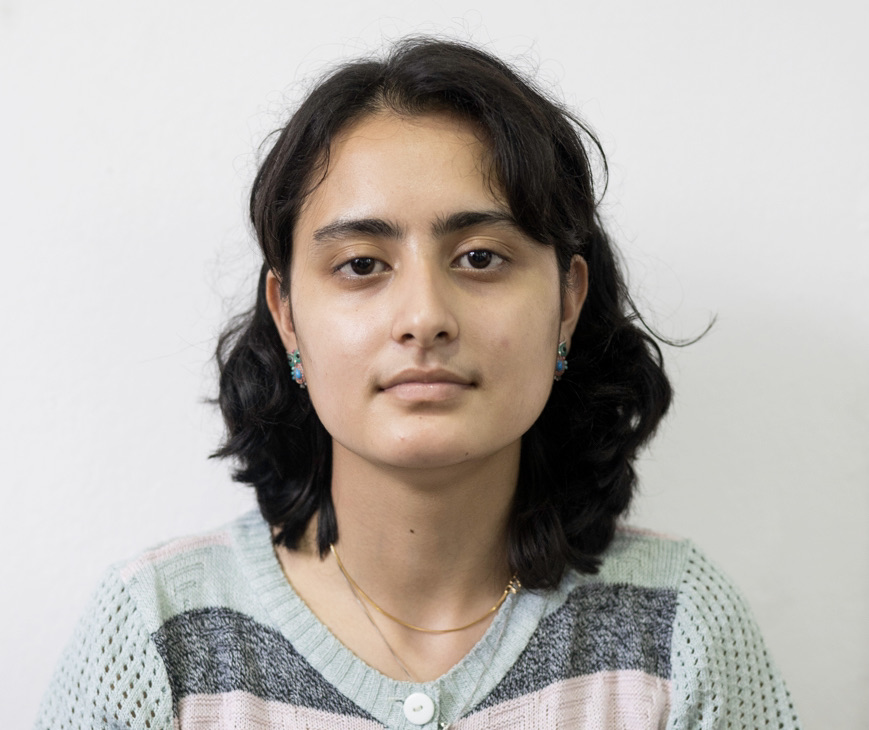
This year’s Film Southasia brings together documentaries that explore migration, fractured histories, cultural resilience and political resistance across the subcontinent. Journalist Subina Shrestha introduces her documentary ‘Devi’ ahead of its screening at Film Southasia in Patan, Lalitpur on November 22, 2024. Photos: Courtesy of Film Southasia
The story of South Asia has always been a story of movement. Long before cartographers drew lines across mountains, rivers and plains, this ancient civilisation was shaped by the movement of people and circulation of ideas, languages and faiths. Beneath the colonial debris—the “corset” of the modern nation state, as Indian sociologist Shiv Visvanathan and Film Southasia Chair Kanak Mani Dixit once put it—a deeper, more resonant reality persists. In their essay ‘Towards a New Ontology of South Asia’, the authors argue that the region cannot be reduced to a dull diplomatic contract; it must be understood as a “commons of belonging”, built on kinship, shared ecologies and pluralistic memory. Today, as checkpoints harden to a point where one cannot fly over certain skies, Kathmandu Valley remains a rare, porous threshold, a space where people from across the subcontinent can still gather in the same room, share a meal and watch each other’s stories unfold on screen.
Film Southasia is one particularly unique gathering that takes advantage of the Valley’s—and Nepal’s—open margins. The festival, now in its 29th year, has established itself as a meeting place for non-fiction cinema made by South Asians, for South Asians. The festival’s new edition is set to start at Yalamaya Kendra in Patan on Thursday and will run through Sunday. It brings together 48 non-fiction films from Afghanistan, Bangladesh, Bhutan, India, Myanmar, Nepal, Pakistan, Sri Lanka, and the wider diaspora under the theme ‘Documentary in Transit’.
The word documentary was coined in 1926 by the Scottish filmmaker and critic John Grierson, who borrowed it from the French ‘documentaire’, then used for travel and expedition films. Its roots run deeper still, through the Latin documentum, from ‘docere’, to teach: a lesson, a proof, an official paper admitted as evidence. Grierson famously defined documentary as “the creative treatment of actuality.” Yet its early legacy was rooted in state-funded ethnography and imperial observation. Many of us have seen those archival black-and-white reels accompanied by a “voice-of-god” narration in proper English explaining an “exotic” culture, including early educational films about Nepal itself. Funded largely by state-run institutions, this tradition carried the risk of turning films into propaganda or reducing peoples of the Majority World to passive curiosities. In Nepali and some South Asian languages, the word for documentary is ‘vrittachitra’—formed of ‘vritta’, meaning a circle or a cycle, and ‘chitra’, meaning images. Vrittachitra binds the image to occurrence itself and to the event as it was lived.
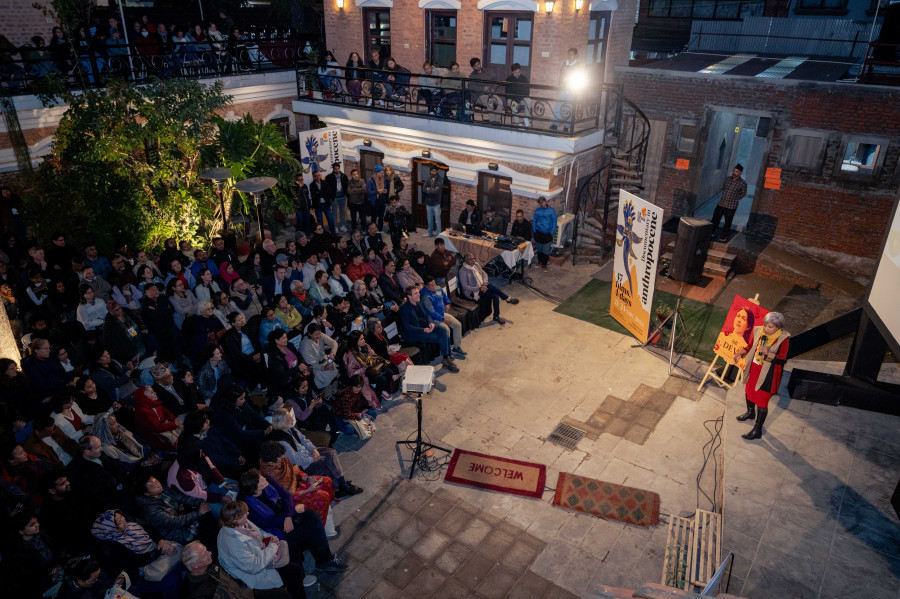
A glimpse of the screening of ‘Land of My Dreams’, a documentary on Muslim women’s nonviolent protest against India’s Citizenship Amendment Act at Shaheen Bagh, at Film Southasia 2024.
We live in a time where documentary has had to reckon itself. What makes it different from increasingly visual media culture? Why should people come and pay money to learn about an issue that one can simply look up online? This is perhaps also why the documentary itself has become self-reflexive. Over the past few decades, documentarians all over the world, including those from South Asia, have increasingly shed that top-down “voice-of-god” posture. Moving past the illusion of objectivity, non-fiction cinema has grown deeply introspective. Filmmakers are looking inward, examining the form itself, questioning the power dynamics between the person holding the camera and those standing in front of it. They are building a close-knit community driven less by commercial spectacle than by a sense of ethical urgency.
That inward-looking sensibility is especially vital now. After all, movement in South Asia is not a historical memory; it is seeped in our households, in our everyday life. Millions of South Asians live and work abroad. Collectively, South Asia receives over $200 billion annually in remittances, according to the latest World Bank figures. In Nepal alone, remittance inflows surged to Rs2.36 trillion in fiscal year 2025/26, according to Nepal Rastra Bank, equivalent to roughly one-third of the country’s GDP. Behind those figures lies a generational vocabulary of departure and absence. Our language itself holds the remnants of these journeys: Muglan, recalling historical migrations toward the Indo-Gangetic plains during the Mughal era; Lahure, a name given to those who traveled to Lahore for military and wage labor; and Khadi, referring to the Gulf states, a word that is increasingly finding a place in contemporary Nepali cinema, folk music, literature, and social media.
The selection for this year’s Film Southasia recognises South Asia as a region that is constantly in flux, with its ancient history becoming incredibly enmeshed, sometimes rather violently, with modern pressures. The physical act of migration, of course, emerges as a recurring theme but filmmakers move beyond the numbers and deal with the nuances. Rather than treating migration simply as a policy crisis, the festival turns the camera to ask what happens to those who leave, those who are forced out and those who remain behind.
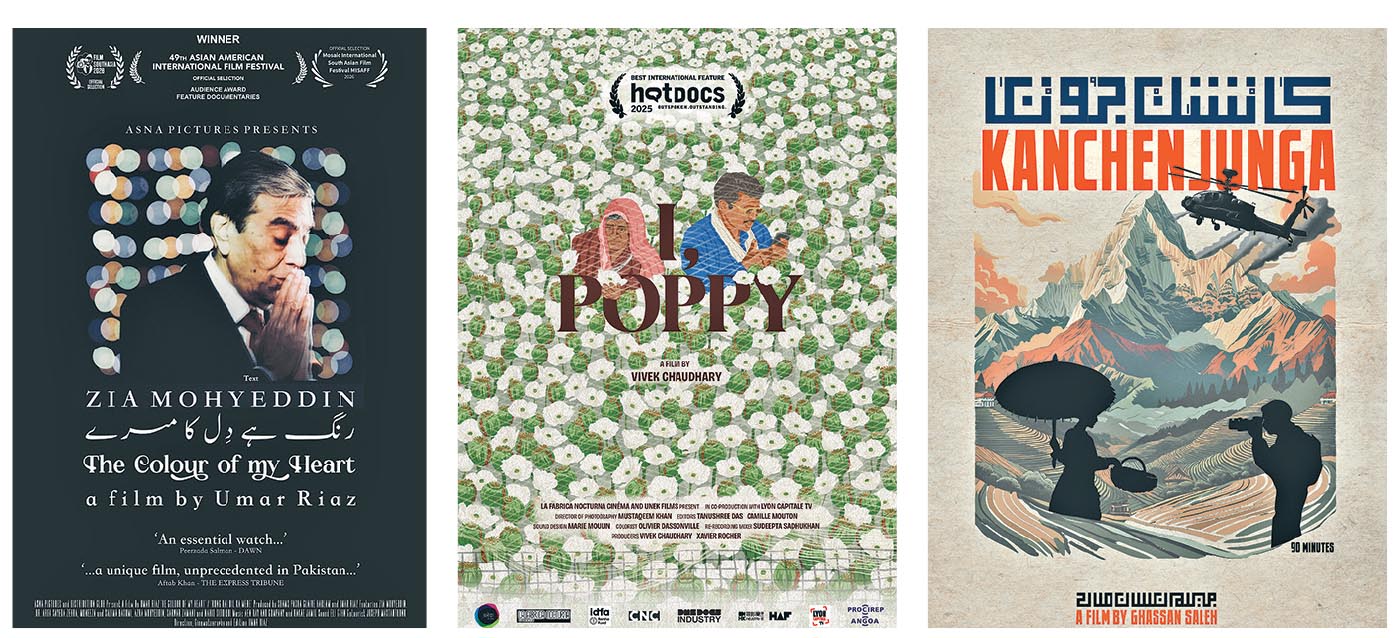
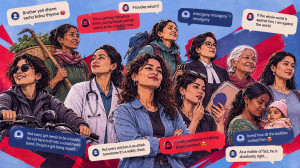
Posters of three of the more notable titles being screened at the festival.
Within Nepal, that inquiry takes familial forms. The student film ‘All About My Father’ reflects on a father’s migration to Japan, tracing the emotional distance that accompanies economic necessity, while the debut feature ‘I Will Be Back with a Pen’looks back across generations at a grandfather who never returned home after the armed insurgency.
Across the wider subcontinent, looking inward also becomes an act of experimentation. In the student film ‘Notes on Dhanyakuria’, an abandoned haveli becomes a vessel for memory. Meanwhile, in ‘Paikar’, Dutch-Afghan filmmaker Dawood Hilmandi turns the lens directly onto his own family, confronting his authoritarian father’s violent past across a journey through Afghanistan, Iran and Iraq. Lebanese filmmaker Ghassan Saleh’s ‘Kanchenjunga’begins with a single photograph taken in Darjeeling of a smiling tea plucker in a blue dress. Returning years later to search for her across tea estates, archives and workers’ homes, Saleh uncovers the colonial residues behind one of the world’s most celebrated teas, ultimately linking the Darjeeling hills to South Lebanon, where his grandmother once ran a small tea and coffee shop through war and occupation.
Other films in the cohort turn inward toward cultural survival and resistance against erasure. Umar Riaz’s ‘The Colour of My Heart’ brings together the revolutionary verses of Pakistani poet Faiz Ahmed Faiz and the life and annual Lahore recitals of legendary actor Zia Mohyeddin, confronting the erosion of native languages and the precarious state of artistic expression across South Asia.
Meanwhile, Indian filmmaker Vivek Chaudhary’s ‘I, Poppy’ follows Dalit poppy farmer Vardibai and her activist son Mangilal as his anti-corruption campaign triggers devastating retaliation—the revocation of his mother’s farming license—revealing the personal cost of confronting state power. That same tension between citizen agency and institutional memory animates Kannan Arunasalam’s ‘Republic of Amnesia’, which traces the rise and fall of Sri Lanka’s 2022 Aragalaya protest movement where three young activists ask whether fragile political hope can survive in a nation built on forgetting.
Audience pictured during a screening at Film Southasia 2024.
In this vein, Film Southasia continues to serve as an essential sanctuary for cinema made under constraint. In many places in South Asia, censorship, conflict, and political precarity make public exhibition difficult. Films like ‘Dating in the Dark’ capture the resilience of daily intimacy, faith and human connection surviving beneath surveillance.
By bringing these works into Patan alongside filmmakers and audiences, Film Southasia attempts to temporarily suspend modern borders, allowing civil society to converse across national lines.
Yet the responsibility does not end with the filmmaker. While we are becoming more comfortable with neatly packaged, bite-sized news clips, non-fiction cinema asks for a different kind of discipline. Looking inward also means cultivating an audience willing to slow down, resist easy answers, and sit with nuance. Film Southasia 2026 is an invitation to do just that—to gather, look closely at our neighbours and recognise our own reflection in a region forever in transit.
Acharya is the festival coordinator at Film Southasia 2026. Tickets for Film Southasia are available for purchase on the festival’s website and social media.




 7.12°C Kathmandu