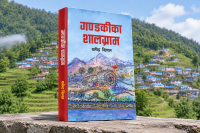
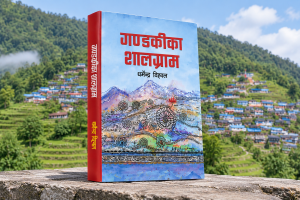
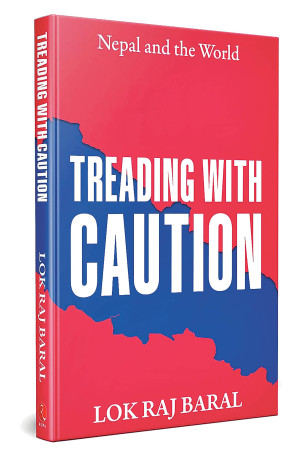
In his new book ‘Gandakika Shalgram’, journalist Dharmendra Jha blends a reporter’s rigour with an outsider’s affection to portray the province through its people and places. The sight of Bhujung village illuminated by electric lights leaves the author spellbound. (Left) The book’s cover.
When writer and journalist Dharmendra Jha visited the Shaligram Museum in Baglung a year ago, he came back overwhelmed. It was not that he was unfamiliar with these sacred stones; he had seen plenty of them in households across Mithila, a region he hails from. But he had never encountered a collection of 125,000 Shaligrams in one place. The experience moved him to write a travel essay titled ‘Bhagwan Dhunga Bhetda’—encountering god-stone. Hindus worship Shaligram as a self-manifested form of Lord Vishnu.
‘Gandakika Shalgram’, a recently published collection of 25 travel essays, brings together such memories and impressions from the author’s journeys across Gandaki Province. Published under Jha’s pen name Dharmendra Bihwal, the book explores the province’s religious and historical sites, tourist destinations and lesser-known landscapes. Jha’s affection for the hills and mountains is particularly striking for a writer from the plains of Mithila.
An interesting episode illustrates how a place’s name alone can shape one’s imagination. Around 1992, after completing his master’s degree in political science, Jha was looking for a stable job. Although he was already working in journalism, he did not see a secure future in the profession. A senior academic at a college in Parbat offered him a teaching position. Jha declined, largely because of the district’s name—the word ‘parbat’ means a mountain.
In ‘From the Land of Sita to Parvati’s Birthplace’, he recalls: “Goodness, the very name is Parbat! How remote must the place be? ... It was only much later, when I finally visited Parbat, that I realised it was nothing like the inaccessible place I had imagined.”
Had he accepted the offer, he might have taken a different professional path. And he might never have written this book at all. Instead, Jha went on to consolidate a career in journalism, having now remained active for 34 years.
Jha’s essays explore Gandaki’s diverse landscapes, cultures, history, religious beliefs and tourism potential. His writing goes beyond describing places to examine their social, economic and cultural dimensions. Writing about Hampal mountain, for instance, he notes that it offers views of several Himalayan ranges, including Dhaulagiri, Annapurna, Nilgiri, Putha Uttarganga, Machhapuchhre and Manaslu. He sees considerable tourism potential in such destinations, arguing that better local promotion could attract visitors, stimulate the economy and benefit residents.
In ‘Chakrashilaka Galeshwar’, Jha recounts a journey from Beni to Muktinath, bringing in local legends and stories of religious origins to enrich his account. His affection for the region is even more evident in ‘Beni, I Still Have So Much to Say to You’. At times, he becomes emotional, expressing the belief that wherever one is born, one should love every part of one’s country and the communities that inhabit it.
His account of Beni goes beyond personal impressions to examine the town's history and strategic significance. He draws on historians, books and other references to substantiate his observations. This journalistic instinct for research and factual accuracy gives the travel essays credibility. He also expresses concern about the risks facing Beni, situated along the Kaligandaki river.
Reading his account reminded me of my own visit there around 2022, with poets Sangeet Shrota and RK Adipta Giri, among others. The settlement along the river and the extraction of its resources had troubled me too. Giri had recounted the damage caused by exploitation and continues to speak out for the river’s protection.
In ‘Myagdiko Parichaya Bandai Tatopani Kunda’, Jha describes his visit to the natural hot springs, popular with visitors from Nepal and abroad. He captures the experience of taking a dip while also offering a brief account of the springs’ origins, development and growing popularity. His narrative combines personal experience with reporting on why the pools attract those seeking natural remedies.
Jha’s special affinity for Gandaki is unmistakable. His earlier Maithili travel collection, ‘Jagannmukti’, also recounts journeys to Jagannath and Muktinath. In Gandaki, he pays attention not just to places and their attractions but also to local enterprise. He includes the story of a young man who abandoned overseas employment to pursue coffee production at home—a reminder that opportunities need not always lie abroad.
In Baglung, Jha explores the origins of the district’s name. According to local folklore, ‘bag’ means tiger, while ‘lung’ in the Magar language means stone or open ground. The place is believed to have acquired its name because of the caves and open grounds once inhabited by tigers. Such accounts help readers understand local history and identity. They also invite reflection on the gradual disappearance of traditional place names and the outside interference that can erode the identities attached to them.
In ‘Ghodabandhe Hudai Torikhola’, Jha describes the hospitality at a homestay where visitors are welcomed with traditional panche baja music. ‘Sirsekotma Pahuna Lagda’ explores how the Gurung community has embraced homestay tourism while seeking to preserve its culture and identity. Recalling the warmth of his hosts, Jha writes: “Our Maithil society is known for its excellent tradition of welcoming guests. But after coming here, I could no longer insist that the Mithila tradition of hospitality was the finest.”
The passage reflects his willingness to appreciate traditions beyond the boundaries of geography and community. It captures the spirit of Atithi Devo Bhawa—the guest is equivalent to God.
Not all destinations, however, have managed to preserve their natural environment and distinctiveness. In ‘Sarangkot Bata Himal Awalokan’, Jha quotes a friend who laments that the place seems to be losing its originality despite becoming more accessible. Pointing to cigarette butts scattered around, the friend observes that commercial interests have received more attention than environmental protection. The episode serves as a reminder that even small acts of neglect can undermine the beauty and character of tourist destinations.
Having travelled to all 75 districts of Nepal, Jha also brings the stories of ordinary people into his essays. His travel companions and encounters include Dik Bahadur Limbu, a driver from Tehrathum, and young men from the Tarai working on roads in the mountains. The latter complain that they earn just Rs800 a day despite working from 7am until late evening. Their experiences raise questions about fair wages and the dignity of labour, particularly for those forced to leave home and undertake hazardous work in search of employment.
Jha’s descriptive ability is particularly evident in ‘Maulikta Jogaudai Paryatak Lobhyaudai Bhujung’. Recalling the journey from Besisahar, he describes an unpaved road winding past steep mountain slopes and deep gorges, with greenery, waterfalls and distant Himalayan peaks offering relief from the difficult drive. By the time he reaches Bhujung, it is dark. But the sight of the village illuminated by electric lights leaves him spellbound. Such passages bring the landscape vividly before the reader.
Overall, ‘Gandakika Shalgram’ presents the province’s natural beauty, culture, religious beliefs, history and tourism potential in accessible language. Jha avoids exaggerated descriptions, grounding his observations in facts and references. In many essays, the journalist’s instinct for research and accuracy comes through more strongly than the travel writer’s personal impressions.
For readers seeking to understand Gandaki not merely through its mountains, rivers, lakes and religious sites, but also through its people, their labour, culture, struggles and possibilities, this book is a worthwhile read. It offers a compact portrait of the region’s many colours and dimensions, through the pen of an experienced journalist.




 8.12°C Kathmandu