



 15.69°C Kathmandu
Thu, Oct 15, 2026
Books
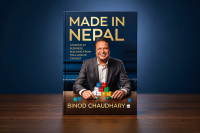
Book review: What Binod Chaudhary’s memoir says about making it in Nepal
‘Made in Nepal’ is as much a story of privilege, power and betrayal as it is of business.
bookmark
Rivash Rijal
Published at : August 15, 2026
Updated at : August 15, 2026 07:26
Kathmandu
The country’s sole dollar billionaire, Binod Chaudhary’s, new memoir, ‘Made in Nepal: Lessons in Business Building from the Land of Everest’, is, above all, a window into his mind. The truthfulness with which Chaudhary writes is striking. He does not attempt to conceal facts that may portray him in a bad light. He is, for example, upfront about the relationship between business and politics.
“Businessmen politicians were a reviled lot,” he says in the part talking about his political journey. He has written with a type of awareness that most of the rich and powerful lack.
At the beginning of his work is a note addressing protests last September, in which he points to Nepal’s staggering economic inequality as the issue at the core of what motivated protestors. This is a welcome understanding for the man, alongside being a lawmaker and, one would imagine, an influential donor, but the understanding does not seem to translate for him into support for left-wing policy. It comes across as more a distrust of Nepal’s politicians and bureaucrats than an aversion to policies aimed at helping the poor itself.
“Nobody can make Binod Chaudhary a communist,” he says in a part where he talks about almost getting a ticket from the CPN-UML. The same party, however, he shares, dropped a policy proposing higher taxes on Nepal’s hyperwealthy, in part because of his lobbying, so I suppose the ‘communist’ in CPN-UML is as little an indication of ideology as his membership in the party is.
The book follows Chaudhary’s journey as he takes over his father’s business and takes it to the heights he did. It was a journey full of many mistakes and betrayals. Chaudhary comes across as both shrewd and naive at the same time. On the one hand, over and over again, he is taken advantage of by lying, scheming, and swindling business partners, and on the other hand, he seems to manage to react in time and well enough to come out on top.
While reading the book, one comes across a long sentence, about four lines long. The following four lines repeat the same sentence in full, almost verbatim, with only a few words replaced. There are many other errors throughout my editions of the book, suggesting that whoever was responsible for finalising the manuscript did a rather slack job.
Some stories Chaudhary shares feel like straight fiction, like things that could never happen in real life, yet have happened to him and those around him. A standout example is when a sitting minister forces Chaudhary’s sons to donate a large sum of money to the PM fund during the Covid-19 pandemic, money that CG had otherwise raised for its own aid efforts.
On that note, the book tells readers a great deal about CG’s philanthropic efforts in Nepal. Of the many projects that the billionaire had overseen, the most impressive are his works in the aftermath of the 2015 Gorkha earthquake and during the Covid-19 pandemic.
Chaudhary is not shy, except in a handful of cases, about naming people with whom he has clashed in the past and detailing how they tried to wrong or harm him. I suppose the point of a business book is to teach readers business lessons; the book’s name would also suggest the same. The biggest lesson in the book is not about business management or efficiency creation, but that people can be really nasty and conniving with each other.
The author is guilty of assuming the best of people; he pays for this mistake at times. It makes him alert but does not tip him over the edge into someone weary of their colleagues.
‘Made in Nepal’ is a good reminder of who gets to become rich in a country like Nepal. And the answer is often those with ancestral wealth and connections with the ruling class.
Prince Dhirendra saves Binod Chaudhary from ruin in the book. This is not my takeaway; the author says as much. Saved from whom, you ask? A leader from the RPP, whose opponent Chaudhary had backed during a bid for power.
In a country like Nepal, power gives just as easily as it threatens to take away. To get to where CG is, one needs Binod Chaudhary’s discipline and brilliance, but one also needs a few generations’ worth of connections and rapport with strong families with deep roots. As long as that does not change, social inequality will remain, and so will the people’s discontent with it.
Made In Nepal: Lessons in Business Building from the Land of Everest
Author: Binod Chaudhary
Year: 2025
Publisher: Harper Business
Rivash Rijal
Rivash Rijal is a culture and lifestyle intern at the post. He is also a rising senior at St John's College in Santa Fe, NM. He will be graduating from the class of 2027 with a BA in Philosophy, Literature and Natural Sciences.

Editor's Picks

Constitutional Bench caught in seniority, ‘pick and choose’ dispute

A Dom boy’s long road to becoming a doctor

From blankets to handmade dolls, two foreign women bring comfort to flood survivors

News Analysis: When institutional defence exposes institutional fault lines

It’s a bird … it’s a plane … it’s the Indian ambassador’s farewell tweets
E-PAPER | October 15, 2026

×