Nepali negotiators at COP31 cling to hope for mountain agenda
Nepal, Bhutan and other mountain countries are pushing for measures to save glaciers and mountain ecosystems.People wait in line at the COP31 UN Climate Summit, on Thursday, in Antalya, Turkey. AP/RSS
The joint proposal of Nepal and Bhutan tabled for COP31 negotiations has received a cold response from the parties, especially the rich nations that are unprepared to pay for loss and damage inflicted in mountainous countries as a result of climate change.
Proposals by Nepal and Bhutan, and separately by Kyrgyzstan, to secure formal agenda items on mountain-related issues at the 31st UN Climate Change Conference (COP31) failed to secure the backing of major negotiating blocs, according to Foreign Minister Shisir Khanal.
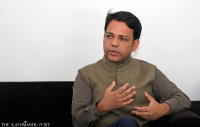
Speaking to the PTI news agency in Antalya, Türkiye, where the conference is going on, Khanal said the three countries would continue to face challenges in securing stronger formal recognition of mountain-related issues without the support of major countries.
Minister Khanal said some nations explicitly backed the proposals, while others remained reluctant. He did not name the countries but sources told the Post that a powerful bloc of nations had blocked the bid.
On Thursday in Antalya, Nepal, Bhutan, Kyrgyz Republic, Tajikistan and Pakistan hosted a joint discussion on the topic ‘Advancing the Mountain Agenda: Glaciers, Cryosphere and Resilience under Overshoot, Shared Responsibility and Sustainable Financing’.
The core objective of the event was to mainstream the agenda of the mountain countries adversely affected by the climate crisis.
Alongside faster access to finance for loss and damage caused by the adverse effects of climate change, Nepal is pressing for stronger recognition of mountain vulnerabilities in COP31 decisions during the ongoing UN climate conference.
The UN climate conference has to address issues ranging from funding to scientific research. Afterall, powerful countries have to fund for climate justice but they looked reluctant to do so, said the official familiar with the negotiations. There is a lack of diplomatic push and reach, according to the Nepali official.
The powerful nations reportedly have agreed to initiate dialogue on climate science and research but are largely uninterested in incorporating all demands and agendas put forward by Nepal and Bhutan.
Demands including predictable, accessible, and grant-based climate finance—not debt—for adaptation and resilient infrastructure and sustainable livelihoods are considered as tough to secure. Multi-hazard early warning systems with high-altitude glacier monitoring, satellite observation networks, and regional data sharing are other demands unlikely to be met as sought by Nepal and Bhutan, said officials.
Decisions at the UN climate negotiations require consensus among major and influential negotiating blocs. Although smaller and least developed countries backed Nepal’s proposal, it failed to secure support from influential developed countries and major negotiating groups.
Two major blocs play a decisive role in climate negotiations: the developed and wealthy countries, and the large grouping of developing countries and emerging economies known as the G77 and China.
The Umbrella Group represents developed countries including the United States, the United Kingdom, Japan, Australia, Canada and Norway. The US, however, has withdrawn from the process.
Developed and wealthy countries are concerned that recognising the Himalayas as a separate agenda item could eventually create pressure on them to provide billions of additional dollars in compensation and adaptation finance to mountain countries.
Officials said that Nepal's agenda is on the negotiation table and hope for some outcome when a document is finally adopted. Partial agendas and demands put forward by Nepal and Bhutan and backed by multiple countries will be inducted in the declaration, they said in a tone of cautious optimism.
Nepal and Bhutan’s proposal for a dedicated mountain agenda item was not formally adopted during preliminary negotiations, Foreign Minister Khanal confirmed in an interview with Anadolu News agency of Türkiye.
Türkiye holds the conference presidency, while Australia leads negotiations, with talks focused on turning climate pledges into action and strengthening support for developing countries.
“At this point, what we really want is the mountain issues to be recognised in the decision-making process,” Khanal said.
Nepal is seeking research and technical assistance to better understand warming and its consequences in mountain regions, giving communities more time to prepare for future disasters.
“Something will hopefully come in the outcome document as we are negotiating on various proposals,” Maheshwar Dhakal, joint secretary at the Ministry of Agriculture, Forest and Environment, told the Post from Antalya.
Nepal and Bhutan are pursuing ambitious mitigation measures for accelerating emission reductions consistent with the 1.5°C warming threshold, curb short-lived pollutants such as black carbon, and protect fragile mountain ecosystems.
Our melting mountains cannot wait for our negotiations to catch up with their changing reality, said Khanal.
“Some developed and advanced countries are trying to scuttle our bid,” another Nepali official told the Post from Antalya. “It's getting difficult for us to include our demands and agenda in the outcome document.”
Lawmaker Sagar Dhakal, who is participating in the negotiation process, has brought the situation out. At both the personal and institutional levels, “we made every effort to table and adopt the Mountain and Climate Change agenda,” Dhakal wrote on Facebook. “Developed countries repeatedly rejected the proposal, even after negotiations extended past 2:00am ahead of Monday’s COP opening.”
The agenda was then dropped from the negotiation paper, Dhakal wrote.
“Until money is there, we cannot address the challenges and crises faced by the mountain countries,” Arjun Karki, a CPN-UML lawmaker who is in Turkey attending the COP31, told the Post.
According to the Organisation for Economic Co-operation and Development, global financing needs to mitigate climate change are estimated at $5 trillion a year until 2030.
“Financing needs for climate action in developing economies alone are estimated at USD 2.4 trillion a year between now and 2030,” said the organisation that tracks global climate financing.
“Achieving our collective environmental goals, combatting climate change, and building sustainable and resilient economic systems will require accelerating private investment towards climate‑friendly, nature‑positive and sustainable pathways, and a shift away from harmful activities.”
Anil Giri is a Chief Sub Editor covering diplomacy, international relations and national politics for The Kathmandu Post. Giri has been working as a journalist for more than two decades, contributing to numerous national and international media outlets.




 10.12°C Kathmandu