Nepal’s federal security gap: Provinces have constitutional authority, CDOs exercise real power
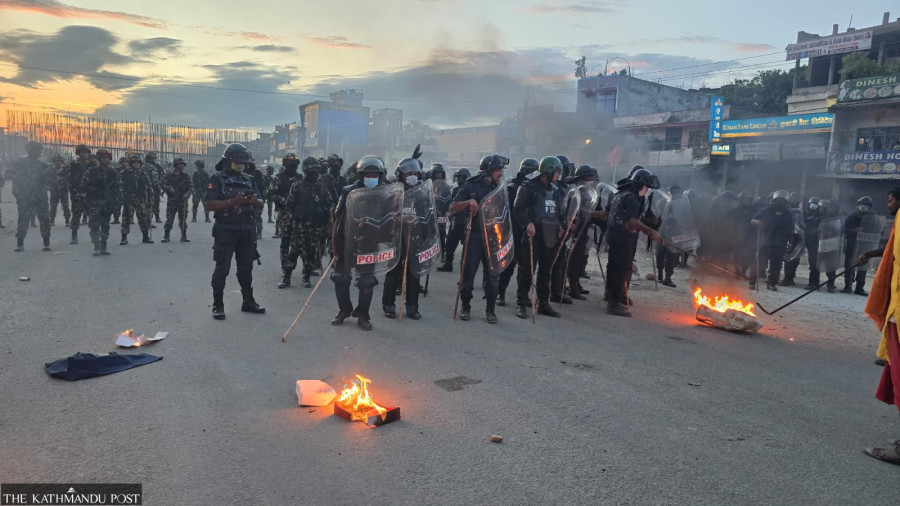
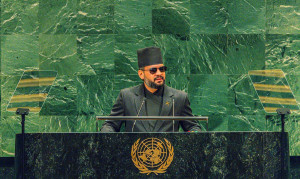
A decade into federalism, chief district officers continue to lead crisis response under the old administrative structure; provinces’ responsibility for peace and security remains largely theoretical. Chief district officers continue issuing security orders under a 1971 law despite Nepal’s federal constitutional framework. File Photo
Last week, as tensions grew in Kaptanganj of Dewanganj Rural Municipality after a minor dispute between Hindu and Muslim youths escalated, the security situation began to deteriorate.
At the centre of decision-making was one person — the Chief District Officer (CDO) of Sunsari. The deployment of the Nepal Police and the Armed Police Force, the imposition of curfew, and decisions that could eventually require the presence of the Nepali Army all rested with him.
The CDO chaired meetings with political party leaders, protesting youths, federal lawmakers, and local representatives from the affected areas.
Meanwhile, in Biratnagar, about 15 kilometres from Kaptanganj, Morang’s CDO declared a curfew in parts of the district and banned loud religious music and sermons. The objective was to prevent a repeat of what was unfolding in the neighbouring district.
Such decisions by CDOs were not limited to Sunsari and Morang districts of Koshi province. As protests and violence spread, CDOs in Dhanusha and Siraha of Madhesh Province adopted similar measures.
What these CDOs did was part of a long-established process in Nepal’s security governance. The contradiction, however, is that these decisions continue to be taken under an old legal framework — the Local Administration Act, 1971, which predates Nepal’s federal constitution. The Constitution of Nepal, 2015, does not recognise districts as administrative units. Thus CDOs have no place in the security structure.
The constitution places “provincial police administration and peace and security” under the exclusive authority of provinces. Yet when the crisis unfolded in Sunsari, the Chief Minister’s Office of Koshi Province and provincial ministers were holding routine formal meetings. The situation was similar in Madhesh Province.
All provinces have their own Ministry of Internal Affairs, similar in function to the federal Ministry of Home Affairs. But despite being responsible for peace and security under the constitution, these ministries remain largely disconnected from security decisions in their districts because CDOs do not report to them.
Appointed by the federal government in Kathmandu, CDOs are answerable to the Ministry of Home Affairs. In practice, provincial internal affairs ministries do not recognise CDOs as officials under their command, and CDOs do not consider themselves accountable to provincial governments.
Province-level political leaders and analysts argue that, in security governance, Nepal’s federal system remains far from functional. According to them, continued federal control through CDOs has weakened the security role assigned to provinces by the constitution and complicated crisis management.
“Just as the Rana rulers used to appoint Patwaris and Ditthas (handpicked local officials), the federal government is now continuing to send CDOs,” said Kedar Karki, former Koshi internal affairs minister and former chief minister. “Peace and security is the most important authority of the provincial government. But in practice, the CDO has become more powerful than the provincial government.”
The underlying issue, according to critics, is that the federal transition has remained incomplete. Nearly a decade after the promulgation of the constitution, the federal government has still not enacted all the laws necessary to make provincial powers operational. The constitution envisioned that many laws required to implement federalism would later be enacted by the federal parliament, but that process remains unfinished.
Federalism is often described as becoming meaningful only when provincial governments possess the “gun, pen, and money.” The phrase is a metaphor for three essential dimensions of provincial autonomy. The gun represents the authority to maintain law and order and enforce decisions through institutions such as a provincial police force. The pen represents the power to legislate on matters assigned to provinces, allowing them to create policies suited to local needs. The money represents the fiscal resources and financial autonomy required to implement those responsibilities.
Nepal’s provinces have gained some authority over the latter two, but policing — the most visible symbol of state authority — has remained largely under federal control.
According to Indramani Parajuli, Koshi Province’s Minister for Internal Affairs and Law, the provincial government is currently limited mostly to coordination and support functions.
“At present, we are working more on the management and coordination side. For example, if relief or rescue work is required somewhere,” Parajuli said. “The provincial police have not been adjusted into the federal structure. In terms of the core spirit and pace of federalism, the important responsibility of maintaining peace and security has not been given to provincial governments.”
The “core spirit of federalism” referred to by Parajuli goes beyond administrative arrangements. It is linked to the fundamental question of why federalism was introduced in Nepal in the first place.
Renu Chand, a former Constituent Assembly member from the then CPN (Maoist) and currently a National Assembly member, says the debate on federalism in Nepal did not emerge from a desire for administrative decentralisation or merely from aspirations for development.
But in practice, she says, everyday security administration continues to operate through the old legal framework.
Sunsari CDO Ishwari Prasad Aryal, however, insists that the command structure for security management is clear and that the existing system provides an effective mechanism for responding to crises.
“Whenever a security crisis occurs in the district, leadership comes from the District Security Committee. The CDO chairs the committee. The Nepal Police, Armed Police Force, National Investigation Department, and local offices of the Nepali Army, among other security agencies, work under this structure,” Aryal told Kantipur. “All matters related to peace and security within the district are handled by this committee under the leadership of the CDO.”
Aryal said that although it is not mandatory under the current law, CDOs continue to inform provincial Ministries of Internal Affairs about security matters.
Morang Chief District Officer Yubaraj Kattel is even more assertive about the authority of CDOs.
“Everything can be done by the CDO,” he said. “Within the current structure, defined by the Local Administration Act, 1971, lies the authority to assess situations, decide whether prohibitory orders or curfews are necessary, request additional forces, and coordinate with the Home Ministry.”
According to Kattel, the law does not even require a CDO to consult the Home Ministry before imposing a curfew.
This is the central contradiction: CDOs say they are operating within the legal framework that exists, while provincial leaders argue that the same framework allows an administrative structure to operate alongside — and above — the constitutional one.
Santosh Pokharel, principal of Adarsha Secondary School in Biratnagar, says the problem began because the federal transition was not accompanied by the necessary laws.
“The constitution guaranteed the rights, but the necessary laws were not enacted. Because the federal government did not make the laws, the provinces could not create and implement them on their own,” he said.
The question of command and control has also drawn attention from security officials, who have at times suggested the need for better coordination between lower-level institutions — provinces and districts. After the Sunsari incident, at a meeting of the Central Security Committee in Kathmandu the following day, security chiefs urged the home minister that lower-level agencies should be guided through coordination rather than receiving strategic instructions on every matter.
However, for the federal Home Ministry, the effective lower-level authority continues to be the CDO leaving the provincial government with limited influence over security decisions.
Biratnagar-based local governance expert Arjun Bishwakarma says that if provincial governments had real authority, they could respond more quickly to incidents such as the one in Sunsari.
“The federal home minister arrived at the scene only on the fifth day after national pressure mounted. A provincial government would not have taken that long,” he said.
According to Bishwakarma, accountability can only exist when authority exists.
“In what happened in Kaptanganj, one could have asked the provincial government, ministers, and other officials why they were not responsible. But that path does not exist right now,” he told Kantipur.
The police operating under the CDOs also understand the command structure according to the framework established by the Local Administration Act, 1971.
SSP Yogendra Singh Thapa, spokesperson of the Koshi Provincial Police Office — which itself carries the word “provincial” in its name — says security management at the district level remains under the authority of the CDO.
“Security management in the district takes place under the Chief District Officer,” he says. “The Local Administration Act has given the CDO full responsibility for issuing prohibitory orders and imposing curfews. The district where an incident occurs is the first to respond.”
For provincial governments, however, the problem is that they carry constitutional responsibility without corresponding authority.
What consequences does this contradiction create?
“The security agency is more accountable to the institution that gives instructions and deploys it. It follows whatever policy and direction comes from above,” said Parajuli. “We are in a situation where whatever results we achieve depend on how much we can work through personal relationships.”
Morang CDO Kattel describes the limitation of such informal arrangements more directly.
“The Local Administration Act does not recognise the province,” he said.
Security committees have also been created at the provincial level through directives from the Home Ministry. The CDO of the district where the provincial capital is located serves as a member of such committees. As a result, Kattel is technically a member of the Koshi Province Security Committee, but he says the arrangement has little practical significance.
“Our law does not recognise that committee. We are not legally required to follow its instructions,” he says.
Kattel says the information he occasionally provides to the province is not a legal obligation but rather an act of goodwill.
“When we send reports to the Home Ministry’s control room in the evening, we also send a copy to the province. But that is not mandatory. There is no legal obligation towards the province at all,” he said. “Sometimes we even forget to inform them, because there is no system. There is no link. So it is not really something that remains in our minds.”
The problem extends beyond information sharing. It also affects police mobilisation and accountability.
A significant portion of the performance evaluation of district police chiefs is conducted by the CDO. The performance evaluation of provincial police is done by the provincial chief secretary. However, the chief secretary is a federal civil servant, and transfers and promotions remain controlled by Kathmandu.
“A federal government joint secretary is more powerful here than our provincial chief secretary,” Karki says. “With a single letter or phone call, he can halt the province’s work or transfer the chief secretary. That is why officials who come here always remain loyal to the federal government.”
The question of who gave orders and how the security response unfolded after the Kaptanganj incident is therefore not only about one district. It reflects how Nepal’s security system continues to operate during crises.
Whenever a security crisis occurs, the CDO takes command. The CDO mobilises the Nepal Police and Armed Police Force. If necessary, the security committee decides on the deployment of the Nepali Army. The provincial government is limited to a “coordination” role, which provincial leaders argue amounts to having responsibility without authority, while the Home Ministry issues directives.
But the question remains: Is this the arrangement envisioned by the constitution?
The Koshi provincial government says — No. The constitution has assigned us that authority.
The CDOs say — We are working according to the law.
The police say — We are operating according to the legal structure that exists.
Political leaders and analysts say — The problem is not in the constitution, but in its implementation.




 20.85°C Kathmandu