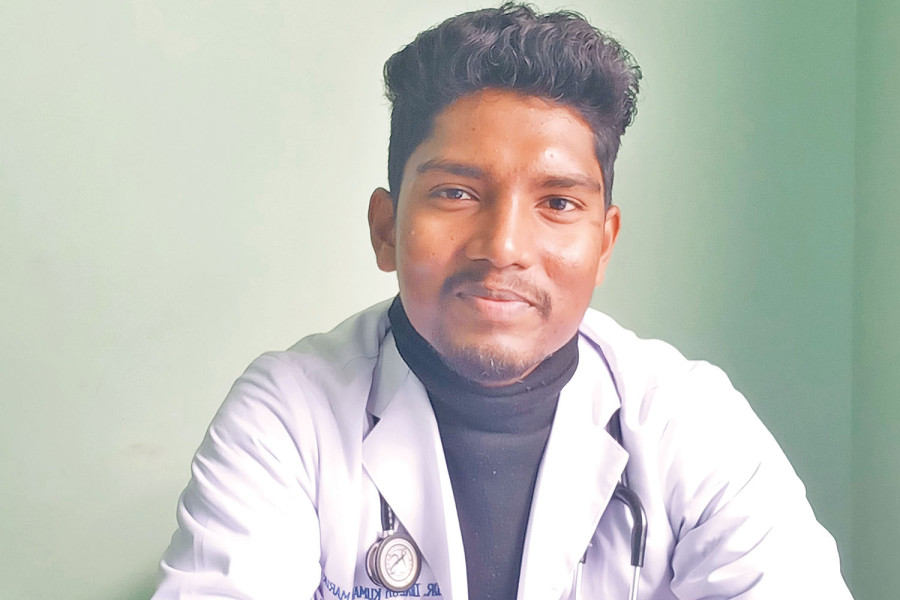
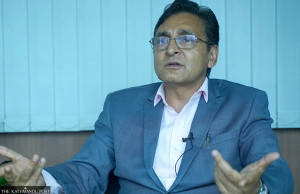
Dinesh Kumar Marik faced caste discrimination and financial hardship at every stage of his education. He has now passed his medical licensing exam on his first attempt. Dr Dinesh Kumar Marik Bidyanand Ram/TKP
In 2015, when Dinesh Kumar Marik arrived in Rajbiraj, the district headquarters of Saptari, for higher studies, he struggled to find a room to rent. Landlords often asked his caste before agreeing to rent out rooms. Marik then began asking for a room to rent without revealing his caste. He finally secured one. “But within two months, the landlord found out that I was a Dom,” Marik said.
The Dom are among Nepal’s historically marginalised Dalit communities, traditionally associated with occupations such as basket-making, bamboo work, and handling the dead. They have long faced caste-based discrimination and social exclusion, particularly in the southern Tarai.
“The landlord did not let me stay even for another day,” Marik recalled. By the time he completed grades 11 and 12, Marik had moved rooms six times.
Marik has carried the stigma of caste throughout his whole life—from his village to the classroom and, later, into the struggle to become a doctor. He has faced discrimination, repeated financial setbacks and mounting debt along the way. Now, after passing the Nepal Medical Council’s licensing examination on his first attempt, the 30-year-old is beginning his medical career—and hoping to help others from communities like his.
Marik has been a bright student since his childhood. At Shree Janata Secondary School in Khudibakhari, he ranked first in grades 8, 9 and 10. Every year, the first-ranked student in grade nine had to attend the Saraswati Puja function, Marik recalled. “But because I belong to the Dom community, I was not allowed to worship the goddess,” he said. “I was not even allowed to distribute the prasad [the food offerings].”
Rather than deter him, the experience strengthened Marik’s resolve to become a doctor. “I used to think that once I became a doctor, my body would not remain ‘untouchable’ when people came to me for treatment,” he told the Post over the phone from Birgunj. “After passing the SLC exams, I told my father that I wanted to study MBBS. He wanted that too, but worried about where the money would come from.”
After grade 12, Marik went to Kathmandu to prepare for the MBBS entrance examination. His hostel fee was Rs10,000 a month and a four-to-five-month entrance preparation course cost Rs25,000.
His father, Yukti Marik, managed those expenses through loans but could not send the additional Rs2,000 needed for transport. Marik walked to the MBBS preparation classes for 20 to 25 days, but eventually found it too difficult to continue. He then began studying in his room instead, while continuing to travel to the tuition centre for weekly tests.
In 2018, he passed the MBBS entrance examination on his first attempt and secured a scholarship. The family received a cheque for Rs2.245 million in the name of his college. At National Medical College and Teaching Hospital in Birgunj, however, they were told they had to pay another Rs550,000 at admission. “For a while, it felt as though my dream of becoming a doctor would remain only a dream,” Marik said.
His father returned to the village and borrowed Rs70,000 at high interest. After an appeal to its managing director, the college allowed him to enrol if the remaining amount was paid within two months.
The family still lacked Rs480,000. Yukti, who is also a Dalit rights activist, sought help from activist and writer Bhola Paswan. “Through Bhola ji’s initiative, I received Rs350,000 from the provincial government as a scholarship for my son,” said Yukti. “I borrowed another Rs130,000 to clear the rest. With interest, our total debt has now reached around Rs1.4 to 1.5 million.”
Marik later lost a year because he could not pay the second-year fee and sit for examinations. He said another Rs1.7-1.8 million was due for the remaining four years.
The dispute coincided with a decision by the Medical Education Commission to cap the total MBBS fee at Rs4.2455 million. Marik said students launched protests seeking implementation of the ceiling. After negotiations, he said, an arrangement was reached under which students would pay Rs200,000 annually.
Marik borrowed money for his medical uniform and equipment and received support from various organisations. The family continued borrowing, but support from organisations eventually helped him finish the course successfully despite repeated financial setbacks and debt.
Marik has now passed the Nepal Medical Council licensing examination, with the results out on September 22, and is currently doing his internship at National Medical College and Teaching Hospital in Birgunj.
“Many people are now sending me messages, saying they will help with my further studies,” said Marik. “I tell them there are many talented students like me who cannot study despite wanting to.”




 25.92°C Kathmandu