Parties pledge cooperation on democracy, constitution and national interest at Congress convention
Nepali Congress president Gagan Thapa calls for a break with the politics of recurring power struggles, while opposition leaders question the government’s approach to Parliament and democracy.
Nepal’s political parties used the opening of the Nepali Congress’s 15th General Convention on Sunday to pledge cooperation on democracy, the constitution, national interests and climate change, even as opposition leaders sharply criticised the government.
The convention was held at Khula Manch, or Tundikhel, a venue long associated with Nepal’s major political movements in Kathmandu. Leaders from various parties ended their addresses with the Congress greeting “Jay Nepal”, while Rastriya Swatantra Party chairman Rabi Lamichhane opened his speech with the phrase, saying: “This is not a party slogan; it is for the country.”
Congress President Gagan Thapa used the venue to argue that Nepal needed more open spaces for political dialogue.
“Open grounds are needed in many places in Nepal. First of all, we need one in Parliament,” Thapa said, accusing Prime Minister Balendra Shah of failing to respect the legislature.
“Parliament is not open. It is closed,” Thapa said. “The prime minister must be present in the Parliament that elected him. Until he appears there with respect for Parliament, the people and the political system, Parliament cannot be considered open.”
Thapa said the same principle should apply to wider society, calling for dialogue between the Madhesh and other parts of the country, among ethnic and religious communities and between generations. He also said party members should be able to question their leaders without fear of expulsion or intimidation.
He used the convention to argue that the Congress needed to become a bridge between generations, citizens’ aspirations and the country’s political future.
“The Congress wants democracy and diversity. We must be able to deliver to citizens and protect their dignity,” Thapa said. “We must become a bridge between history and possibility. If the bridge collapses, trust collapses.”
Thapa said political parties should be judged by whether they can answer prevalent questions rather than by how long they have existed.
“The party that can answer citizens’ questions is the new party,” he said.
He also criticised what he described as a “musical chairs” culture in which politicians repeatedly return to the prime ministerial or ministerial posts. This, he said, had contributed to public disillusionment with politics and the September 8-9 protests last year. He said both the state’s suppression of protesters on September 8 and the criminal violence on September 9 were wrong.
Thapa said the Congress needed to change its political style, language, approach and organisational culture while retaining the values associated with BP Koirala and Ganesh Man Singh.
He said the party should also bring together older leaders’ experience and younger politicians’ energy. “We must be prepared to lose not one but five elections for the sake of our principles,” he said.
Ruling RSP’s chair Lamichhane said his party would continue cooperating with other political forces on democracy and political change.
“We will not deviate from democratic values and principles,” he said. “If the government makes wrong decisions, we will correct them. The process of cooperation among political parties will continue. We will move forward together in support of democracy and change.”
Lamichhane defended the government against criticism from opposition speakers, saying there was an understanding that he would lead the party while Prime Minister Shah handled the government’s affairs. He dismissed speculation that the government could be brought down.
He also said he was willing to accept electoral defeat in defence of democratic principles and argued that the government should remain accountable to citizens.
Lamichhane told Thapa that leaders who repeatedly create internal disputes should be left behind, rather than repeatedly being persuaded to return.
Nepali Communist Party coordinator Pushpa Kamal Dahal said Nepal faced a risk of moving towards disorder and urged political forces to work together.
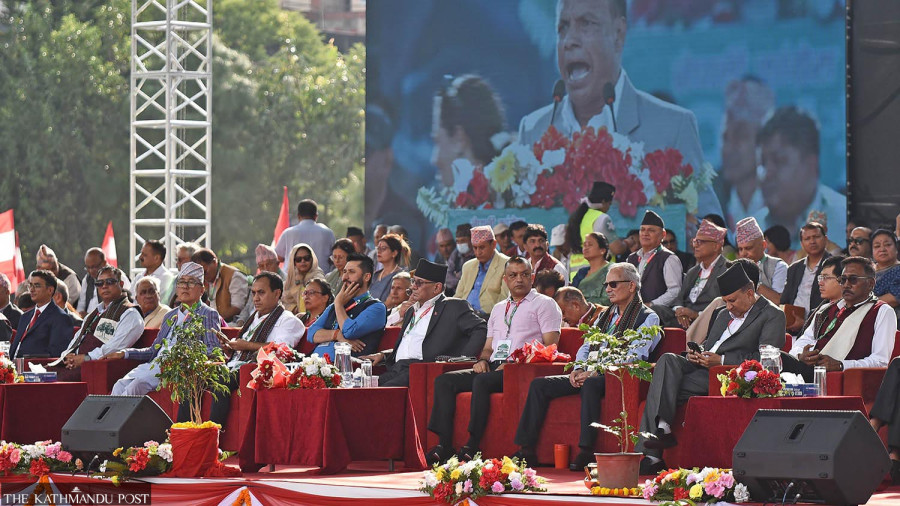
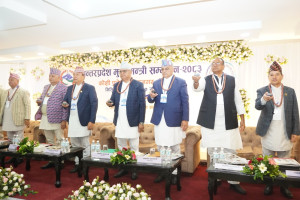
Major leaders of political parties pictured at the stage of the Nepali Congress general convention on Sunday.
“Democracy and the country are in difficulty. Some statements and activities of the government have raised fears that the country could move towards authoritarianism,” Dahal said. “All political forces need to move forward together.”
He called for the federal democratic republic and the constitution to be strengthened, along with the remaining work of the peace process.
Dahal congratulated Thapa on breaking with political continuity and urged him and Lamichhane to bring about further change.
“I broke with continuity by moving from war to peace, to a republic and to the constitution,” Dahal said. “Now I find it difficult to break with continuity. Gaganji and Rabiji, you break with continuity. Then Nepal will be built.”
CPN-UML general secretary Shankar Pokhrel also called for cooperation among parties on democracy, the constitution and national sovereignty, but questioned the government’s approach to political dialogue.
“RSP chair Lamichhane seeks consensus among political parties, but the government does not engage with political parties and does not listen to the people,” Pokhrel said. “Are we seeking Nepal’s future in democracy or moving towards authoritarianism?”
He said political parties needed to act collectively to protect democracy and prevent the aspirations of the younger generation from turning into frustration.
Pokhrel also said parties needed to cooperate in responding to the growing risks posed by climate change. Referring to the Bhotekoshi and Trishuli floods, he said climate justice was a shared national concern.
Calls for broader consensus
Congress vice-president Bishwa Prakash Sharma said a strong government and responsible opposition provided an opportunity to pursue issues of national importance through cooperation rather than constant government-opposition confrontation.
He called for common positions on climate change, constitutional amendments, economic reform, the role of Nepalis living abroad and social harmony. He said constitutional amendments should reflect broad ownership rather than rely only on parliamentary arithmetic.
Former prime minister Baburam Bhattarai urged politicians of his generation to trust younger leaders and called on parties to protect and improve the constitution.
“My message to leaders of my generation is: let us learn from the past. We must now trust the new generation,” Bhattarai said.
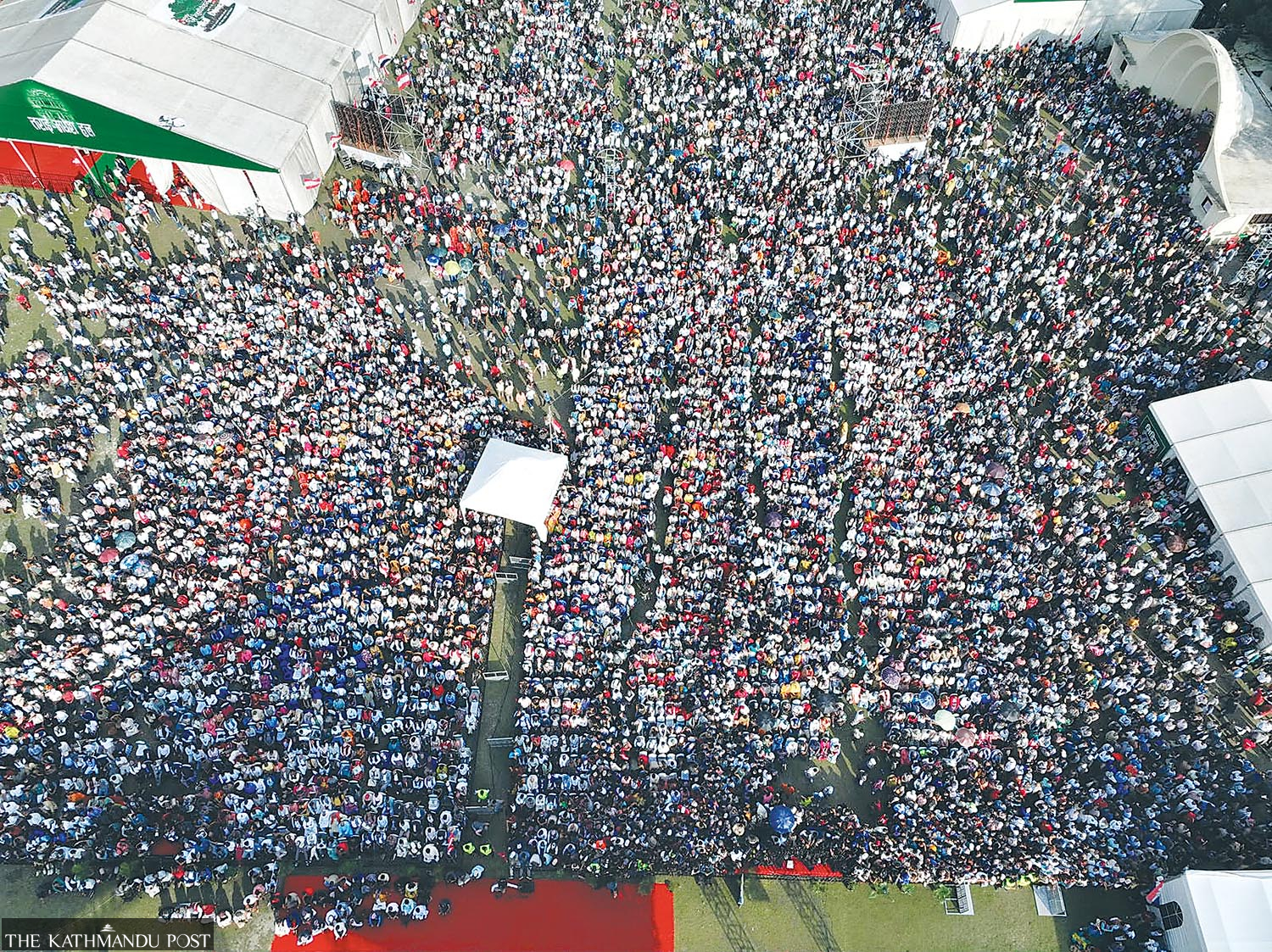
Delegates fill the Nepali Congress general convention venue at Khula Manch in Kathmandu on Sunday.
He urged Lamichhane to keep the RSP-led government in office for five years, noting that no government had previously lasted more than three years. He also said the RSP’s near two-thirds majority would be difficult to repeat.
Bhattarai said Nepal had failed to achieve sufficient economic progress in the decade since the constitution was promulgated, while around 5 million young people had gone abroad and economic growth had failed to reach double digits.
He said political leaders needed to examine why young people had become disillusioned rather than blaming foreign forces for last year’s protests.
Rastriya Prajatantra Party Chairman Rajendra Lingden called for a new national understanding that would bring political parties, younger people and other forces together.
“There is a need for an agreement in which nobody loses and the whole country wins,” he said.
Janata Samajbadi Party-Nepal leader Sharat Singh Bhandari said Nepalis would not accept “controlled democracy” and called for cooperation among major parties amid what he described as serious economic, social and geopolitical changes.
He said his party expected Congress support for greater inclusion and efforts to strengthen the federal democratic republican system.
Resham Chaudhary, a leader of the Nagarik Unmukti Party, said constitutional rights had been granted to Tharus and other communities on paper but not fully delivered.
“Rights were written in the constitution, but they were not honoured,” he said, asking when the roughly 6.5 percent Tharu population of Nepal would reach the country’s top leadership.
Aaren Rai, general secretary of the Shram Sanskriti Party, said the Congress had played a historic role in establishing democracy and the republican system and urged it to focus on serving people rather than simply remaining in power.
Congress vice-president Pushpa Bhusal said the party faced the challenge of making policy decisions transparent and leading further political change.
The convention also highlighted divisions within the Congress. Former president Sher Bahadur Deuba, who served as prime minister five times and led the party twice, did not attend the gathering. Several former office-bearers, including Shekhar Koirala, Purna Bahadur Khadka, Prakash Man Singh, Shashank Koirala, Bimalendra Nidhi and Krishna Prasad Sitaula, were also absent from the convention.
A parallel gathering involving the Deuba camp was under way in Chundevi, Kathmandu, as the main convention proceeded at Tundikhel.
Thapa said a seat had been kept vacant for Deuba and that the party had expected him to attend. He argued, however, that respect for a former leader should be measured by whether the party became stronger and broader under his leadership rather than by ceremonial gestures.
He also sought to reassure those concerned that the Congress was not abandoning its political heritage, saying the “spirit” of BP Koirala and Ganesh Man Singh remained with the party even as it changed its methods and leadership.




 13.76°C Kathmandu