In a settlement destroyed by the Bhotekoshi flood, a disabled couple offer strangers the little they have
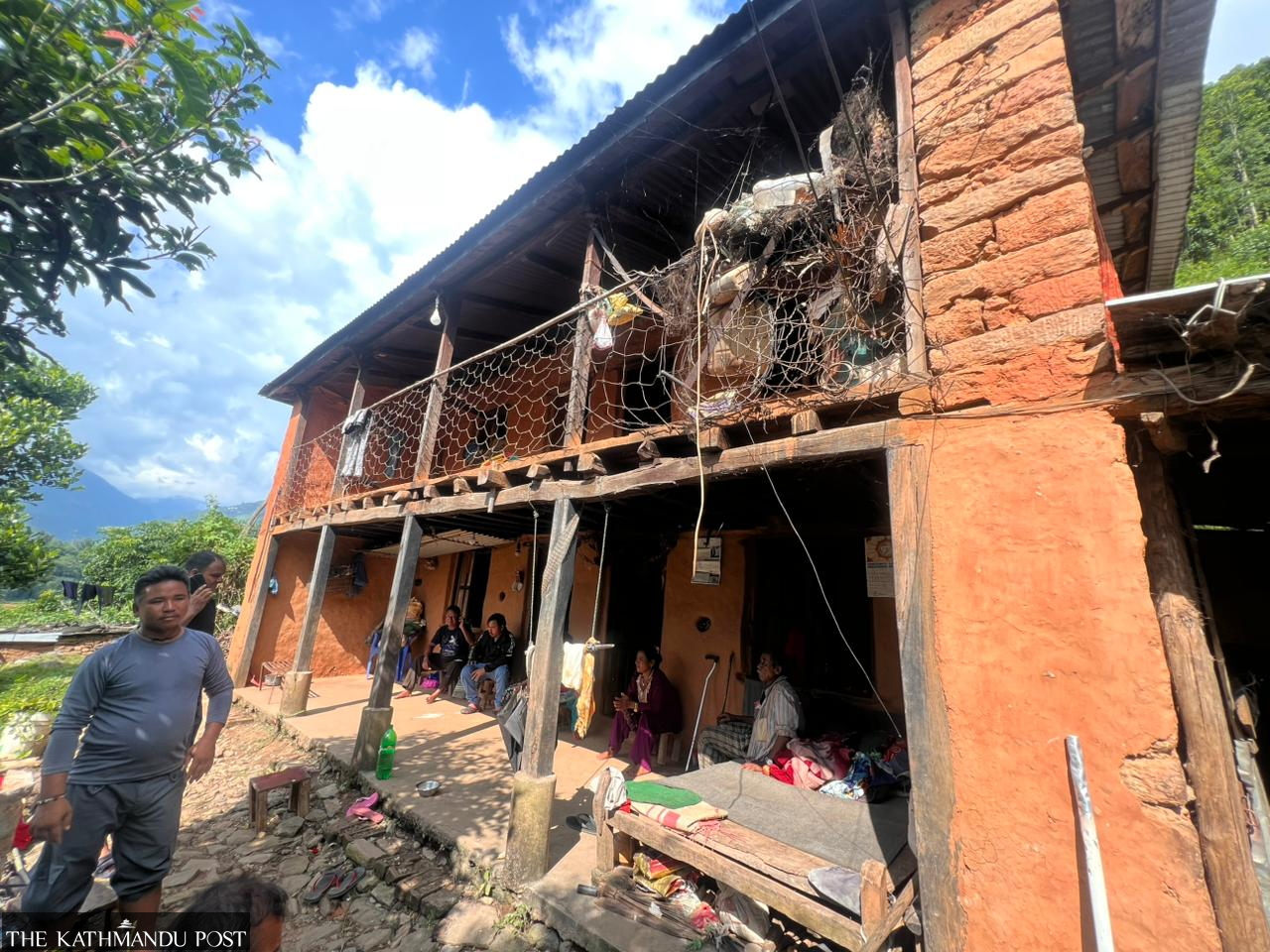
Prem Bahadur and Maiya Tamang have turned their lone hillside home into a shelter, feeding and housing more than 200 people since the disaster despite relying mainly on small government allowances. Prem Bahadur has a spinal injury and can barely move around the house with the help of a walking stick. Maiya has difficulty moving her left leg. Despite their own physical limitations, the couple continue to take in anyone who comes to their doorstep. They do not let their guests go hungry. Angad Dhakal/TKP
On a hillside in Dabile of Bidur Municipality-10 stands a lone house with a corrugated zinc-sheet roof. There are no other houses nearby. From the house, the only view below is of a settlement devastated by Wednesday’s flooding of the Bhotekoshi River. Concrete houses lie submerged, while those on the opposite bank stand intact but eerily deserted.
Yet since the flood, the small house has rarely been without guests.
On August 16, the day the flood struck, 31 students and teachers who escaped the disaster spent the night there. The house became a safe haven for those who fled the nearby Uttargaya Public Secondary School.
Since then, it has become a refuge for people arriving in search of relatives missing in the flood. Between 15 and 20 people come here every day. At the edge of a forest, the house has become a place where people exhausted from walking in the sun can find drinking water, a meal and a place to sleep. More than 200 people have taken shelter here since the flood.
With no other houses around, it has become a sanctuary for families searching for relatives swept away by the flood and landslides, as well as for those who fled to save their lives.
The homeowners, Prem Bahadur Tamang and his wife, Maiya, are both disabled. Prem Bahadur has a spinal injury and can barely move around the house with the help of a walking stick. Maiya has difficulty moving her left leg. Despite their own physical limitations, the couple continue to take in anyone who comes to their doorstep. They do not let their guests go hungry.
With no other houses around, it has become a sanctuary for families searching for relatives swept away by the flood and landslides Angad Dhakal/TKP
Government support for food and shelter has yet to adequately reach the area. In its absence, the Tamang couple have been helping those in distress with whatever little they have.
Asked how they make a living, Maiya says her husband receives a monthly old-age allowance of Rs3,000 and she receives Rs2,000. Their children also send them money occasionally.
“That is how we survive,” she says.
The grain they grow on their hillside farmland does not last the year. The couple also complain that they cannot protect their crops from monkeys.
On the day of the flood, Prem Bahadur was sitting outside his house when the Bhotekoshi began roaring. He approached the river with the help of his walking stick and was alarmed by what he saw.
“Look, the flood is destroying everything,” he recalls telling Maiya as he called her to see the river.
“People were swept away and houses were buried right before our eyes. We were in no condition to go and rescue anyone. We kept watching the Bhotekoshi, thinking the flood would not reach this high. But within seconds, Betrawati Bazaar had turned into a riverbed. The road used by vehicles was swept away. The school was submerged and school buses were buried.”
Prem Bahadur, who has lived in the area for four generations, says he had never witnessed such a disaster.
“It did not even look like a flood. It looked as if a volcano had erupted,” he says.
The couple say they feel they must do whatever they can to help people affected by the disaster.
Maiya says their stock of rice and lentils is running low. Despite her physical limitations, she cooks for the people who come to their home. Some guests cook for themselves.
“What else can we do? When things are normal, everyone can cook and eat on their own. Who would come looking for our house? It is at times like this that we have to help. We do whatever we can,” she says.
Her brother-in-law, Juhanlal Tamang, is also taking shelter there with his family after losing their home. Five members of his family are staying at the house. Juhanlal’s grandson was swept away by the Bhotekoshi and remains missing.
Haribahadur Rai, whose family members are also missing, is sheltering there as well. His house at Angitar was swept away. His wife, granddaughter, mother-in-law and father-in-law are among those missing.
The couple have taken in several families in similar circumstances.
“Although the house is small, we are all living and sleeping inside and outside, sharing our joys and sorrows,” Maiya says. “We are not in a position to go out and bring food and water. If supplies could come from somewhere, at least we would not have to send away people who come here for shelter on an empty stomach.”
She says they have enough rice and lentils for only a few more days.
The couple have two sons and two daughters, but none lives with them. Their eldest son, Bishal, is in India for work. Their younger son, Buddha, used to drive an auto-rickshaw along the Trishuli-Betrawati route, earning a living for himself while also helping his parents.
The Bhotekoshi flood not only swept away Buddha’s auto-rickshaw but also destroyed the route on which he worked.
“What are we going to do now?” Buddha asks, his face downcast. “My parents are disabled and our family is struggling. I would do any labouring job if I could find one.”
No government agency has yet been able to reach the area. Bodies floating in the river have begun to decompose, while the bodies of people trapped inside houses have yet to be recovered.
Amid the devastation, the Tamang couple’s house is the only one still standing intact.
Arjun Poudel is a health reporter for The Kathmandu Post. Before joining the Post, he worked for Sagarmatha Television, Naya Patrika, Republica and The Himalayan Times.




 17.79°C Kathmandu