Explained: The leaked WhatsApp chats that have shaken Nepal’s judiciary
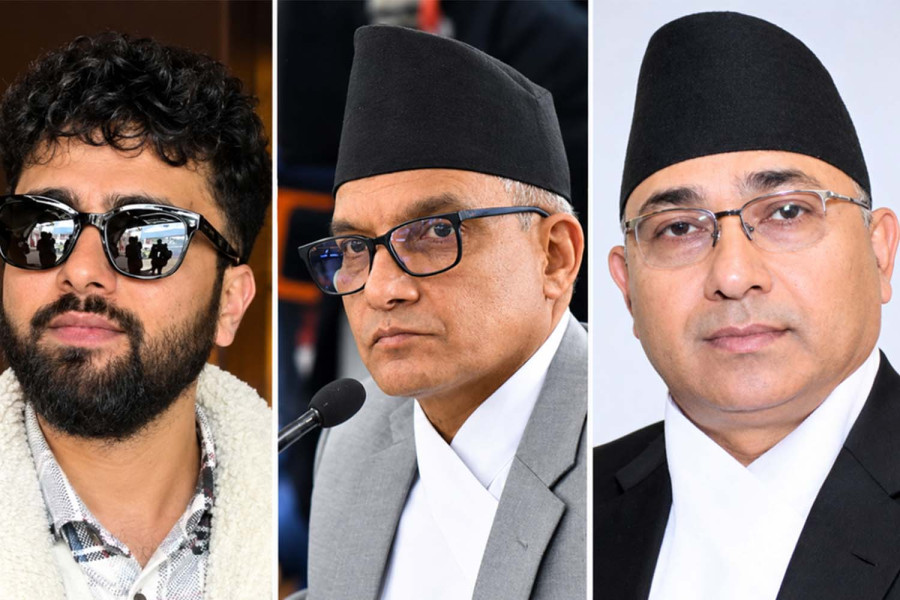
The messages between Justice Hari Prasad Phuyal and Inam Sapkota, an alleged fixer, have put the top court’s credibility in question. Here is what they reveal, what Phuyal says and why the fallout reaches the chief justice. From left, Inam Sapkota, Chief Justice Manoj Kumar Sharma and Justice Hari Prasad Phuyal.
On Thursday, the Naya Patrika daily published a bombshell report detailing a WhatsApp exchange between Supreme Court Justice Hari Prasad Phuyal and Inam Sapkota, a man accused of using connections with powerful figures to influence state institutions.
The revelation has brought Nepal’s judiciary under renewed scrutiny, raising questions about possible attempts to influence court proceedings, Phuyal’s own conduct and the deeper institutional fault lines within Nepal’s highest court.
Here’s what you need to know about the unfolding controversy, explained in five points.
1. What do the leaked WhatsApp exchanges reveal?
The messages show Sapkota sending Phuyal a screenshot of businessman Rohit Gupta’s habeas corpus petition, followed by a request to dismiss it, invoking Prime Minister Balendra Shah’s interest in the matter.
“Please stop this, sir,” Sapkota reportedly wrote. “The prime minister is also interested in this matter. Please dismiss it.”
Hours later, Phuyal replied that there were grounds to release Gupta and that the court had ordered him to post Rs20 million in bail. He also shared a link to the court order and proposed meeting Sapkota at Hotel Himalaya the following evening. The exchange has raised questions about why a sitting justice was communicating with an alleged fixer about a pending case.
2. Who is Inam Sapkota, and why is he under investigation?
Sapkota, 30, came under police scrutiny after investigators examining the phone of former chief justice Cholendra Shumsher Rana found repeated calls between the two. Police detained Sapkota at Tribhuvan International Airport on September 27, as he was preparing to travel to India.
Further examination of his electronic devices reportedly revealed communications with serving and former judges, senior police officials, politicians, lawmakers and lawyers. Investigators suspect he acted as an intermediary for officials seeking promotions and for people seeking favourable outcomes in court cases.
His reported connections with former chief justice Rana, businessman Deepak Bhatta and other influential figures have widened the investigation. Police are also examining possible money-laundering links.
3. What has Phuyal said about his dealings with Sapkota?
Phuyal has acknowledged exchanging messages and meeting Sapkota at Hotel Himalaya, a five-star facility about two kilometres from the Supreme Court. He says Sapkota initially approached him claiming to represent the prime minister and offering reassurance amid rumours that some justices could face impeachment following Manoj Kumar Sharma’s appointment as chief justice.
According to Phuyal, Sapkota subsequently began to bring up pending cases, including the Nepali Congress leadership dispute and cases involving businessman Bhatta. Phuyal says he and several other justices eventually grew suspicious, discussed Sapkota’s conduct among themselves and reported their concerns to the prime minister’s secretariat, the police chief and the army chief.
Phuyal maintains that he did not act on Sapkota’s request in Gupta’s case and that the decision to release Gupta on bail was based on the merits of the case. He denies financial dealings or any improper arrangement. But he has not explained why he felt obliged to justify a decision his bench took to an individual with an interest in the case.
His statement leaves other important questions unanswered: Why did he rely on someone whose claim to represent the prime minister had not been verified? Why was a hotel meeting considered appropriate? What exactly was discussed, and when did he first suspect Sapkota's intentions?
The questions have acquired added significance because Phuyal later sat on a bench that dismissed a habeas corpus petition filed by Sapkota’s wife challenging his detention. The bench, which included Justice Sunil Pokharel, rejected the petition on October 9.
4. Why has Chief Justice Manoj Kumar Sharma also come under scrutiny?
The controversy extends beyond Phuyal. Separate documents reportedly recovered from Sapkota’s phone and circulated publicly refer to deposits into bank accounts associated with Chief Justice Sharma, Rastriya Swatantra Party lawmaker Bishwaraj Pokharel and senior police officer Banshiraj Dahal. The records mention deposits totalling 198,333 in unspecified currency over three months and a request for a further $7,500, with payments directed to accounts held by Sapkota’s relatives.
Sharma has denied knowing Sapkota or having any direct or indirect contact with him. Dahal was dismissed following an investigation into his communications with Sapkota and a late-night visit to former chief justice Cholendra Shumsher Rana after the latter was taken into police custody.
The alleged transactions have not been independently established as bribes or conclusively linked to the individuals named. The Nepal Bar Association has called for an impartial, evidence-based investigation into the revelations.
5. How does this controversy fit into the Supreme Court’s wider crisis?
The latest revelations come amid months of tension within the judiciary. In September, police took former chief justice Rana from his home, initially describing the action as an arrest before saying he had been moved to a secure location because of a security threat. The Supreme Court’s subsequent full-court statement condemned arbitrary executive action but also pledged to prevent both external and internal influence in judicial proceedings. The reference to internal influence exposed concerns about the role of former office-holders and divisions within the court.
The tensions also stem from Sharma’s appointment as chief justice in May, when the Constitutional Council bypassed three more senior justices, including Phuyal, without setting out clear criteria. Disagreements over judicial appointments, the formation of the Constitutional Bench, transfers and promotions have further strained relations.
The Sapkota revelations have brought these institutional fault lines into the fore. The challenge now is not simply to determine whether individual judges or officials engaged in wrongdoing, but also to establish credible safeguards against intermediaries seeking to influence judicial decisions. The credibility of the Supreme Court will depend on whether it can address both questions through a transparent and impartial process.
Timothy is a copy editor for The Kathmandu Post. Previously, he was a reporter on the Features desk and deputy editor on the National News desk. He joined the Post in 2015.




 15.98°C Kathmandu