News Analysis: When institutional defence exposes institutional fault lines
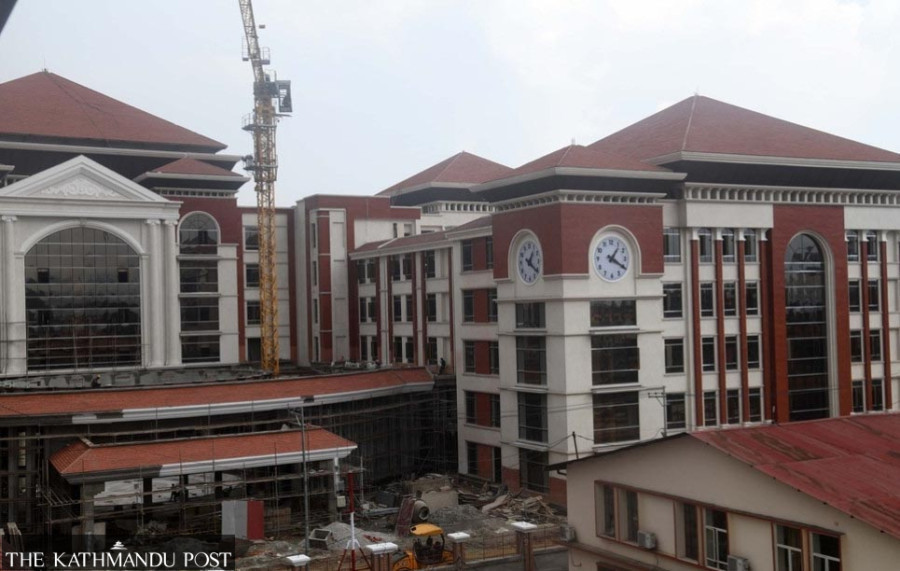
The Supreme Court’s response to Cholendra Shumsher Rana’s detention has united justices against executive interference while laying bare tensions within the judiciary itself. Supreme Court of Nepal File Photo
When Manoj Kumar Sharma, the fourth-ranking judge in the Supreme Court, was appointed chief justice in May this year, the decision drew flak from judicial and political circles, with some senior justices not even mincing words in criticising the move.
Though Sharma’s appointment was not unconstitutional in itself, it marked a departure from a long-standing tradition—a practice never broken before, as it was believed to ensure predictability and equilibrium.
In the last four and a half months, however, there were no visible signs of concern from inside the judiciary. But in the wee hours of Sunday, police, acting on government orders, picked up former Chief Justice Cholendra Shumsher Rana from his home. The Kathmandu Valley Crime Investigation Office (KVCIO) initially said Rana had been arrested, but later claimed that he had been taken from his home in light of a security threat to him. The nature of the security threat remains unexplained. Government spokesperson Sasmit Pokharel even went on to say that he had to be “rescued” because of a threat from an unidentified group.
The 12-hour detention and subsequent release of Rana, however, set off a strong reaction within judicial circles. Supreme Court justices demanded a full court meeting, which Chief Justice Sharma could not refuse.
But what unfolded inside the Supreme Court afterwards is even more significant.
A four-paragraph statement issued on Monday by Supreme Court spokesperson Arjun Prasad Koirala contains two contradictory messages.
The first concerns the incident in which a team from the KVCIO took Rana from his Maharajgunj residence in the middle of Sunday night and kept him at Teku.
The full court did not use any of the words arrest, detention, custody or rescue. Instead, it described whatever the government had done to Rana through the police as an “arbitrary” act. It also said that such conduct could not be accepted in a democratic system of government.
The second paragraph of the statement says that former officeholders, too, are an “integral part of an independent judiciary,” and urges state agencies to be sensitive in their dealings with them. In other words, the full court treated what happened to Rana as a serious matter because of his status as a former chief justice.
But another paragraph of the statement raises the opposite question. Urging that the functioning of the judiciary not be linked to former officeholders, it declares a commitment to ensuring that no “external or internal” influence is given “even the slightest space” in the administration of justice.
The word “internal” is significant here.
There have been allegations that, even after his retirement, Rana was influencing cases involving major political and economic disputes pending in different courts through his contacts and relationships with sitting judges. People in the Prime Minister’s Office, some Rastriya Swatantra Party leaders and some lawyers have claimed that Rana is still influencing cases. Regardless of whether those allegations are true or false, the Supreme Court’s full court appears to have sought, through its statement, to convey that the administration of justice is free from such influence.
This is where the Rana episode connects with the older and deeper tensions within the judiciary.
Reports have emerged that during the full court meeting, justices questioned the relationship between Chief Justice Sharma and former Chief Justice Rana, and its impact on judicial administration and the administration of justice. The statement issued after the meeting also offers a glimpse of those concerns.
The two contradictory messages made public by the full court in response to Rana’s detention therefore reveal the depth of the crisis inside the Supreme Court. On the one hand, the court appears united against executive interference. On the other, the same meeting appears to have become a forum for expressing long-accumulated grievances over leadership, the balance of power and judicial administration within the court itself.
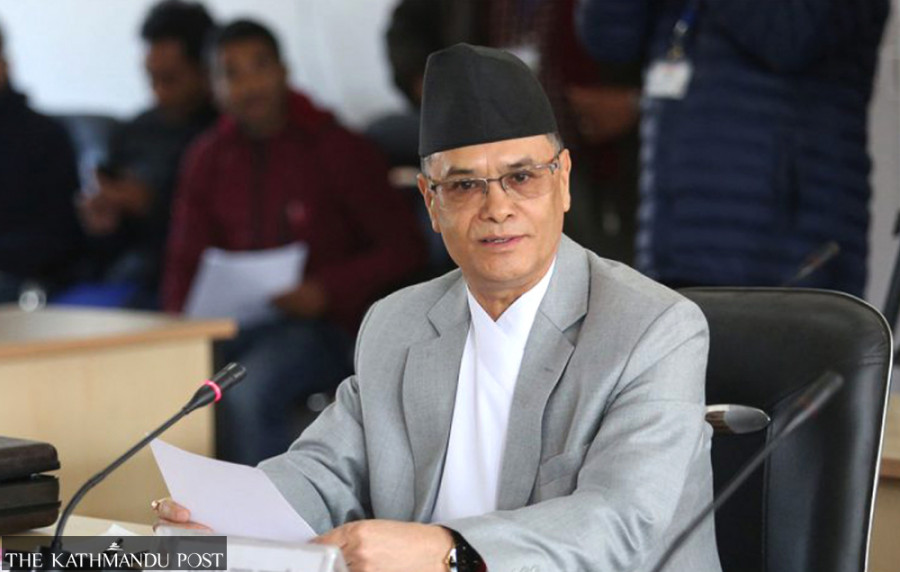
Former chief justice Cholendra Shumsher Rana File Photo
According to former Attorney General Dinamani Pokharel, the statement conveyed the message that the Supreme Court was aware that “the administration of justice was being viewed in connection with former officeholders.” In his view, this has created the impression that the court itself could be “guided.”
To understand the Supreme Court’s current crisis, it is therefore necessary to look beyond the immediate incident involving Rana.
Public confidence in the judiciary has declined significantly in recent years on issues including judicial independence, corruption and irregularities, access to justice and impartiality. In the World Justice Project’s 2025 Rule of Law Index, Nepal ranks 72nd out of 143 countries. On the civil justice indicator, which is directly related to the courts, Nepal ranks 105th, while on the indicator measuring control of corruption in state institutions, including the judiciary, it ranks 91st. According to Transparency International Nepal, Nepal’s score on indicators relating to the judiciary has also declined in recent years, alongside those relating to government, parliament and the public sector.
According to a study by the National Judicial Academy, 40 percent of service users said they faced major obstacles in accessing justice. Another study by the Ministry of Law found that only 5 percent of service users were satisfied with court services. A committee led by then Justice Hari Krishna Karki had also pointed to the need for sweeping reforms in the judiciary, including in corruption, irregularities and judicial appointments. Its report identified political influence, lack of transparency, procedural complexity and barriers to access to justice as problems.
But as efforts to address these problems institutionally have failed to advance sufficiently, dissatisfaction within the court appears to have deepened.
Against this backdrop, Sharma’s appointment added another layer to what the Supreme Court was already wrestling with. By departing from the established practice of appointing the most senior judge, the decision disrupted a predictable basis for leadership selection without replacing it with another clear and transparent criterion. The balance of power within the court consequently changed.
The Constitutional Council led by Prime Minister Balendra Shah recommended Sharma in the first week of May by majority vote, despite written dissent from two members, bypassing Sapana Pradhan Malla, Kumar Regmi and Hari Prasad Phuyal. It was the first time that the most senior justice had been bypassed in recommending a chief justice.
According to legal experts, after becoming Chief Justice, Sharma failed to take a sufficiently firm position in defence of judicial independence, made decisions on the appointment and transfer of judges and the promotion of staff without clear criteria, and also broke with the convention of having senior justice sit on the Constitutional Bench. Under the constitutional arrangement, the chief justice leads the bench and selects the other four justices.
According to former Attorney General Pokharel, “judicial politics” has long existed in the formation of constitutional benches. Senior Advocate Satish Krishna Kharel says it is already too late to establish transparent and clear rules for the formation of the Constitutional Bench.
According to reports published about the recent full court meeting, justices raised questions about the selection of members for the Constitutional Bench, allegations of growing corruption in the Special Court, the activities of intermediaries in the courts, and the chief justice’s working style.
Asked whether corruption or irregularities in the judiciary increased after Sharma’s appointment, Kharel says, “I have not heard that Manoj Sharma personally committed any wrongdoing, but during this period, disorder and corruption in the judiciary have increased extensively.”
Asked whether a court can deteriorate to that extent without the involvement of its leadership, he says factionalism exists within the judiciary and that the situation has reached a point where it is difficult to have confidence in most justices.
Saying that some Rastriya Swatantra Party leaders have been advancing a narrative that there is corruption in the courts, that Rana is somehow connected to it, and that taking him into custody and then releasing him has sent a “message” that things will now be corrected, Kharel says, “The government has not been able to show, or perhaps has not wanted to show, that Cholendra [Rana] committed a punishable act.”
According to him, it is unclear both whether Rana had done anything wrong and whether he was intimidated by the action. But the process by which he was taken into custody was wrong.
In Kharel’s view, the impact of the incident will not be confined to Rana. “If a former chief justice can be taken away, what prevents the current justices from being arrested and taken away? The law is the same, the practice is the same,” he says.
He has also raised the question of whether the Constitutional Bench would have issued its recent order against the House of Representatives Rules had the incident involving Rana taken place earlier.
After an impeachment motion was registered against Rana in 2022, he was suspended. The term of the House of Representatives ended before Parliament could conclude the matter. He subsequently retired amid a prolonged period of legal uncertainty. His tenure had been controversial because of allegations of irregularities and collusion with political forces. After his departure, there were efforts to undertake broad reforms in the judiciary, but before those reforms could become institutionalised, Sharma’s appointment brought questions of factionalism, leadership and the balance of power back to the surface.
But the more important question is where this dissatisfaction leads.
If this dissatisfaction is transformed into reforms aimed at establishing clear criteria for judicial appointments, a predictable and transparent system for forming the Constitutional Bench, institutional mechanisms to reduce the influence of intermediaries, and greater transparency in judicial administration, the current crisis could provide an opportunity to strengthen the judiciary.
But if the institutional resistance that began around Rana’s detention ultimately becomes confined to an internal power struggle against the chief justice, it could deepen the court’s crisis rather than resolve it.
The Supreme Court is thus confronted with a paradox. It appears to have found an unprecedented measure of unity in resisting what it considers arbitrary executive interference. Yet the same confrontation has brought its own unresolved questions of leadership, power and institutional process into public view.
If those questions are not addressed, an effort that appears to be a collective defence of the institution could itself contribute to its further erosion.




 15.34°C Kathmandu