



 15.36°C Kathmandu
Wed, Oct 21, 2026
Money
In Nepal’s premium rental market, the dollar is everywhere but on paper
Apartments and homes are increasingly listed in US dollars, edging out Nepali renters and operating in a legal gray zone that no regulator has ever tested.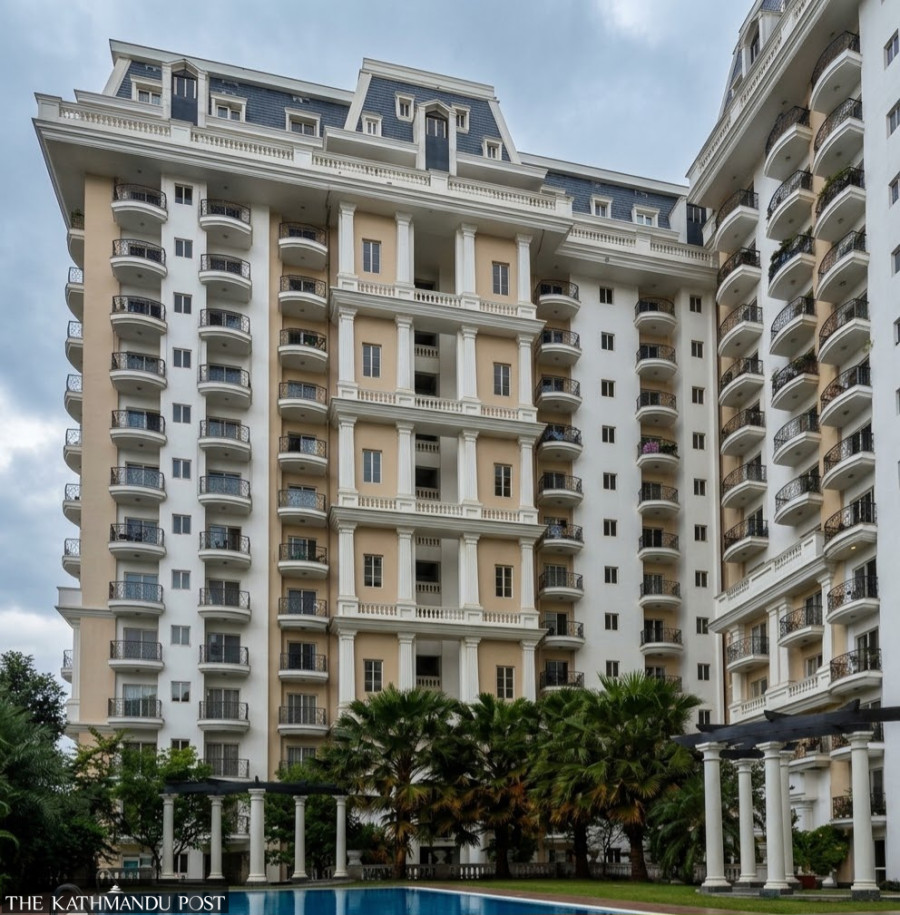
bookmark![]()
Sun City Apartment, Kathmandu. Angad Dhakal/TKP ![]()
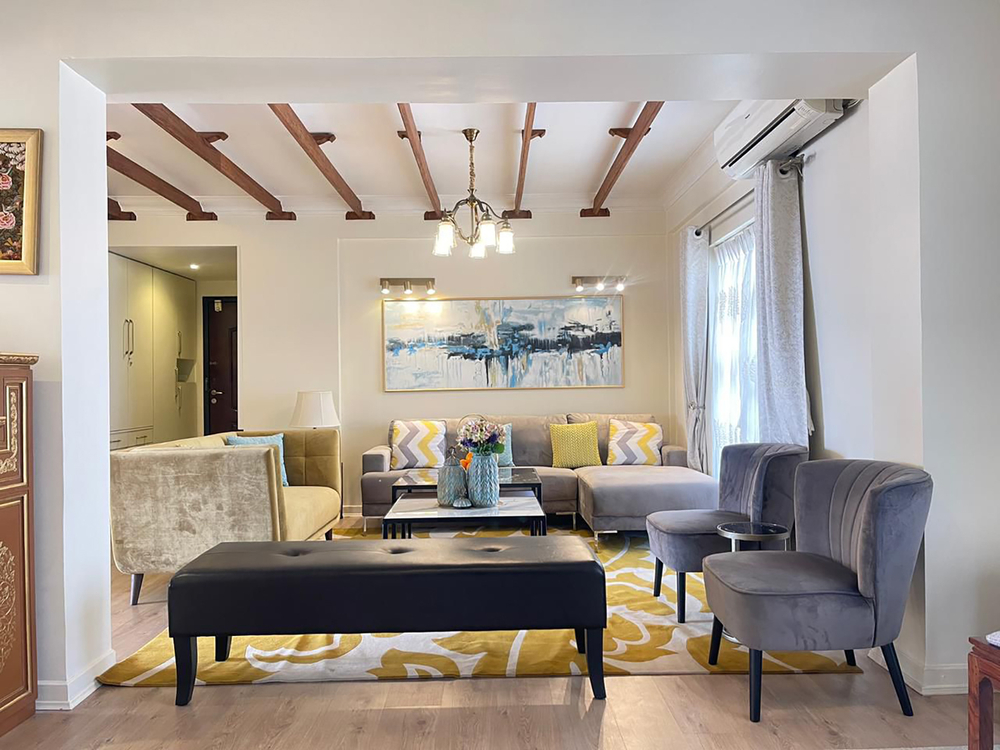
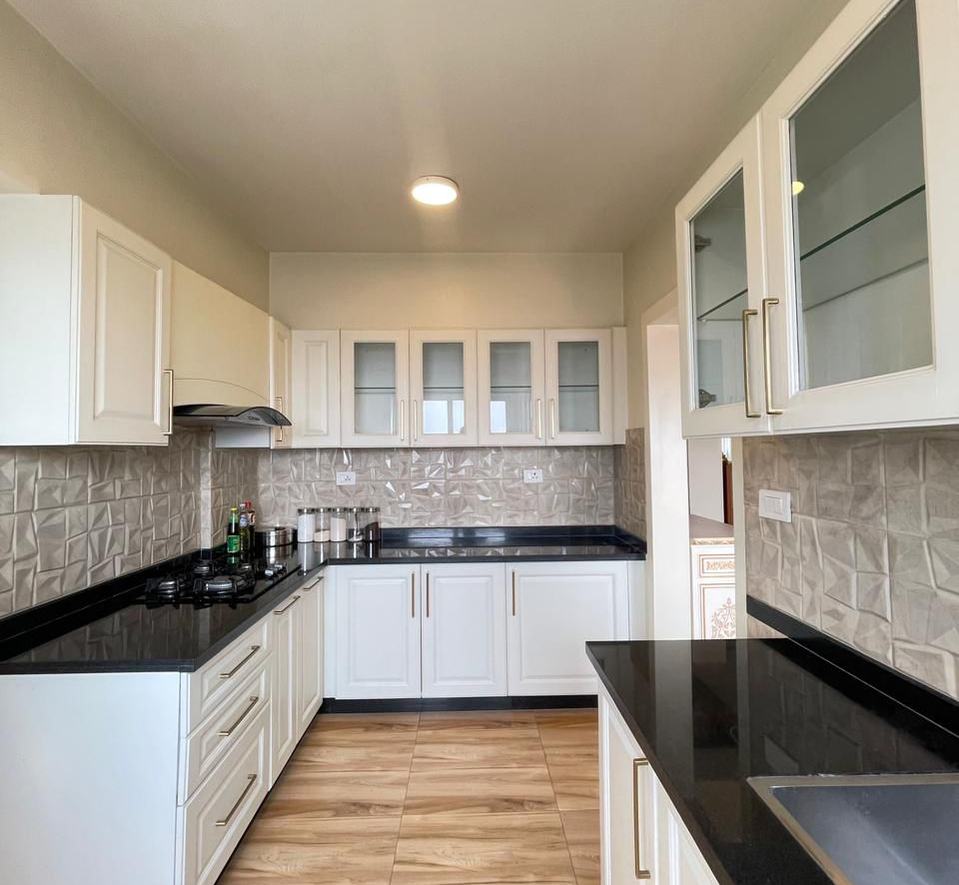
The living area of a fully furnished Sanepa apartment marketed to premium, often foreign, tenants. Photo: Courtesy of NRES ![]()
Photo: Courtesy of NRES
Aarya Chand
Published at : September 29, 2026
Updated at : September 29, 2026 21:15
Kathmandu
When Sachin Dangi arrived in Pokhara for two months of work, the cheapest decent apartment he could find cost him $30 a day. Not 4,600 in Nepali rupees, but 30 US Dollars. He rented it and was the only Nepali living in the building. What Dangi had run into was a rental market that, in practical terms, had stopped catering to people like him. After all, if he decided to stay at the apartment for two months, he would have to pay about Rs276,000.
“The lowest price I could find was $20 to $30—Rs3,000 to Rs4,600 a day,” said Dangi, founder and chief executive officer of Saarang, a web-based platform for tourists. “For a foreigner, that’s still pretty cheap.” At Paramount Apartment, where he stayed, the math made sense to him. “The feeling you get is that this place is not for a Nepali audience,” he said.
What Dangi experienced has, over the past several years, become the default logic of the premium rental market in cities like Pokhara. The issue is even graver in Kathmandu. In neighbourhoods like Sanepa, Jhamsikhel, Baluwatar, Lazimpat, realtors estimate that 40 to 60 percent of listings are now priced in US dollars, a currency that, according to the country’s central bank and lawyers, private landlords are not legally permitted to charge. No regulator has ever tested that law. No government agency currently tracks how widespread the practice has become. The Post spoke to about a dozen officials, lawyers and economists who are responsible for overseeing the arrangement, each of whom said someone else was responsible.
The scale of what has been built is clear. Records from the Department of Urban Development and Building Construction show that Bagmati Province is home to 79 of the 80 multi-unit apartment projects approved nationwide as of the last fiscal year. Out of 6,943 approved housing units, 6,905 are in Bagmati Province. The office does not keep any record of which of those buildings are marketed to foreign tenants, or in what currency their rent is set. Doing so goes beyond the jurisdiction granted to the office, said Prabesh Shrestha, an engineer at the department.
According to Jitendra Gopal Shrestha, director of Cosy Nepal, one of Kathmandu’s earliest apartment rental platforms, there was no apartment concept to speak of twenty years ago. “Nepalis don’t have the culture of hosting guests long-term,” he said. “Most of them have caste-based considerations when renting.”
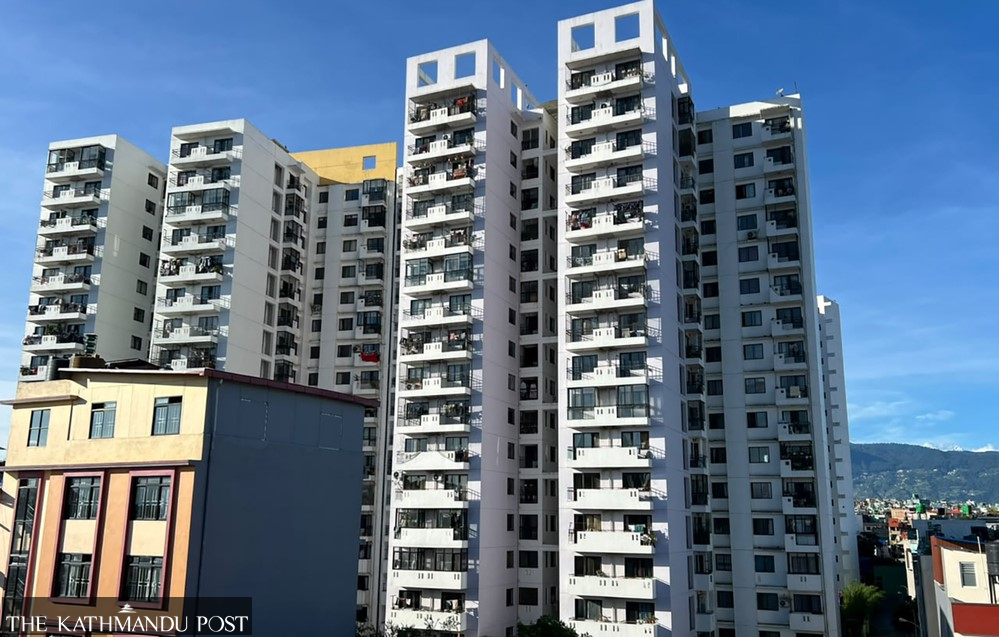
Shrestha said he started his business in 2013 watching two trends intersect—joint families breaking into nuclear ones, and a steady flow of expats into the Valley who needed furnished housing for months at a time.
What he built has since been replicated dozens of times over. But what began as a solution to a genuine housing gap has evolved into something else: an investment vehicle built explicitly to attract foreign tenants—diplomats, INGO staff, researchers and non-resident Nepalis whose remittances flow home in dollars which most Nepali renters do not earn.
Narendra Lohar, a realtor at Charkilla, one of Kathmandu’s more active property agencies, has had a ringside view of the changing market. In the premium areas he covers, including Sanepa, Lazimpat, Jhamsikhel, Thamel and Bhainsepati, the cost of renting a property has seen a steep rise over the years. “Previously, it was just $700 to $800 per month,” he said. “Now it has increased to $900 to $1,100 which is roughly a 30-35 percent increase.”
The pricing logic originates almost entirely with landlords. “The landlords set the price themselves,” Lohar said. “They ask us for suggestions but it’s usually them who come up with the price.” Landlords generally raise rents by about 10 percent each year, in line with standard Nepali rental practices. But when rents are set in foreign currency, the 10 percent increase is applied to the foreign-currency amount rather than the rupee value. The result is a market that inflates in two currencies simultaneously.
LB Thapa, the owner of a newly built 5,500 sq ft residence near Lemon Tree Hotel in Budhanilkantha, said his property—featuring seven bedrooms and six bathrooms—was recently listed exclusively “for foreigners only.” He is targeting embassies for long-term tenancy. His minimum asking rent is $9,860—or Rs1.5million a month and it is negotiable.
Why only foreigners? What if a Nepali tenant agreed to Thapa’s terms and price? Thapa said that most Nepalis cannot afford it but added that if any Nepali agreed to his terms and price, he’d rent it. “But why would a Nepali pay so much money?” he said.
Lohar said that landlords also calculate that dollar mostly appreciates. For many, it is the return calculation that justifies constructing the property at all, he said.
What landlords, realtors and property managers have built is, on paper, a practice that the country’s laws do not permit.
Chapter 9 of Nepal’s Civil Code, 2018, governs residential tenancy. Section 391 states that rent must be paid by cheque or cash in Nepali currency or cheques exchangeable within Nepal. “It does not say ‘such-and-such currency’ or ‘dollars’, but Section 391(3) makes it clear that this refers to Nepali rupees,” said Sakun Bhandari, a property lawyer practising for 13 years.
The Foreign Exchange (Regulation) Act, 2019 adds further weight. Section 4 bars foreign exchange transactions without approval from NRB. “The law contains no explicit prohibition by name, this is where the gray zone enters, but neither does it permit dollar-denominated rent,” Bhandari said. “Within Nepal’s territory, if any landlord rents out their house, land, or apartment, they must use Nepali rupees. Doing it in USD in itself becomes an incorrect practice.”
There is further practical constraint. Rental agreements above Rs20,000 must be certified by the local ward office where the property is located. If such an agreement arrived at a ward office denominated in foreign currency, the office would likely refuse to certify it, Bhandari said. “None of our laws state that rental agreements can be done in foreign currency. That’s where the problem can arise.”
When asked whether any landlord had ever been prosecuted, any tenant had ever filed a challenge, or any court had ever ruled on this practice, the answer was the same across every institution contacted for this story—no. “Such issues have not come up so far,” Bhandari said.
Sudha Shrestha, deputy spokesperson of Nepal Rastra Bank, confirmed that under Section 4 of the Foreign Exchange Act, transactions in foreign currency without NRB permission are not permitted. But she added that NRB itself has no enforcement authority. That authority was recently transferred, per a gazette notification dated July 29, 2026, to the Department of Money Laundering Investigation, or DMLI. Previously it lay with the Department of Revenue Investigation.
An officer at the DMLI told the Post no such case has ever been brought to his department. “The specific nature of this issue you are raising has not been seen here at all,” the officer said, under the condition of anonymity. The officer added that his department was handed the authority for less than two months and it has received no complaint so far.
At the Baluwatar Ward Office, for instance, the picture is equally uncertain. Nabin Mainali, a ward committee member, confirmed that agreements are registered in Nepali rupees and that a USD-denominated agreement presented would likely be refused by the ward.
Guna Raj Bhatta, an economist at NRB, said he had not been aware the practice was active in Kathmandu’s prime location, until the questions were put to him. “Transacting or doing business in dollars is not allowed in Nepal,” he said. “Even if a foreign tourist comes here, they have to transact using Nepali currency. Our law itself has banned foreign currency transactions; there is no doubt about that.”
There was, however, doubt about everything else.
In practice, the dollar is present everywhere except the official record. Listings appear online in dollars. Landlords and agents negotiate in dollars. The conversion to rupees happens at the moment of formal agreement, just before the contract is registered at the ward office, and just often enough to satisfy whatever scrutiny exists. “For foreign clients we just price the list in USD as it is easy for them to understand but in the legal document, it’s in Rs,” said Lohar, the Charkilla realtor. “We negotiate and keep a flexible amount as it should be okay for the owner and also for the client. When paying, they convert USD into Nepali.”
What complicates this further is the payment chain involving landlords who live abroad. A manager at one of Sanepa’s premium apartment complexes described an arrangement that has become common practice. Most landlords whose properties command dollar rents are Nepalis living abroad, in the United States, Dubai, Singapore, who manage the lease paperwork themselves and keep it formally compliant with Nepali law. But the actual transaction bypasses Nepal’s banking system entirely. Tenants transfer rent in US dollars directly to the landlord’s international account, or in many cases, to the account of the landlord’s child studying at a university abroad. The rent, in effect, funds tuition.
Sapkota of DMLI flagged this dimension. “If a cross-border transaction link is found, the laws regarding Hundi can also be attracted,” he said. The channels for moving money across borders—such as Western Union, MoneyGram, informal hawala networks—are used. His department has not yet received a formal complaint on this practice.
Shrestha, the director of Cosy Nepal, described a version of this in the context of his own platform: international listings are quoted in dollars, converted to rupees at transaction, and received into Nepali bank accounts. “We don’t have to deal with NRB,” Shrestha said. “Even if card transactions are done, the currency is converted into Nepali. The money comes in Nepali bank.” This is the legal model. But between this and the arrangement where rent disappears into an offshore account accessed by a landlord’s child studying abroad, the distance may be shorter than the paperwork suggests.
The dollar premium is no longer confined to Kathmandu. In Pokhara, the pattern Dangi described has taken hold in a certain way that he called a regulatory gray zone—a rental market where properties register as hotels, list as apartments, operate as short-term rentals, and charge by the dollar.
“There is no legal recognition for hostels and apartments even in Gandaki Province,” Dangi said. Properties advertise as apartments while registered under hotel categories. Safety standards are discretionary—whether to install CCTV cameras, whether to maintain a reception desk, “everything is so wide open to interpretation.” He contrasted this with the hotel sector, which has an association, an inspection process, and a star-rating system. Apartments have none of it.
Lohar confirmed the Pokhara trend and extended it further: in tourist areas including Mustang, properties are priced in dollars as standard. Hotels in Chitwan are now converting rooms into short-term apartment-style rentals, entering a market that operates by the same informal dollar logic with even less oversight. The practice travels with the foreigners, and whenever foreigners go in sufficient numbers, the dollar follows.
Yuxiang, an anthropologist and researcher at a US-based institution conducting fieldwork in Bauddha, was paying approximately $15 per night for accommodation booked through Airbnb. “It’s ridiculously high when we look at local standards,” he said. He had, in a previous visit, rented accommodation in rupees through a mutual friend, negotiated directly and paid in cash. The difference was the channel—Nepali networks price in rupees; international platforms, built for a global audience accustomed to dollar benchmarks, price in dollars. The same city, the same rooms but two different economies.
Shrestha, the Cosy Nepal director who has watched the market evolve for two decades, said he no longer recognises it as the industry he had started.
Since last year, despite the noticeable decline in the number of INGO staff clients, new buildings keep going up. The foreign tenants that premium landlords have built entire buildings to attract are arriving in smaller numbers than before. But the prices continue to rise, and the dollar keeps appearing at the top of every rental listing.
Shrestha describes the continuous investment not driven by housing need but by financial positioning—landlords building because the apartment has become the asset class of the moment. “People have no awareness and are blindly investing money,” he said, calling the competition unhealthy, the pricing chaotic, the whole dynamic something he did not support. “Those who’ve done it without awareness, I bet they are not going to sell, because there are already too many apartments and home rentals in the market.”
Aarya Chand
Aarya Chand is a reporter at The Kathmandu Post covering social issues. Before moving to the social beat, Chand was an intern covering culture and lifestyle for the Post.



Most Read from Money

Nepal travel agents threaten to stop selling Thailand trips over visa rules

Why does an hour long flight to Dhangadhi cost more than a flight to New Delhi?
Malaysia rejects Nepal’s demand to open recruitment to all manpower agencies

No school, but a graduation cap for women dairy farmers
Nepal arrests four medical service providers as Malaysia recruitment row deepens
Editor's Picks




E-PAPER | October 21, 2026

×