



 21.66°C Kathmandu
.jpg)

Mon, Oct 19, 2026
Money
All three major Nepal-China crossings hit by monsoon disruptions ahead of Dashain
Floods and landslides have halted trade through Rasuwagadhi-Kerung, Tatopani, and Korala border points. Hundreds of containers remain stranded and supplies disrupted ahead of the festive season.
bookmark![]()
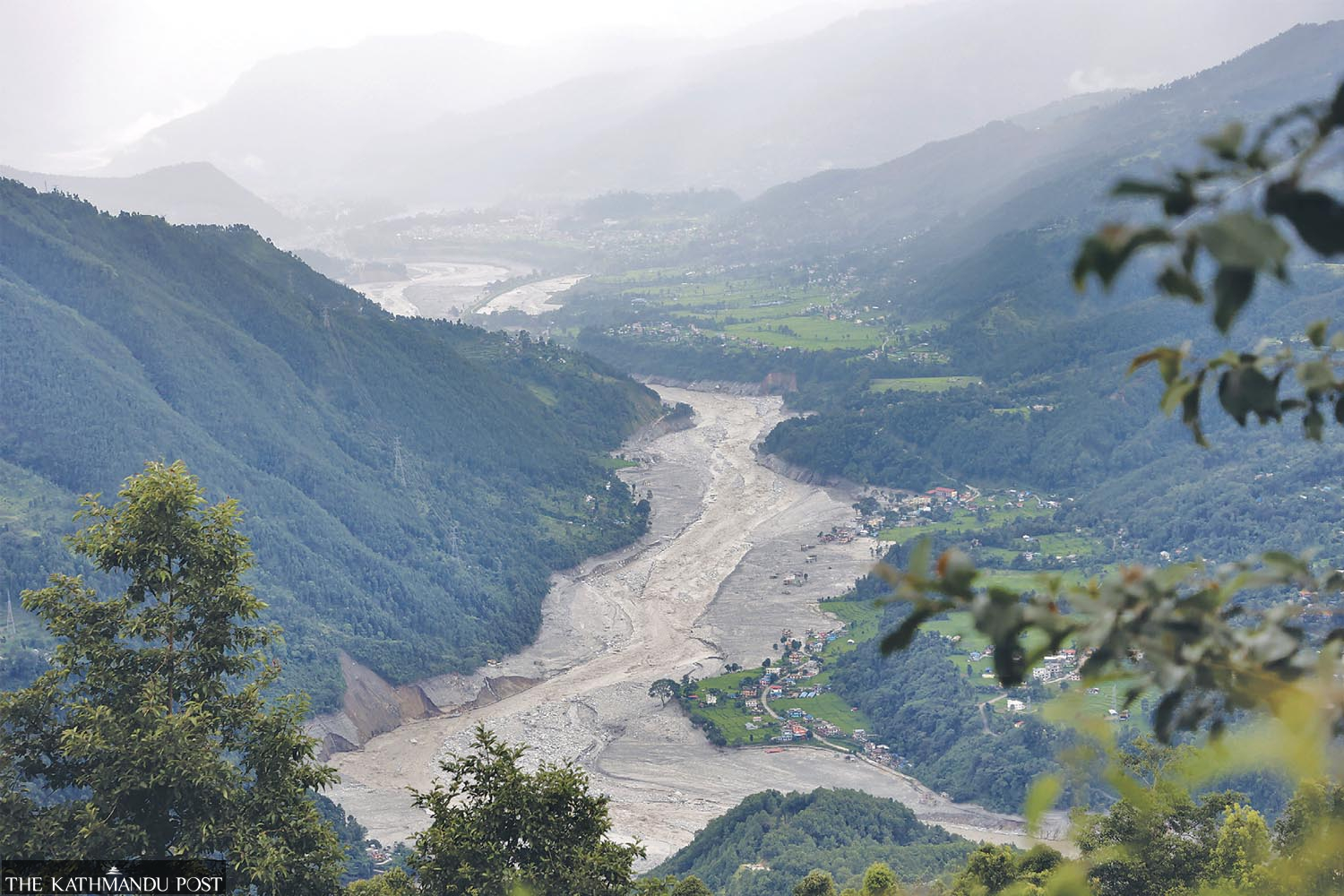
Flood destruction at Betrawati Bazar and surroundings, pictured on September 3, seven days after the Trishuli river wreaked havoc in the area. Hemanta Shrestha/TKP
Yagya Banjade, Deepak Pariyar & Anish Tiwari
Published at : September 29, 2026
Updated at : September 29, 2026 06:35
Kathmandu/pokhara/sindhupalchok
All three major land crossings between Nepal and China have been disrupted just weeks before Dashain, the country’s biggest Hindu festival, affecting trade and cross-border movement at a time when demand typically rises.
The Korala crossing in Mustang, the latest to be affected, has been cut off after three days of heavy rain triggered flooding, landslides and road erosion along the Beni-Jomsom section of the Kali Gandaki corridor. The Rasuwagadhi-Kerung crossing in Rasuwa has remained closed since the devastating flood of August 26, while China has kept the Tatopani crossing in Sindhupalchok closed on its side for about a month.
The simultaneous disruption of all three crossings has affected Nepal’s overland trade with China and the movement of goods across the northern border.
Heavy rain has caused extensive damage along the Kali Gandaki corridor. Kul Prasad Acharya, assistant chief district officer of Mustang, said more than 50 landslides, large and small, had occurred along the Maldhunga-Beni-Jomsom road in Parbat.
The Kali Gandaki river has also eroded the road at several locations. Sunday’s flooding washed away a section of road leading to the bridge across the river at Pokharebagar in Annapurna Rural Municipality, leaving northern Myagdi and the entire Mustang district cut off by road after a large gap opened between the road and the bridge.
“People could not even travel between settlements within their own local units because of the floods and landslides,” Acharya said. “Power has also been out for three days, making it difficult to receive information on time. The damage is much greater than we had expected.”
The District Administration Office, Myagdi, had restricted vehicular movement from 6pm to 6am between September 24 and 27 citing the weather and road conditions.
The disruption of the northern crossings has also hit automobile imports, according to Surendra Kumar Upreti, president of the NADA Automobiles Association of Nepal.
“We are already unable to deliver vehicles to customers who booked them for Dashain,” Upreti said. “There is a risk that customers hoping to buy new vehicles for Dashain and Tihar will not be able to get them. Between 35 and 45 percent of annual vehicle sales take place during the festive season, so government revenue will also be affected by the disruption.”
Importing vehicles through Korala adds between Rs50,000 and Rs100,000 to traders’ costs per vehicle, Upreti said. He added that businesses had so far absorbed the additional transport costs rather than passing them on to customers.
China accounts for about 14 percent of Nepal’s total foreign trade. It supplies around 17 percent of Nepal’s imports but accounts for only about 0.5 percent of its exports.
In the first two months of the current fiscal year, from July 17 to September 17, Nepal imported goods worth Rs76.4 billion from China while exports amounted to just Rs293.3 million. In the previous fiscal year, imports from China totalled Rs425.24 billion, compared with exports worth Rs1.8925 billion.
Nepal imports mainly vehicles, mobile phones, computers, chemical fertilisers, ceramic products and cosmetics from China. Its exports include incense, handicrafts, pashmina and readymade garments.
Beni-Jomsom road could take a week to reopen
The three days of rain also damaged several sections of the Beni-Jomsom-Korala road of the Kali Gandaki corridor, including at Galeshwar, Bhirung Tatopani, the Rahughat substation and Khambhitta in Myagdi, according to Tejaswi Sharma, chief of the corridor project.
Several landslides have occurred along the Myagdi section, with a major one reported at Bainsari.
“We will clear the landslides in the Mustang and Parbat sections of the corridor within three days,” Sharma said. “But rebuilding the bridge at Pokharebagar and clearing the major landslides could take up to a week.”
He said some sections of the road would have to be rebuilt using gabion walls to stabilise areas washed away by the river, meaning it would take longer for the road to fully reopen.
The road closure has brought trade through the Korala crossing to an almost halt. Containers that had travelled to the border to collect goods are now stranded.
More than 200 containers are parked in the Korala Customs yard alone, according to Bidur Chudal, chief customs officer at the Mustang Customs Office. The containers had reached Korala before the rains to collect goods, but were unable to return because of flooding, landslides and road erosion.
“Until now, we had been processing around 50 containers a day,” Chudal said. “Now containers cannot travel up from the south, while those already there are stuck.”
Traders said the containers are carrying goods for Dashain and other festivals, as well as daily necessities and other commercial products.
Prahlad Thapa, vice-president of the Nepal Truck Container Entrepreneurs’ Association, said the prolonged road closure would have a direct impact on the market.
“With all three crossings closed just before the festive season, shortages and price rises are likely in the market,” Thapa said. “Consumers will inevitably feel the impact. If traders cannot bring in goods, the disruption will also affect the wider economy.”
Kamalesh Kumar Agrawal, president of the Federation of Nepalese Chambers of Commerce and Industry, said alternative border crossings should also be brought into use.
“Importers will bring goods through whichever route is cheaper,” Agrawal said. “Until now, Korala had been the most suitable option in many respects. The Rasuwa floods have damaged a large amount of goods that had already been ordered.”
He said disruptions at the Chinese border, combined with a landslide at Krishnabhir that has also affected the Mugling-Narayangadh road, would impact the market.
However, Agrawal said the economy was already sluggish and the Bhotekoshi flood had added to the pressure. He did not expect an immediate shortage of goods.
“Demand in the market is not particularly strong either, and we are not seeing the same level of Dashain-Tihar activity as in previous years,” he said. He added that the government was also working to address the disruptions.
Rasuwagadhi remains closed after August flood
The Rasuwagadhi-Kerung crossing has been completely shut since the August 26 flood caused extensive damage to roads and other infrastructure. The disaster has continued to disrupt the movement of goods across Nepal’s northern border.
After the Bhotekoshi flood, containers originally headed for Rasuwagadhi were diverted to Korala. Electric vehicles imported from China have also been stranded at the Korala crossing.
Tribhuvandhar Tuladhar, president of the Nepal Trans-Himalayan Commerce Association, said the simultaneous disruption of Rasuwagadhi, Tatopani and Korala had temporarily interrupted Nepal’s overland trade with China, but he expected the disruption to be temporary for two of the crossings.
“China has temporarily closed Tatopani because the road on the Nepali side is in poor condition and there are concerns about landslide risks,” Tuladhar said. “There have been discussions about reopening it within a week or two after the rain stops.”
He said Korala itself had not been closed by China and that the disruption was caused by poor road conditions on the Nepali side due to rain and snowfall.
“Once the obstruction on the road is cleared, it should reopen,” he said.
The Rasuwagadhi crossing cannot be rebuilt immediately because of the damage caused by the Bhotekoshi flood. But Tuladhar said the Korala road was likely to reopen soon and this would limit the impact on the supply of goods and prices.
“Market demand is low. Traders are focused on clearing their stocks, so there is no reason to expect an overall rise in prices,” he said. “There could, however, be price increases for some specific goods.”
He said existing stocks meant the disruption at the northern crossings was unlikely to have a major impact on the Dashain and Tihar markets.
Tatopani closed again
The Tatopani crossing in Sindhupalchok has been closed for about a month.
Shashidhar Ghimire, chief district officer of Sindhupalchok, said Nepal had been holding continuous discussions with Chinese authorities to reopen the crossing, but no agreement had been reached.
Although customs operations have stopped, the crossing remains open for tourist movement, he said.
More than 45 containers carrying readymade goods, machinery and other products are stranded in Nyalam and surrounding areas on the Chinese side, unable to enter Nepal.
Buddharaj Basnet, president of the Sindhupalchok Chamber of Commerce and Industry, said traders were suffering substantial daily losses because of the closure.
“Traders had shifted towards Korala after the other crossings were disrupted. Now that China has closed that crossing again, businesses that depended on Tatopani are exhausted and suffering big losses daily,” he said. “When will the government finally see our problem?”
Rajesh Bhandari, an executive committee member of the Nepal Trans-Himalayan Border Commerce Association, said traders had moved towards Korala after the Rasuwagadhi crossing was damaged by floods and Tatopani was closed by China.
“When the closer Tatopani crossing is closed, we have to use the more distant Korala route, but the situation there is also difficult,” he said. “The customs office has sent additional staff because of the increased workload, but quarantine services are operating from tents. Internet connectivity at the customs and quarantine facilities is also poor. We are frustrated by these problems.”
Tatopani is one of the shortest trade routes connecting Kathmandu with China’s Kerung and Zhangmu (also known as Khasa) areas. Kathmandu is about 124 km from Zhangmu, while the distance from Kathmandu to Rasuwagadhi is around 164 km. Traders say goods normally take at least 12 to 15 days to reach Kathmandu from Khasa. Shigatse is also around 30 km closer to Tatopani than to Kerung.
Tatopani has repeatedly been affected by natural disasters, the Covid pandemic and other disruptions. The crossing was fully closed for about three weeks from mid July after repeated landslides blocked the Araniko Highway and halted cross-border trade with China.
Traders say the crossing, which was reopened for one-way imports after the 2015 earthquake, has still not returned to full capacity.
According to trader Dorje Lama, exports through Tatopani have virtually come to a standstill.
“There are various problems with imports as well, but exports have almost come to a complete halt,” he said.
Yagya Banjade
Banjade covers government finance, banking, capital markets, and the economy for Kantipur Daily.
Deepak Pariyar
Deepak Pariyar is the Kaski correspondent for Kantipur Publications.
Anish Tiwari
Anish Tiwari is the Sindhupalchok correspondent for Kantipur Publications.




Most Read from Money
Nepal travel agents threaten to stop selling Thailand trips over visa rules

Why does an hour long flight to Dhangadhi cost more than a flight to New Delhi?
Malaysia rejects Nepal’s demand to open recruitment to all manpower agencies

No school, but a graduation cap for women dairy farmers
Nepal arrests four medical service providers as Malaysia recruitment row deepens
Editor's Picks




E-PAPER | October 19, 2026

×