Nepal plans temporary bridges to reopen flood-hit Rasuwagadhi border crossing
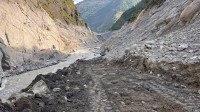
Authorities aim to restore road access to the Chinese border before rebuilding permanently, while also considering an expressway to Kerung in place of a proposed railway. Workers clear a track along the flood-damaged Syaphrubesi–Rasuwagadhi road section after the Bhotekoshi floods. Photo: Ministry of Physical Infrastructure Development
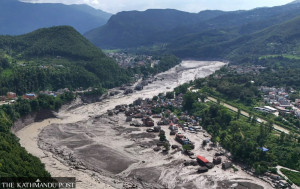
The Rasuwagadhi border crossing with China has been cut off since floods on August 26, with no clear timeline for reopening. More than two months on, the road to the crossing remains incomplete, with bridges washed away and essential infrastructure yet to be restored.
So when will the crossing reopen? Neither the Department of Customs nor the Department of Roads has a definite answer.
Work is underway to prepare the foundations for a Bailey bridge over the Bhotekoshi river at Syaphrubesi. Vijay Jaisi, director general of the Department of Roads, said the bridge was expected to be installed before Tihar, the Hindu festival that falls in early November.
“After that, we need to install four Bailey bridges between Syaphrubesi and the Rasuwagadhi border,” he said. “The immediate priority is to open a temporary road track to the border and make it easier for people and vehicles to move.”
A permanent road will be planned after further studies, Jaisi said. The immediate goal is to reconnect communities cut off by the floods, followed by a feasibility study for a lasting road link. The department has sought the finance ministry’s approval to proceed with the study, he added.
The closure has disrupted a key trade route between Nepal and China. Rasuwagadhi has been a major entry point for electric vehicles, which account for 60 percent of imports through the crossing, according to customs data. Other goods imported through the route include electrical equipment, ready-made garments, footwear, agricultural products, telecommunications equipment, machinery for hydropower projects, vehicles and industrial machinery.
Located about 152 kilometres north of Kathmandu, Rasuwagadhi has long played a central role in Nepal-China trade, revenue collection, border management and economic ties.
The customs office was established there in 1956 to facilitate trade between communities in Rasuwa and the Kerung area of Tibet, including the exchange of goods for everyday needs and the collection of customs revenue, according to the office’s website.
The crossing gained prominence after the April 2015 earthquake severely disrupted the Tatopani route in Sindhupalchok, then a major gateway for Nepal-China trade. Rasuwagadhi subsequently emerged as the country’s principal northern trade route. Its importance grew further after China recognised it as an international border crossing in 2017, according to the Rasuwa Customs Office.
But the route has suffered repeated damage. On July 8, 2025, flooding in the Lhende river along the Nepal-China border swept away the Miteri Bridge. The floods also destroyed the customs yard at Timure, carrying away vehicles and containers and causing substantial losses.
The crossing reopened on January 1, 2026, after remaining closed for nearly six months. It is now once again out of operation, with the latest destruction raising questions about how the route should be rebuilt. “We will study how to build a permanent road and consult experts before moving ahead with construction,” Jaisi said. “We also asked the Chinese government to open a track towards Syaphrubesi from the Rasuwagadhi side as an immediate measure, but no work has been done, and we have received no further information.”
Construction of a bridge at Syaphrubesi is a prerequisite for opening the road track towards the border, said Krishna Nath Ojha, project chief of the Galchhi-Trishuli-Mailung-Syaphrubesi -Rasuwagadhi Road Project, based in Bidur. Work on the track and the installation of Bailey bridges will proceed as required, he said.
Sushil Babu Dhakal, chief of the Development Assistance Coordination and Quality Division under the Ministry of Physical Infrastructure Development, said officials from Nepal and China had an understanding that the old crossing should be restored.
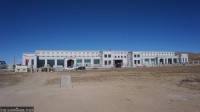
However, key decisions about the facilities needed to resume operations remain pending. “No decision has been made on where to relocate the customs and immigration offices, and China has not yet communicated its position on the matter,” Dhakal said. “We will have to decide whether to rebuild them at the old site or establish them somewhere else.”
An eight-member Chinese technical team is also assessing the flood damage around Rasuwagadhi, he said.
An expressway instead of a railway?
The government is also considering a longer-term alternative to repeatedly rebuilding roads damaged by major floods: an expressway linking Kathmandu and Kerung, potentially replacing the proposed cross-border railway.
“The Kathmandu-Kerung railway corridor had been studied as a long-term solution, but there is now also a proposal to study an expressway instead of a railway,” Dhakal said.
The proposed road could include tunnels, bridges and elevated sections, depending on the terrain and engineering requirements. The aim would be to build infrastructure capable of withstanding or bypassing extreme flooding similar to the recent disaster, he said. “How high the road would need to be built, how much it would cost and how long construction would take will become clear only after a detailed study,” Dhakal said.
Before the floods, work was underway with Chinese grant assistance to upgrade the 16-kilometre road between Syaphrubesi and Rasuwagadhi into a two-lane highway. The damage has made it impossible to simply resume construction along the original alignment, he said.
A Chinese technical team that includes structural engineers and geotechnical experts will examine the site to assess possible routes, construction challenges and the feasibility of rebuilding the road, Dhakal said. The team came after Nepal requested technical advice from China on restoring the Rasuwagadhi corridor. It had visited the Korala border crossing in Mustang before Dashain and was preparing to inspect Rasuwagadhi.
“China is positive about rebuilding the road and reopening the crossing,” Dhakal said. “Its importance is also clear because it is an international border crossing.”
For now, however, restoring access depends on temporary bridges and a road track through terrain reshaped by the floods. A permanent route, and the future location of customs and immigration facilities, remain undecided.




 13.58°C Kathmandu